
🔍

DOP-C02 — questions

Page 7 of 22 · 431 total questions.

Topic 1 · Question 121 · Select all that apply

A company is building a new pipeline by using AWS CodePipeline and AWS CodeBuild in a build account. The pipeline consists of two stages. The first stage is a CodeBuild job to build and package an AWS Lambda function. The second stage consists of deployment actions that operate on two different AWS accounts: a development environment account and a production environment account. The deployment stages use the AWS CloudFormation action that CodePipeline invokes to deploy the infrastructure that the Lambda function requires. A DevOps engineer creates the CodePipeline pipeline and configures the pipeline to encrypt build artifacts by using the AWS Key Management Service (AWS KMS) AWS managed key for Amazon S3 (the aws/s3 key). The artifacts are stored in an S3 bucket. When the pipeline runs, the CloudFormation actions fail with an access denied error. Which combination of actions must the DevOps engineer perform to resolve this error? (Choose two.)

  • ACreate an S3 bucket in each AWS account for the artifacts. Allow the pipeline to write to the S3 buckets. Create a CodePipeline S3 action to copy the artifacts to the S3 bucket in each AWS account. Update the CloudFormation actions to reference the artifacts S3 bucket in the production account.
  • BCreate a customer managed KMS key. Configure the KMS key policy to allow the IAM roles used by the CloudFormation action to perform decrypt operations. Modify the pipeline to use the customer managed KMS key to encrypt artifacts. (correct answer)
  • CCreate an AWS managed KMS key. Configure the KMS key policy to allow the development account and the production account to perform decrypt operations. Modify the pipeline to use the KMS key to encrypt artifacts.
  • DIn the development account and in the production account, create an IAM role for CodePipeline. Configure the roles with permissions to perform CloudFormation operations and with permissions to retrieve and decrypt objects from the artifacts S3 bucket. In the CodePipeline account, configure the CodePipeline CloudFormation action to use the roles.
  • EIn the development account and in the production account, create an IAM role for CodePipeline. Configure the roles with permissions to perform CloudFormation operations and with permissions to retrieve and decrypt objects from the artifacts S3 bucket. In the CodePipeline account, modify the artifacts S3 bucket policy to allow the roles access. Configure the CodePipeline CloudFormation action to use the roles. (correct answer)
Reveal answer & explanation
Correct answer: B, E

The correct answer is B, E. Option B: Create a customer managed KMS key. Configure the KMS key policy to allow the IAM roles used by the CloudFormation action to perform decrypt operations. Modify the pipeline to use the customer managed KMS key to encryp... Option E: In the development account and in the production account, create an IAM role for CodePipeline. Configure the roles with permissions to perform CloudFormation operations and with permissions to retrieve and decrypt obj...

Explanation

Amazon S3 provides durable, scalable object storage that is fully managed. An IAM role grants temporary, least-privilege permissions to AWS resources without long-term credentials. AWS IAM controls authenticated and authorized access to AWS resources with fine-grained policies.
Topic 1 · Question 122 · Select all that apply

A company is using an organization in AWS Organizations to manage multiple AWS accounts. The company’s development team wants to use AWS Lambda functions to meet resiliency requirements and is rewriting all applications to work with Lambda functions that are deployed in a VPC. The development team is using Amazon Elastic File System (Amazon EFS) as shared storage in Account A in the organization. The company wants to continue to use Amazon EFS with Lambda. Company policy requires all serverless projects to be deployed in Account B. A DevOps engineer needs to reconfigure an existing EFS file system to allow Lambda functions to access the data through an existing EFS access point. Which combination of steps should the DevOps engineer take to meet these requirements? (Choose three.)

  • AUpdate the EFS file system policy to provide Account B with access to mount and write to the EFS file system in Account A. (correct answer)
  • BCreate SCPs to set permission guardrails with fine-grained control for Amazon EFS.
  • CCreate a new EFS file system in Account B. Use AWS Database Migration Service (AWS DMS) to keep data from Account A and Account B synchronized.
  • DUpdate the Lambda execution roles with permission to access the VPC and the EFS file system. (correct answer)
  • ECreate a VPC peering connection to connect Account A to Account B. (correct answer)
  • FConfigure the Lambda functions in Account B to assume an existing IAM role in Account A.
Reveal answer & explanation
Correct answer: A, D, E

The correct answer is A, D, E. Option A: Update the EFS file system policy to provide Account B with access to mount and write to the EFS file system in Account A. Option D: Update the Lambda execution roles with permission to access the VPC and the EFS file system. Option E: Create a VPC peering connection to connect Account A to Account B.

Explanation

AWS Lambda runs code without provisioning servers and scales automatically, which minimizes operational overhead. Amazon EFS is a shared, elastic NFS file system that multiple instances can mount concurrently across AZs. VPC peering privately connects two VPCs without a gateway. By spanning multiple Availability Zones / adding redundancy, this option provides the high availability and resilience required.

Topic 1 · Question 123

A media company has several thousand Amazon EC2 instances in an AWS account. The company is using Slack and a shared email inbox for team communications and important updates. A DevOps engineer needs to send all AWS-scheduled EC2 maintenance notifications to the Slack channel and the shared inbox. The solution must include the instances’ Name and Owner tags. Which solution will meet these requirements?

  • AIntegrate AWS Trusted Advisor with AWS Config. Configure a custom AWS Config rule to invoke an AWS Lambda function to publish notifications to an Amazon Simple Notification Service (Amazon SNS) topic. Subscribe a Slack channel endpoint and the shared inbox to the topic.
  • BUse Amazon EventBridge to monitor for AWS Health events. Configure the maintenance events to target an Amazon Simple Notification Service (Amazon SNS) topic. Subscribe an AWS Lambda function to the SNS topic to send notifications to the Slack channel and the shared inbox. (correct answer)
  • CCreate an AWS Lambda function that sends EC2 maintenance notifications to the Slack channel and the shared inbox. Monitor EC2 health events by using Amazon CloudWatch metrics. Configure a CloudWatch alarm that invokes the Lambda function when a maintenance notification is received.
  • DConfigure AWS Support integration with AWS CloudTrail. Create a CloudTrail lookup event to invoke an AWS Lambda function to pass EC2 maintenance notifications to Amazon Simple Notification Service (Amazon SNS). Configure Amazon SNS to target the Slack channel and the shared inbox.
Reveal answer & explanation
Correct answer: B

The correct answer is B. Option B: Use Amazon EventBridge to monitor for AWS Health events. Configure the maintenance events to target an Amazon Simple Notification Service (Amazon SNS) topic. Subscribe an AWS Lambda function to the SNS topic to send n...

Explanation

AWS Lambda runs code without provisioning servers and scales automatically, which minimizes operational overhead. Amazon SNS is a managed pub/sub service for fan-out notifications to many subscribers. Amazon EventBridge routes events between services with rules, enabling event-driven, decoupled architectures.

Topic 1 · Question 124

An AWS CodePipeline pipeline has implemented a code release process. The pipeline is integrated with AWS CodeDeploy to deploy versions of an application to multiple Amazon EC2 instances for each CodePipeline stage. During a recent deployment, the pipeline failed due to a CodeDeploy issue. The DevOps team wants to improve monitoring and notifications during deployment to decrease resolution times. What should the DevOps engineer do to create notifications when issues are discovered?

  • AImplement Amazon CloudWatch Logs for CodePipeline and CodeDeploy, create an AWS Config rule to evaluate code deployment issues, and create an Amazon Simple Notification Service (Amazon SNS) topic to notify stakeholders of deployment issues.
  • BImplement Amazon EventBridge for CodePipeline and CodeDeploy, create an AWS Lambda function to evaluate code deployment issues, and create an Amazon Simple Notification Service (Amazon SNS) topic to notify stakeholders of deployment issues. (correct answer)
  • CImplement AWS CloudTrail to record CodePipeline and CodeDeploy API call information, create an AWS Lambda function to evaluate code deployment issues, and create an Amazon Simple Notification Service (Amazon SNS) topic to notify stakeholders of deployment issues.
  • DImplement Amazon EventBridge for CodePipeline and CodeDeploy, create an Amazon Inspector assessment target to evaluate code deployment issues, and create an Amazon Simple Notification Service (Amazon SNS) topic to notify stakeholders of deployment issues.
Reveal answer & explanation
Correct answer: B

The correct answer is B. Option B: Implement Amazon EventBridge for CodePipeline and CodeDeploy, create an AWS Lambda function to evaluate code deployment issues, and create an Amazon Simple Notification Service (Amazon SNS) topic to notify stakeholder...

Explanation

AWS Lambda runs code without provisioning servers and scales automatically, which minimizes operational overhead. Amazon SNS is a managed pub/sub service for fan-out notifications to many subscribers. Amazon EventBridge routes events between services with rules, enabling event-driven, decoupled architectures.

Topic 1 · Question 125

A global company manages multiple AWS accounts by using AWS Control Tower. The company hosts internal applications and public applications. Each application team in the company has its own AWS account for application hosting. The accounts are consolidated in an organization in AWS Organizations. One of the AWS Control Tower member accounts serves as a centralized DevOps account with CI/CD pipelines that application teams use to deploy applications to their respective target AWS accounts. An IAM role for deployment exists in the centralized DevOps account. An application team is attempting to deploy its application to an Amazon Elastic Kubernetes Service (Amazon EKS) cluster in an application AWS account. An IAM role for deployment exists in the application AWS account. The deployment is through an AWS CodeBuild project that is set up in the centralized DevOps account. The CodeBuild project uses an IAM service role for CodeBuild. The deployment is failing with an Unauthorized error during attempts to connect to the cross-account EKS cluster from CodeBuild. Which solution will resolve this error?

  • AConfigure the application account’s deployment IAM role to have a trust relationship with the centralized DevOps account. Configure the trust relationship to allow the sts:AssumeRole action. Configure the application account’s deployment IAM role to have the required access to the EKS cluster. Configure the EKS cluster aws-auth ConfigMap to map the role to the appropriate system permissions. (correct answer)
  • BConfigure the centralized DevOps account’s deployment IAM role to have a trust relationship with the application account. Configure the trust relationship to allow the sts:AssumeRole action. Configure the centralized DevOps account’s deployment IAM role to allow the required access to CodeBuild.
  • CConfigure the centralized DevOps account’s deployment IAM role to have a trust relationship with the application account. Configure the trust relationship to allow the sts:AssumeRoleWithSAML action. Configure the centralized DevOps account’s deployment IAM role to allow the required access to CodeBuild.
  • DConfigure the application account’s deployment IAM role to have a trust relationship with the AWS Control Tower management account. Configure the trust relationship to allow the sts:AssumeRole action. Configure the application account’s deployment IAM role to have the required access to the EKS cluster. Configure the EKS cluster aws-auth ConfigMap to map the role to the appropriate system permissions.
Reveal answer & explanation
Correct answer: A

The correct answer is A. Option A: Configure the application account’s deployment IAM role to have a trust relationship with the centralized DevOps account. Configure the trust relationship to allow the sts:AssumeRole action. Configure the application...

Explanation

Amazon EKS runs managed Kubernetes when you need the Kubernetes ecosystem. An IAM role grants temporary, least-privilege permissions to AWS resources without long-term credentials. AWS IAM controls authenticated and authorized access to AWS resources with fine-grained policies.

Topic 1 · Question 126

A highly regulated company has a policy that DevOps engineers should not log in to their Amazon EC2 instances except in emergencies. If a DevOps engineer does log in, the security team must be notified within 15 minutes of the occurrence. Which solution will meet these requirements?

  • AInstall the Amazon Inspector agent on each EC2 instance. Subscribe to Amazon EventBridge notifications. Invoke an AWS Lambda function to check if a message is about user logins. If it is, send a notification to the security team using Amazon SNS.
  • BInstall the Amazon CloudWatch agent on each EC2 instance. Configure the agent to push all logs to Amazon CloudWatch Logs and set up a CloudWatch metric filter that searches for user logins. If a login is found, send a notification to the security team using Amazon SNS. (correct answer)
  • CSet up AWS CloudTrail with Amazon CloudWatch Logs. Subscribe CloudWatch Logs to Amazon Kinesis. Attach AWS Lambda to Kinesis to parse and determine if a log contains a user login. If it does, send a notification to the security team using Amazon SNS.
  • DSet up a script on each Amazon EC2 instance to push all logs to Amazon S3. Set up an S3 event to invoke an AWS Lambda function, which invokes an Amazon Athena query to run. The Athena query checks for logins and sends the output to the security team using Amazon SNS.
Reveal answer & explanation
Correct answer: B

The correct answer is B. Option B: Install the Amazon CloudWatch agent on each EC2 instance. Configure the agent to push all logs to Amazon CloudWatch Logs and set up a CloudWatch metric filter that searches for user logins. If a login is found, send a...

Explanation

Amazon EC2 provides resizable virtual servers when you need full control of the operating system. Amazon SNS is a managed pub/sub service for fan-out notifications to many subscribers. Amazon CloudWatch collects metrics, logs and alarms to monitor and react to operational health.

Topic 1 · Question 127 · Select all that apply

A company updated the AWS CloudFormation template for a critical business application. The stack update process failed due to an error in the updated template, and AWS CloudFormation automatically began the stack rollback process. Later, a DevOps engineer discovered that the application was still unavailable and that the stack was in the UPDATE_ROLLBACK_FAILED state. Which combination of actions should the DevOps engineer perform so that the stack rollback can complete successfully? (Choose two.)

  • AAttach the AWSCloudFormationFullAccess IAM policy to the AWS CloudFormation role.
  • BAutomatically recover the stack resources by using AWS CloudFormation drift detection.
  • CIssue a ContinueUpdateRollback command from the AWS CloudFormation console or the AWS CLI. (correct answer)
  • DManually adjust the resources to match the expectations of the stack. (correct answer)
  • EUpdate the existing AWS CloudFormation stack by using the original template.
Reveal answer & explanation
Correct answer: C, D

The correct answer is C, D. Option C: Issue a ContinueUpdateRollback command from the AWS CloudFormation console or the AWS CLI. Option D: Manually adjust the resources to match the expectations of the stack.

Explanation

AWS CloudFormation provisions infrastructure as code repeatably.

Topic 1 · Question 128 · Select all that apply

A development team manually builds an artifact locally and then places it in an Amazon S3 bucket. The application has a local cache that must be cleared when a deployment occurs. The team runs a command to do this, downloads the artifact from Amazon S3, and unzips the artifact to complete the deployment. A DevOps team wants to migrate to a CI/CD process and build in checks to stop and roll back the deployment when a failure occurs. This requires the team to track the progression of the deployment. Which combination of actions will accomplish this? (Choose three.)

  • AAllow developers to check the code into a code repository. Using Amazon EventBridge, on every pull into the main branch, invoke an AWS Lambda function to build the artifact and store it in Amazon S3.
  • BCreate a custom script to clear the cache. Specify the script in the BeforeInstall lifecycle hook in the AppSpec file. (correct answer)
  • CCreate user data for each Amazon EC2 instance that contains the clear cache script. Once deployed, test the application. If it is not successful, deploy it again.
  • DSet up AWS CodePipeline to deploy the application. Allow developers to check the code into a code repository as a source for the pipeline. (correct answer)
  • EUse AWS CodeBuild to build the artifact and place it in Amazon S3. Use AWS CodeDeploy to deploy the artifact to Amazon EC2 instances. (correct answer)
  • FUse AWS Systems Manager to fetch the artifact from Amazon S3 and deploy it to all the instances.
Reveal answer & explanation
Correct answer: B, D, E

The correct answer is B, D, E. Option B: Create a custom script to clear the cache. Specify the script in the BeforeInstall lifecycle hook in the AppSpec file. Option D: Set up AWS CodePipeline to deploy the application. Allow developers to check the code into a code repository as a source for the pipeline. Option E: Use AWS CodeBuild to build the artifact and place it in Amazon S3. Use AWS CodeDeploy to deploy the artifact to Amazon EC2 instances.

Explanation

Amazon EC2 provides resizable virtual servers when you need full control of the operating system. Amazon S3 provides durable, scalable object storage that is fully managed. AWS CodePipeline automates continuous delivery pipelines.

Topic 1 · Question 129 · Select all that apply

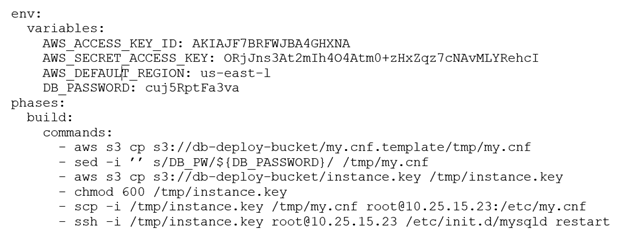
A DevOps engineer is working on a project that is hosted on Amazon Linux and has failed a security review. The DevOps manager has been asked to review the company buildspec.yaml file for an AWS CodeBuild project and provide recommendations. The buildspec.yaml file is configured as follows: What changes should be recommended to comply with AWS security best practices? (Choose three.)

Exhibit 1 for question 129
  • AAdd a post-build command to remove the temporary files from the container before termination to ensure they cannot be seen by other CodeBuild users.
  • BUpdate the CodeBuild project role with the necessary permissions and then remove the AWS credentials from the environment variable. (correct answer)
  • CStore the DB_PASSWORD as a SecureString value in AWS Systems Manager Parameter Store and then remove the DB_PASSWORD from the environment variables. (correct answer)
  • DMove the environment variables to the ‘db-deploy-bucket’ Amazon S3 bucket, add a prebuild stage to download, then export the variables.
  • EUse AWS Systems Manager run command versus scp and ssh commands directly to the instance. (correct answer)
  • FScramble the environment variables using XOR followed by Base64, add a section to install, and then run XOR and Base64 to the build phase.
Reveal answer & explanation
Correct answer: B, C, E

The correct answer is B, C, E. Option B: Update the CodeBuild project role with the necessary permissions and then remove the AWS credentials from the environment variable. Option C: Store the DB_PASSWORD as a SecureString value in AWS Systems Manager Parameter Store and then remove the DB_PASSWORD from the environment variables. Option E: Use AWS Systems Manager run command versus scp and ssh commands directly to the instance.

Explanation

Systems Manager Parameter Store securely stores configuration data and secrets. Service Control Policies set guardrails on what accounts in an organization can do. AWS Systems Manager operates and automates management of fleets of resources.

Topic 1 · Question 130

A company has a legacy application. A DevOps engineer needs to automate the process of building the deployable artifact for the legacy application. The solution must store the deployable artifact in an existing Amazon S3 bucket for future deployments to reference. Which solution will meet these requirements in the MOST operationally efficient way?

  • ACreate a custom Docker image that contains all the dependencies for the legacy application. Store the custom Docker image in a new Amazon Elastic Container Registry (Amazon ECR) repository. Configure a new AWS CodeBuild project to use the custom Docker image to build the deployable artifact and to save the artifact to the S3 bucket. (correct answer)
  • BLaunch a new Amazon EC2 instance. Install all the dependencies for the legacy application on the EC2 instance. Use the EC2 instance to build the deployable artifact and to save the artifact to the S3 bucket.
  • CCreate a custom EC2 Image Builder image. Install all the dependencies for the legacy application on the image. Launch a new Amazon EC2 instance from the image. Use the new EC2 instance to build the deployable artifact and to save the artifact to the S3 bucket.
  • DCreate an Amazon Elastic Kubernetes Service (Amazon EKS) cluster with an AWS Fargate profile that runs in multiple Availability Zones. Create a custom Docker image that contains all the dependencies for the legacy application. Store the custom Docker image in a new Amazon Elastic Container Registry (Amazon ECR) repository. Use the custom Docker image inside the EKS cluster to build the deployable artifact and to save the artifact to the S3 bucket.
Reveal answer & explanation
Correct answer: A

The correct answer is A. Option A: Create a custom Docker image that contains all the dependencies for the legacy application. Store the custom Docker image in a new Amazon Elastic Container Registry (Amazon ECR) repository. Configure a new AWS CodeBui...

Explanation

Amazon S3 provides durable, scalable object storage that is fully managed. AWS Config tracks resource configuration changes and evaluates compliance. AWS CodeBuild compiles, tests and packages code in a managed build service.

Topic 1 · Question 131

A company builds a container image in an AWS CodeBuild project by running Docker commands. After the container image is built, the CodeBuild project uploads the container image to an Amazon S3 bucket. The CodeBuild project has an IAM service role that has permissions to access the S3 bucket. A DevOps engineer needs to replace the S3 bucket with an Amazon Elastic Container Registry (Amazon ECR) repository to store the container images. The DevOps engineer creates an ECR private image repository in the same AWS Region of the CodeBuild project. The DevOps engineer adjusts the IAM service role with the permissions that are necessary to work with the new ECR repository. The DevOps engineer also places new repository information into the docker build command and the docker push command that are used in the buildspec.yml file. When the CodeBuild project runs a build job, the job fails when the job tries to access the ECR repository. Which solution will resolve the issue of failed access to the ECR repository?

  • AUpdate the buildspec.yml file to log in to the ECR repository by using the aws ecr get-login-password AWS CLI command to obtain an authentication token. Update the docker login command to use the authentication token to access the ECR repository. (correct answer)
  • BAdd an environment variable of type SECRETS_MANAGER to the CodeBuild project. In the environment variable, include the ARN of the CodeBuild project's IAM service role. Update the buildspec.yml file to use the new environment variable to log in with the docker login command to access the ECR repository.
  • CUpdate the ECR repository to be a public image repository. Add an ECR repository policy that allows the IAM service role to have access.
  • DUpdate the buildspec.yml file to use the AWS CLI to assume the IAM service role for ECR operations. Add an ECR repository policy that allows the IAM service role to have access.
Reveal answer & explanation
Correct answer: A

The correct answer is A. Option A: Update the buildspec.yml file to log in to the ECR repository by using the aws ecr get-login-password AWS CLI command to obtain an authentication token. Update the docker login command to use the authentication token...

Topic 1 · Question 132

A company manually provisions IAM access for its employees. The company wants to replace the manual process with an automated process. The company has an existing Active Directory system configured with an external SAML 2.0 identity provider (IdP). The company wants employees to use their existing corporate credentials to access AWS. The groups from the existing Active Directory system must be available for permission management in AWS Identity and Access Management (IAM). A DevOps engineer has completed the initial configuration of AWS IAM Identity Center (AWS Single Sign-On) in the company’s AWS account. What should the DevOps engineer do next to meet the requirements?

  • AConfigure an external IdP as an identity source. Configure automatic provisioning of users and groups by using the SCIM protocol. (correct answer)
  • BConfigure AWS Directory Service as an identity source. Configure automatic provisioning of users and groups by using the SAML protocol.
  • CConfigure an AD Connector as an identity source. Configure automatic provisioning of users and groups by using the SCIM protocol.
  • DConfigure an external IdP as an identity source Configure automatic provisioning of users and groups by using the SAML protocol.
Reveal answer & explanation
Correct answer: A

The correct answer is A. Option A: Configure an external IdP as an identity source. Configure automatic provisioning of users and groups by using the SCIM protocol.

Explanation

AWS Config tracks resource configuration changes and evaluates compliance.

Topic 1 · Question 133

A company is using AWS to run digital workloads. Each application team in the company has its own AWS account for application hosting. The accounts are consolidated in an organization in AWS Organizations. The company wants to enforce security standards across the entire organization. To avoid noncompliance because of security misconfiguration, the company has enforced the use of AWS CloudFormation. A production support team can modify resources in the production environment by using the AWS Management Console to troubleshoot and resolve application-related issues. A DevOps engineer must implement a solution to identify in near real time any AWS service misconfiguration that results in noncompliance. The solution must automatically remediate the issue within 15 minutes of identification. The solution also must track noncompliant resources and events in a centralized dashboard with accurate timestamps. Which solution will meet these requirements with the LEAST development overhead?

  • AUse CloudFormation drift detection to identify noncompliant resources. Use drift detection events from CloudFormation to invoke an AWS Lambda function for remediation. Configure the Lambda function to publish logs to an Amazon CloudWatch Logs log group. Configure an Amazon CloudWatch dashboard to use the log group for tracking.
  • BTurn on AWS CloudTrail in the AWS accounts. Analyze CloudTrail logs by using Amazon Athena to identify noncompliant resources. Use AWS Step Functions to track query results on Athena for drift detection and to invoke an AWS Lambda function for remediation. For tracking, set up an Amazon QuickSight dashboard that uses Athena as the data source.
  • CTurn on the configuration recorder in AWS Config in all the AWS accounts to identify noncompliant resources. Enable AWS Security Hub with the --no-enable-default-standards option in all the AWS accounts. Set up AWS Config managed rules and custom rules. Set up automatic remediation by using AWS Config conformance packs. For tracking, set up a dashboard on Security Hub in a designated Security Hub administrator account. (correct answer)
  • DTurn on AWS CloudTrail in the AWS accounts. Analyze CloudTrail logs by using Amazon CloudWatch Logs to identify noncompliant resources. Use CloudWatch Logs filters for drift detection. Use Amazon EventBridge to invoke the Lambda function for remediation. Stream filtered CloudWatch logs to Amazon OpenSearch Service. Set up a dashboard on OpenSearch Service for tracking.
Reveal answer & explanation
Correct answer: C

The correct answer is C. Option C: Turn on the configuration recorder in AWS Config in all the AWS accounts to identify noncompliant resources. Enable AWS Security Hub with the --no-enable-default-standards option in all the AWS accounts. Set up AWS Co...

Explanation

Amazon RDS is a managed relational database that handles patching, backups and failover. AWS Security Hub centralizes security findings and compliance checks. AWS Config tracks resource configuration changes and evaluates compliance. This option meets the real-time / low-latency performance requirement.

Topic 1 · Question 134

A company uses AWS Organizations to manage its AWS accounts. The organization root has an OU that is named Environments. The Environments OU has two child OUs that are named Development and Production, respectively. The Environments OU and the child OUs have the default FullAWSAccess policy in place. A DevOps engineer plans to remove the FullAWSAccess policy from the Development OU and replace the policy with a policy that allows all actions on Amazon EC2 resources. What will be the outcome of this policy replacement?

  • AAll users in the Development OU will be allowed all API actions on all resources.
  • BAll users in the Development OU will be allowed all API actions on EC2 resources. All other API actions will be denied. (correct answer)
  • CAll users in the Development OU will be denied all API actions on all resources.
  • DAll users in the Development OU will be denied all API actions on EC2 resources. All other API actions will be allowed.
Reveal answer & explanation
Correct answer: B

The correct answer is B. Option B: All users in the Development OU will be allowed all API actions on EC2 resources. All other API actions will be denied.

Explanation

Amazon EC2 provides resizable virtual servers when you need full control of the operating system.

Topic 1 · Question 135

A company is examining its disaster recovery capability and wants the ability to switch over its daily operations to a secondary AWS Region. The company uses AWS CodeCommit as a source control tool in the primary Region. A DevOps engineer must provide the capability for the company to develop code in the secondary Region. If the company needs to use the secondary Region, developers can add an additional remote URL to their local Git configuration. Which solution will meet these requirements?

  • ACreate a CodeCommit repository in the secondary Region. Create an AWS CodeBuild project to perform a Git mirror operation of the primary Region's CodeCommit repository to the secondary Region's CodeCommit repository. Create an AWS Lambda function that invokes the CodeBuild project. Create an Amazon EventBridge rule that reacts to merge events in the primary Region's CodeCommit repository. Configure the EventBridge rule to invoke the Lambda function. (correct answer)
  • BCreate an Amazon S3 bucket in the secondary Region. Create an AWS Fargate task to perform a Git mirror operation of the primary Region's CodeCommit repository and copy the result to the S3 bucket. Create an AWS Lambda function that initiates the Fargate task. Create an Amazon EventBridge rule that reacts to merge events in the CodeCommit repository. Configure the EventBridge rule to invoke the Lambda function.
  • CCreate an AWS CodeArtifact repository in the secondary Region. Create an AWS CodePipeline pipeline that uses the primary Region’s CodeCommit repository for the source action. Create a cross-Region stage in the pipeline that packages the CodeCommit repository contents and stores the contents in the CodeArtifact repository when a pull request is merged into the CodeCommit repository.
  • DCreate an AWS Cloud9 environment and a CodeCommit repository in the secondary Region. Configure the primary Region's CodeCommit repository as a remote repository in the AWS Cloud9 environment. Connect the secondary Region's CodeCommit repository to the AWS Cloud9 environment.
Reveal answer & explanation
Correct answer: A

The correct answer is A. Option A: Create a CodeCommit repository in the secondary Region. Create an AWS CodeBuild project to perform a Git mirror operation of the primary Region's CodeCommit repository to the secondary Region's CodeCommit repository....

Explanation

AWS Lambda runs code without provisioning servers and scales automatically, which minimizes operational overhead. Amazon EventBridge routes events between services with rules, enabling event-driven, decoupled architectures. AWS Config tracks resource configuration changes and evaluates compliance. By spanning multiple Availability Zones / adding redundancy, this option provides the high availability and resilience required.

Topic 1 · Question 136

A DevOps team is merging code revisions for an application that uses an Amazon RDS Multi-AZ DB cluster for its production database. The DevOps team uses continuous integration to periodically verify that the application works. The DevOps team needs to test the changes before the changes are deployed to the production database. Which solution will meet these requirements?

  • AUse a buildspec file in AWS CodeBuild to restore the DB cluster from a snapshot of the production database, run integration tests, and drop the restored database after verification. (correct answer)
  • BDeploy the application to production. Configure an audit log of data control language (DCL) operations to capture database activities to perform if verification fails.
  • CCreate a snapshot of the DB cluster before deploying the application. Use the Update requires:Replacement property on the DB instance in AWS CloudFormation to deploy the application and apply the changes.
  • DEnsure that the DB cluster is a Multi-AZ deployment. Deploy the application with the updates. Fail over to the standby instance if verification fails.
Reveal answer & explanation
Correct answer: A

The correct answer is A. Option A: Use a buildspec file in AWS CodeBuild to restore the DB cluster from a snapshot of the production database, run integration tests, and drop the restored database after verification.

Explanation

AWS CodeBuild compiles, tests and packages code in a managed build service. By spanning multiple Availability Zones / adding redundancy, this option provides the high availability and resilience required.

Topic 1 · Question 137

A company manages a multi-tenant environment in its VPC and has configured Amazon GuardDuty for the corresponding AWS account. The company sends all GuardDuty findings to AWS Security Hub. Traffic from suspicious sources is generating a large number of findings. A DevOps engineer needs to implement a solution to automatically deny traffic across the entire VPC when GuardDuty discovers a new suspicious source. Which solution will meet these requirements?

  • ACreate a GuardDuty threat list. Configure GuardDuty to reference the list. Create an AWS Lambda function that will update the threat list. Configure the Lambda function to run in response to new Security Hub findings that come from GuardDuty.
  • BConfigure an AWS WAF web ACL that includes a custom rule group. Create an AWS Lambda function that will create a block rule in the custom rule group. Configure the Lambda function to run in response to new Security Hub findings that come from GuardDuty.
  • CConfigure a firewall in AWS Network Firewall. Create an AWS Lambda function that will create a Drop action rule in the firewall policy. Configure the Lambda function to run in response to new Security Hub findings that come from GuardDuty. (correct answer)
  • DCreate an AWS Lambda function that will create a GuardDuty suppression rule. Configure the Lambda function to run in response to new Security Hub findings that come from GuardDuty.
Reveal answer & explanation
Correct answer: C

The correct answer is C. Option C: Configure a firewall in AWS Network Firewall. Create an AWS Lambda function that will create a Drop action rule in the firewall policy. Configure the Lambda function to run in response to new Security Hub findings tha...

Explanation

AWS Lambda runs code without provisioning servers and scales automatically, which minimizes operational overhead. Amazon GuardDuty continuously monitors for threats and malicious activity. AWS Security Hub centralizes security findings and compliance checks.

Topic 1 · Question 138 · Select all that apply

A company uses AWS Secrets Manager to store a set of sensitive API keys that an AWS Lambda function uses. When the Lambda function is invoked the Lambda function retrieves the API keys and makes an API call to an external service. The Secrets Manager secret is encrypted with the default AWS Key Management Service (AWS KMS) key. A DevOps engineer needs to update the infrastructure to ensure that only the Lambda function’s execution role can access the values in Secrets Manager. The solution must apply the principle of least privilege. Which combination of steps will meet these requirements? (Choose two.)

  • AUpdate the default KMS key for Secrets Manager to allow only the Lambda function’s execution role to decrypt
  • BCreate a KMS customer managed key that trusts Secrets Manager and allows the Lambda function's execution role to decrypt. Update Secrets Manager to use the new customer managed key (correct answer)
  • CCreate a KMS customer managed key that trusts Secrets Manager and allows the account's root principal to decrypt. Update Secrets Manager to use the new customer managed key
  • DEnsure that the Lambda function’s execution role has the KMS permissions scoped on the resource level. Configure the permissions so that the KMS key can encrypt the Secrets Manager secret (correct answer)
  • ERemove all KMS permissions from the Lambda function’s execution role
Reveal answer & explanation
Correct answer: B, D

The correct answer is B, D. Option B: Create a KMS customer managed key that trusts Secrets Manager and allows the Lambda function's execution role to decrypt. Update Secrets Manager to use the new customer managed key Option D: Ensure that the Lambda function’s execution role has the KMS permissions scoped on the resource level. Configure the permissions so that the KMS key can encrypt the Secrets Manager secret

Explanation

AWS Lambda runs code without provisioning servers and scales automatically, which minimizes operational overhead. AWS KMS manages encryption keys and integrates with most AWS services for encryption at rest. AWS Secrets Manager stores and automatically rotates secrets such as database credentials.

Topic 1 · Question 139 · Select all that apply

A company's DevOps engineer is creating an AWS Lambda function to process notifications from an Amazon Simple Notification Service (Amazon SNS) topic. The Lambda function will process the notification messages and will write the contents of the notification messages to an Amazon RDS Multi-AZ DB instance. During testing, a database administrator accidentally shut down the DB instance. While the database was down the company lost several of the SNS notification messages that were delivered during that time. The DevOps engineer needs to prevent the loss of notification messages in the future. Which solutions will meet this requirement? (Choose two.)

  • AReplace the RDS Multi-AZ DB instance with an Amazon DynamoDB table.
  • BConfigure an Amazon Simple Queue Service (Amazon SQS) queue as a destination of the Lambda function.
  • CConfigure an Amazon Simple Queue Service (Amazon SQS) dead-letter queue for the SNS topic. (correct answer)
  • DSubscribe an Amazon Simple Queue Service (Amazon SQS) queue to the SNS topic. Configure the Lambda function to process messages from the SQS queue. (correct answer)
  • EReplace the SNS topic with an Amazon EventBridge event bus. Configure an EventBridge rule on the new event bus to invoke the Lambda function for each event.
Reveal answer & explanation
Correct answer: C, D

The correct answer is C, D. Option C: Configure an Amazon Simple Queue Service (Amazon SQS) dead-letter queue for the SNS topic. Option D: Subscribe an Amazon Simple Queue Service (Amazon SQS) queue to the SNS topic. Configure the Lambda function to process messages from the SQS queue.

Explanation

AWS Lambda runs code without provisioning servers and scales automatically, which minimizes operational overhead. Amazon SQS is a fully managed message queue that decouples components and absorbs traffic spikes. Amazon SNS is a managed pub/sub service for fan-out notifications to many subscribers. By spanning multiple Availability Zones / adding redundancy, this option provides the high availability and resilience required.

Topic 1 · Question 140

A company has an application that runs on Amazon EC2 instances. The company uses an AWS CodePipeline pipeline to deploy the application into multiple AWS Regions. The pipeline is configured with a stage for each Region. Each stage contains an AWS CloudFormation action for each Region. When the pipeline deploys the application to a Region, the company wants to confirm that the application is in a healthy state before the pipeline moves on to the next Region. Amazon Route 53 record sets are configured for the application in each Region. A DevOps engineer creates a Route 53 health check that is based on an Amazon CloudWatch alarm for each Region where the application is deployed. What should the DevOps engineer do next to meet the requirements?

  • ACreate an AWS Step Functions workflow to check the state of the CloudWatch alarm. Configure the Step Functions workflow to exit with an error if the alarm is in the ALARM state. Create a new stage in the pipeline between each Region deployment stage. In each new stage, include an action to invoke the Step Functions workflow. (correct answer)
  • BConfigure an AWS CodeDeploy application to deploy a CloudFormation template with automatic rollback. Configure the CloudWatch alarm as the instance health check for the CodeDeploy application. Remove the CloudFormation actions from the pipeline. Create a CodeDeploy action in the pipeline stage for each Region.
  • CCreate a new pipeline stage for each Region where the application is deployed. Configure a CloudWatch alarm action for the new stage to check the state of the CloudWatch alarm and to exit with an error if the alarm is in the ALARM state
  • DConfigure the CloudWatch agent on the EC2 instances to report the application status to the Route 53 health check. Create a new pipeline stage for each Region where the application is deployed. Configure a CloudWatch alarm action to exit with an error if the CloudWatch alarm is in the ALARM state.
Reveal answer & explanation
Correct answer: A

The correct answer is A. Option A: Create an AWS Step Functions workflow to check the state of the CloudWatch alarm. Configure the Step Functions workflow to exit with an error if the alarm is in the ALARM state. Create a new stage in the pipeline betw...

Explanation

AWS Step Functions coordinates multi-step workflows as a managed state machine. Amazon CloudWatch collects metrics, logs and alarms to monitor and react to operational health. AWS Config tracks resource configuration changes and evaluates compliance.

Showing questions 121140 of 431 · Page 7 of 22