
πŸ”

MLS-C01 β€” questions

Page 12 of 19 Β· 369 total questions.

Topic 1 Β· Question 221

A company wants to segment a large group of customers into subgroups based on shared characteristics. The company’s data scientist is planning to use the Amazon SageMaker built-in k-means clustering algorithm for this task. The data scientist needs to determine the optimal number of subgroups (k) to use. Which data visualization approach will MOST accurately determine the optimal value of k?

  • ACalculate the principal component analysis (PCA) components. Run the k-means clustering algorithm for a range of k by using only the first two PCA components. For each value of k, create a scatter plot with a different color for each cluster. The optimal value of k is the value where the clusters start to look reasonably separated.
  • BCalculate the principal component analysis (PCA) components. Create a line plot of the number of components against the explained variance. The optimal value of k is the number of PCA components after which the curve starts decreasing in a linear fashion.
  • CCreate a t-distributed stochastic neighbor embedding (t-SNE) plot for a range of perplexity values. The optimal value of k is the value of perplexity, where the clusters start to look reasonably separated.
  • DRun the k-means clustering algorithm for a range of k. For each value of k, calculate the sum of squared errors (SSE). Plot a line chart of the SSE for each value of k. The optimal value of k is the point after which the curve starts decreasing in a linear fashion. (correct answer)
Reveal answer & explanation
Correct answer: D

The correct answer is D. Option D: Run the k-means clustering algorithm for a range of k. For each value of k, calculate the sum of squared errors (SSE). Plot a line chart of the SSE for each value of k. The optimal value of k is the point after which...
Topic 1 Β· Question 222 Β· Select all that apply

A data scientist at a financial services company used Amazon SageMaker to train and deploy a model that predicts loan defaults. The model analyzes new loan applications and predicts the risk of loan default. To train the model, the data scientist manually extracted loan data from a database. The data scientist performed the model training and deployment steps in a Jupyter notebook that is hosted on SageMaker Studio notebooks. The model's prediction accuracy is decreasing over time. Which combination of steps is the MOST operationally efficient way for the data scientist to maintain the model's accuracy? (Choose two.)

  • AUse SageMaker Pipelines to create an automated workflow that extracts fresh data, trains the model, and deploys a new version of the model. (correct answer)
  • BConfigure SageMaker Model Monitor with an accuracy threshold to check for model drift. Initiate an Amazon CloudWatch alarm when the threshold is exceeded. Connect the workflow in SageMaker Pipelines with the CloudWatch alarm to automatically initiate retraining. (correct answer)
  • CStore the model predictions in Amazon S3. Create a daily SageMaker Processing job that reads the predictions from Amazon S3, checks for changes in model prediction accuracy, and sends an email notification if a significant change is detected.
  • DRerun the steps in the Jupyter notebook that is hosted on SageMaker Studio notebooks to retrain the model and redeploy a new version of the model.
  • EExport the training and deployment code from the SageMaker Studio notebooks into a Python script. Package the script into an Amazon Elastic Container Service (Amazon ECS) task that an AWS Lambda function can initiate.
Reveal answer & explanation
Correct answer: A, B

The correct answer is A, B. Option A: Use SageMaker Pipelines to create an automated workflow that extracts fresh data, trains the model, and deploys a new version of the model. Option B: Configure SageMaker Model Monitor with an accuracy threshold to check for model drift. Initiate an Amazon CloudWatch alarm when the threshold is exceeded. Connect the workflow in SageMaker Pipelines with the CloudWatc...

Explanation

Amazon SageMaker builds, trains and deploys machine learning models in a fully managed service. Amazon CloudWatch collects metrics, logs and alarms to monitor and react to operational health. AWS Config tracks resource configuration changes and evaluates compliance.

Topic 1 Β· Question 223 Β· Select all that apply

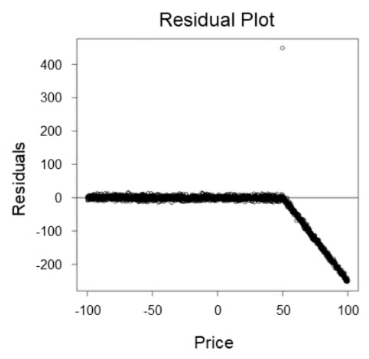
A retail company wants to create a system that can predict sales based on the price of an item. A machine learning (ML) engineer built an initial linear model that resulted in the following residual plot: Which actions should the ML engineer take to improve the accuracy of the predictions in the next phase of model building? (Choose three.)

Exhibit 1 for question 223
  • ADownsample the data uniformly to reduce the amount of data.
  • BCreate two different models for different sections of the data. (correct answer)
  • CDownsample the data in sections where Price < 50.
  • DOffset the input data by a constant value where Price > 50.
  • EExamine the input data, and apply non-linear data transformations where appropriate. (correct answer)
  • FUse a non-linear model instead of a linear model. (correct answer)
Reveal answer & explanation
Correct answer: B, E, F

The correct answer is B, E, F. Option B: Create two different models for different sections of the data. Option E: Examine the input data, and apply non-linear data transformations where appropriate. Option F: Use a non-linear model instead of a linear model.

Topic 1 Β· Question 224

A data scientist at a food production company wants to use an Amazon SageMaker built-in model to classify different vegetables. The current dataset has many features. The company wants to save on memory costs when the data scientist trains and deploys the model. The company also wants to be able to find similar data points for each test data point. Which algorithm will meet these requirements?

  • AK-nearest neighbors (k-NN) with dimension reduction (correct answer)
  • BLinear learner with early stopping
  • CK-means
  • DPrincipal component analysis (PCA) with the algorithm mode set to random
Reveal answer & explanation
Correct answer: A

The correct answer is A. Option A: K-nearest neighbors (k-NN) with dimension reduction.

Topic 1 Β· Question 225

A data scientist is training a large PyTorch model by using Amazon SageMaker. It takes 10 hours on average to train the model on GPU instances. The data scientist suspects that training is not converging and that resource utilization is not optimal. What should the data scientist do to identify and address training issues with the LEAST development effort?

  • AUse CPU utilization metrics that are captured in Amazon CloudWatch. Configure a CloudWatch alarm to stop the training job early if low CPU utilization occurs.
  • BUse high-resolution custom metrics that are captured in Amazon CloudWatch. Configure an AWS Lambda function to analyze the metrics and to stop the training job early if issues are detected.
  • CUse the SageMaker Debugger vanishing_gradient and LowGPUUtilization built-in rules to detect issues and to launch the StopTrainingJob action if issues are detected. (correct answer)
  • DUse the SageMaker Debugger confusion and feature_importance_overweight built-in rules to detect issues and to launch the StopTrainingJob action if issues are detected.
Reveal answer & explanation
Correct answer: C

The correct answer is C. Option C: Use the SageMaker Debugger vanishing_gradient and LowGPUUtilization built-in rules to detect issues and to launch the StopTrainingJob action if issues are detected.

Explanation

Amazon SageMaker builds, trains and deploys machine learning models in a fully managed service. This option needs the least custom development effort.

Topic 1 Β· Question 226

A bank wants to launch a low-rate credit promotion campaign. The bank must identify which customers to target with the promotion and wants to make sure that each customer's full credit history is considered when an approval or denial decision is made. The bank's data science team used the XGBoost algorithm to train a classification model based on account transaction features. The data science team deployed the model by using the Amazon SageMaker model hosting service. The accuracy of the model is sufficient, but the data science team wants to be able to explain why the model denies the promotion to some customers. What should the data science team do to meet this requirement in the MOST operationally efficient manner?

  • ACreate a SageMaker notebook instance. Upload the model artifact to the notebook. Use the plot_importance() method in the Python XGBoost interface to create a feature importance chart for the individual predictions.
  • BRetrain the model by using SageMaker Debugger. Configure Debugger to calculate and collect Shapley values. Create a chart that shows features and SHapley. Additive explanations (SHAP) values to explain how the features affect the model outcomes.
  • CSet up and run an explainability job powered by SageMaker Clarify to analyze the individual customer data, using the training data as a baseline. Create a chart that shows features and SHapley Additive explanations (SHAP) values to explain how the features affect the model outcomes. (correct answer)
  • DUse SageMaker Model Monitor to create Shapley values that help explain model behavior. Store the Shapley values in Amazon S3. Create a chart that shows features and SHapley Additive explanations (SHAP) values to explain how the features affect the model outcomes.
Reveal answer & explanation
Correct answer: C

The correct answer is C. Option C: Set up and run an explainability job powered by SageMaker Clarify to analyze the individual customer data, using the training data as a baseline. Create a chart that shows features and SHapley Additive explanations (S...

Explanation

Amazon SageMaker builds, trains and deploys machine learning models in a fully managed service.

Topic 1 Β· Question 227 Β· Select all that apply

A company has hired a data scientist to create a loan risk model. The dataset contains loan amounts and variables such as loan type, region, and other demographic variables. The data scientist wants to use Amazon SageMaker to test bias regarding the loan amount distribution with respect to some of these categorical variables. Which pretraining bias metrics should the data scientist use to check the bias distribution? (Choose three.)

  • AClass imbalance
  • BConditional demographic disparity
  • CDifference in proportions of labels
  • DJensen-Shannon divergence (correct answer)
  • EKullback-Leibler divergence (correct answer)
  • FTotal variation distance (correct answer)
Reveal answer & explanation
Correct answer: D, E, F

The correct answer is D, E, F. Option D: Jensen-Shannon divergence Option E: Kullback-Leibler divergence Option F: Total variation distance.

Topic 1 Β· Question 228

A retail company wants to use Amazon Forecast to predict daily stock levels of inventory. The cost of running out of items in stock is much higher for the company than the cost of having excess inventory. The company has millions of data samples for multiple years for thousands of items. The company’s purchasing department needs to predict demand for 30-day cycles for each item to ensure that restocking occurs. A machine learning (ML) specialist wants to use item-related features such as "category," "brand," and "safety stock count." The ML specialist also wants to use a binary time series feature that has "promotion applied?" as its name. Future promotion information is available only for the next 5 days. The ML specialist must choose an algorithm and an evaluation metric for a solution to produce prediction results that will maximize company profit. Which solution will meet these requirements?

  • ATrain a model by using the Autoregressive Integrated Moving Average (ARIMA) algorithm. Evaluate the model by using the Weighted Quantile Loss (wQL) metric at 0.75 (P75).
  • BTrain a model by using the Autoregressive Integrated Moving Average (ARIMA) algorithm. Evaluate the model by using the Weighted Absolute Percentage Error (WAPE) metric.
  • CTrain a model by using the Convolutional Neural Network - Quantile Regression (CNN-QR) algorithm. Evaluate the model by using the Weighted Quantile Loss (wQL) metric at 0.75 (P75). (correct answer)
  • DTrain a model by using the Convolutional Neural Network - Quantile Regression (CNN-QR) algorithm. Evaluate the model by using the Weighted Absolute Percentage Error (WAPE) metric.
Reveal answer & explanation
Correct answer: C

The correct answer is C. Option C: Train a model by using the Convolutional Neural Network - Quantile Regression (CNN-QR) algorithm. Evaluate the model by using the Weighted Quantile Loss (wQL) metric at 0.75 (P75).

Topic 1 Β· Question 229 Β· Select all that apply

An online retail company wants to develop a natural language processing (NLP) model to improve customer service. A machine learning (ML) specialist is setting up distributed training of a Bidirectional Encoder Representations from Transformers (BERT) model on Amazon SageMaker. SageMaker will use eight compute instances for the distributed training. The ML specialist wants to ensure the security of the data during the distributed training. The data is stored in an Amazon S3 bucket. Which combination of steps should the ML specialist take to protect the data during the distributed training? (Choose three.)

  • ARun distributed training jobs in a private VPC. Enable inter-container traffic encryption. (correct answer)
  • BRun distributed training jobs across multiple VPCs. Enable VPC peering.
  • CCreate an S3 VPC endpoint. Then configure network routes, endpoint policies, and S3 bucket policies. (correct answer)
  • DGrant read-only access to SageMaker resources by using an IAM role. (correct answer)
  • ECreate a NAT gateway. Assign an Elastic IP address for the NAT gateway.
  • FConfigure an inbound rule to allow traffic from a security group that is associated with the training instances.
Reveal answer & explanation
Correct answer: A, C, D

The correct answer is A, C, D. Option A: Run distributed training jobs in a private VPC. Enable inter-container traffic encryption. Option C: Create an S3 VPC endpoint. Then configure network routes, endpoint policies, and S3 bucket policies. Option D: Grant read-only access to SageMaker resources by using an IAM role.

Explanation

Amazon S3 provides durable, scalable object storage that is fully managed. A VPC endpoint provides private connectivity to AWS services without traversing the public internet. Amazon SageMaker builds, trains and deploys machine learning models in a fully managed service.

Topic 1 Β· Question 230

An analytics company has an Amazon SageMaker hosted endpoint for an image classification model. The model is a custom-built convolutional neural network (CNN) and uses the PyTorch deep learning framework. The company wants to increase throughput and decrease latency for customers that use the model. Which solution will meet these requirements MOST cost-effectively?

  • AUse Amazon Elastic Inference on the SageMaker hosted endpoint. (correct answer)
  • BRetrain the CNN with more layers and a larger dataset.
  • CRetrain the CNN with more layers and a smaller dataset.
  • DChoose a SageMaker instance type that has multiple GPUs.
Reveal answer & explanation
Correct answer: A

The correct answer is A. Option A: Use Amazon Elastic Inference on the SageMaker hosted endpoint.

Explanation

Amazon SageMaker builds, trains and deploys machine learning models in a fully managed service. This option delivers the requirement at the lowest cost.

Topic 1 Β· Question 231 Β· Select all that apply

An ecommerce company is collecting structured data and unstructured data from its website, mobile apps, and IoT devices. The data is stored in several databases and Amazon S3 buckets. The company is implementing a scalable repository to store structured data and unstructured data. The company must implement a solution that provides a central data catalog, self-service access to the data, and granular data access policies and encryption to protect the data. Which combination of actions will meet these requirements with the LEAST amount of setup? (Choose three.)

  • AIdentify the existing data in the databases and S3 buckets. Link the data to AWS Lake Formation. (correct answer)
  • BIdentify the existing data in the databases and S3 buckets. Link the data to AWS Glue.
  • CRun AWS Glue crawlers on the linked data sources to create a central data catalog. (correct answer)
  • DApply granular access policies by using AWS Identity and Access Management (1AM). Configure server-side encryption on each data source.
  • EApply granular access policies and encryption by using AWS Lake Formation. (correct answer)
  • FApply granular access policies and encryption by using AWS Glue.
Reveal answer & explanation
Correct answer: A, C, E

The correct answer is A, C, E. Option A: Identify the existing data in the databases and S3 buckets. Link the data to AWS Lake Formation. Option C: Run AWS Glue crawlers on the linked data sources to create a central data catalog. Option E: Apply granular access policies and encryption by using AWS Lake Formation.

Explanation

Amazon S3 provides durable, scalable object storage that is fully managed. AWS Glue is a serverless ETL and data-catalog service that prepares and integrates data. AWS Lake Formation builds and secures data lakes quickly.

Topic 1 Β· Question 232 Β· Select all that apply

A machine learning (ML) specialist is developing a deep learning sentiment analysis model that is based on data from movie reviews. After the ML specialist trains the model and reviews the model results on the validation set, the ML specialist discovers that the model is overfitting. Which solutions will MOST improve the model generalization and reduce overfitting? (Choose three.)

  • AShuffle the dataset with a different seed.
  • BDecrease the learning rate.
  • CIncrease the number of layers in the network.
  • DAdd L1 regularization and L2 regularization. (correct answer)
  • EAdd dropout. (correct answer)
  • FDecrease the number of layers in the network. (correct answer)
Reveal answer & explanation
Correct answer: D, E, F

The correct answer is D, E, F. Option D: Add L1 regularization and L2 regularization. Option E: Add dropout. Option F: Decrease the number of layers in the network.

Topic 1 Β· Question 233

An online advertising company is developing a linear model to predict the bid price of advertisements in real time with low-latency predictions. A data scientist has trained the linear model by using many features, but the model is overfitting the training dataset. The data scientist needs to prevent overfitting and must reduce the number of features. Which solution will meet these requirements?

  • ARetrain the model with L1 regularization applied. (correct answer)
  • BRetrain the model with L2 regularization applied.
  • CRetrain the model with dropout regularization applied.
  • DRetrain the model by using more data.
Reveal answer & explanation
Correct answer: A

The correct answer is A. Option A: Retrain the model with L1 regularization applied. This option meets the real-time / low-latency performance requirement.

Topic 1 Β· Question 234

A credit card company wants to identify fraudulent transactions in real time. A data scientist builds a machine learning model for this purpose. The transactional data is captured and stored in Amazon S3. The historic data is already labeled with two classes: fraud (positive) and fair transactions (negative). The data scientist removes all the missing data and builds a classifier by using the XGBoost algorithm in Amazon SageMaker. The model produces the following results: β€’ True positive rate (TPR): 0.700 β€’ False negative rate (FNR): 0.300 β€’ True negative rate (TNR): 0.977 β€’ False positive rate (FPR): 0.023 β€’ Overall accuracy: 0.949 Which solution should the data scientist use to improve the performance of the model?

  • AApply the Synthetic Minority Oversampling Technique (SMOTE) on the minority class in the training dataset. Retrain the model with the updated training data. (correct answer)
  • BApply the Synthetic Minority Oversampling Technique (SMOTE) on the majority class in the training dataset. Retrain the model with the updated training data.
  • CUndersample the minority class.
  • DOversample the majority class.
Reveal answer & explanation
Correct answer: A

The correct answer is A. Option A: Apply the Synthetic Minority Oversampling Technique (SMOTE) on the minority class in the training dataset. Retrain the model with the updated training data. This option meets the real-time / low-latency performance requirement.

Topic 1 Β· Question 235

A company is training machine learning (ML) models on Amazon SageMaker by using 200 TB of data that is stored in Amazon S3 buckets. The training data consists of individual files that are each larger than 200 MB in size. The company needs a data access solution that offers the shortest processing time and the least amount of setup. Which solution will meet these requirements?

  • AUse File mode in SageMaker to copy the dataset from the S3 buckets to the ML instance storage.
  • BCreate an Amazon FSx for Lustre file system. Link the file system to the S3 buckets.
  • CCreate an Amazon Elastic File System (Amazon EFS) file system. Mount the file system to the training instances.
  • DUse FastFile mode in SageMaker to stream the files on demand from the S3 buckets. (correct answer)
Reveal answer & explanation
Correct answer: D

The correct answer is D. Option D: Use FastFile mode in SageMaker to stream the files on demand from the S3 buckets.

Explanation

Amazon S3 provides durable, scalable object storage that is fully managed. Amazon SageMaker builds, trains and deploys machine learning models in a fully managed service.

Topic 1 Β· Question 236

An online store is predicting future book sales by using a linear regression model that is based on past sales data. The data includes duration, a numerical feature that represents the number of days that a book has been listed in the online store. A data scientist performs an exploratory data analysis and discovers that the relationship between book sales and duration is skewed and non-linear. Which data transformation step should the data scientist take to improve the predictions of the model?

  • AOne-hot encoding
  • BCartesian product transformation
  • CQuantile binning (correct answer)
  • DNormalization
Reveal answer & explanation
Correct answer: C

The correct answer is C. Option C: Quantile binning.

Topic 1 Β· Question 237

A company's data engineer wants to use Amazon S3 to share datasets with data scientists. The data scientists work in three departments: Finance. Marketing, and Human Resources. Each department has its own IAM user group. Some datasets contain sensitive information and should be accessed only by the data scientists from the Finance department. How can the data engineer set up access to meet these requirements?

  • ACreate an S3 bucket for each dataset. Create an ACL for each S3 bucket. For each S3 bucket that contains a sensitive dataset, set the ACL to allow access only from the Finance department user group. Allow all three department user groups to access each S3 bucket that contains a non-sensitive dataset.
  • BCreate an S3 bucket for each dataset. For each S3 bucket that contains a sensitive dataset, set the bucket policy to allow access only from the Finance department user group. Allow all three department user groups to access each S3 bucket that contains a non-sensitive dataset.
  • CCreate a single S3 bucket that includes two folders to separate the sensitive datasets from the non-sensitive datasets. For the Finance department user group, attach an IAM policy that provides access to both folders. For the Marketing and Human Resources department user groups, attach an IAM policy that provides access to only the folder that contains the non-sensitive datasets. (correct answer)
  • DCreate a single S3 bucket that includes two folders to separate the sensitive datasets from the non-sensitive datasets. Set the policy for the S3 bucket to allow only the Finance department user group to access the folder that contains the sensitive datasets. Allow all three department user groups to access the folder that contains the non-sensitive datasets.
Reveal answer & explanation
Correct answer: C

The correct answer is C. Option C: Create a single S3 bucket that includes two folders to separate the sensitive datasets from the non-sensitive datasets. For the Finance department user group, attach an IAM policy that provides access to both folders....

Explanation

Amazon S3 provides durable, scalable object storage that is fully managed. AWS IAM controls authenticated and authorized access to AWS resources with fine-grained policies.

Topic 1 Β· Question 238

A company operates an amusement park. The company wants to collect, monitor, and store real-time traffic data at several park entrances by using strategically placed cameras. The company’s security team must be able to immediately access the data for viewing. Stored data must be indexed and must be accessible to the company’s data science team. Which solution will meet these requirements MOST cost-effectively?

  • AUse Amazon Kinesis Video Streams to ingest, index, and store the data. Use the built-in integration with Amazon Rekognition for viewing by the security team.
  • BUse Amazon Kinesis Video Streams to ingest, index, and store the data. Use the built-in HTTP live streaming (HLS) capability for viewing by the security team. (correct answer)
  • CUse Amazon Rekognition Video and the GStreamer plugin to ingest the data for viewing by the security team. Use Amazon Kinesis Data Streams to index and store the data.
  • DUse Amazon Kinesis Data Firehose to ingest, index, and store the data. Use the built-in HTTP live streaming (HLS) capability for viewing by the security team.
Reveal answer & explanation
Correct answer: B

The correct answer is B. Option B: Use Amazon Kinesis Video Streams to ingest, index, and store the data. Use the built-in HTTP live streaming (HLS) capability for viewing by the security team.

Explanation

Amazon Kinesis ingests and processes real-time streaming data at scale. This option delivers the requirement at the lowest cost.

Topic 1 Β· Question 239

An engraving company wants to automate its quality control process for plaques. The company performs the process before mailing each customized plaque to a customer. The company has created an Amazon S3 bucket that contains images of defects that should cause a plaque to be rejected. Low-confidence predictions must be sent to an internal team of reviewers who are using Amazon Augmented AI (Amazon A2I). Which solution will meet these requirements?

  • AUse Amazon Textract for automatic processing. Use Amazon A2I with Amazon Mechanical Turk for manual review.
  • BUse Amazon Rekognition for automatic processing. Use Amazon A2I with a private workforce option for manual review. (correct answer)
  • CUse Amazon Transcribe for automatic processing. Use Amazon A2I with a private workforce option for manual review.
  • DUse AWS Panorama for automatic processing. Use Amazon A2I with Amazon Mechanical Turk for manual review.
Reveal answer & explanation
Correct answer: B

The correct answer is B. Option B: Use Amazon Rekognition for automatic processing. Use Amazon A2I with a private workforce option for manual review.

Explanation

Amazon Rekognition adds image and video analysis with pre-trained models.

Topic 1 Β· Question 240

A machine learning (ML) engineer at a bank is building a data ingestion solution to provide transaction features to financial ML models. Raw transactional data is available in an Amazon Kinesis data stream. The solution must compute rolling averages of the ingested data from the data stream and must store the results in Amazon SageMaker Feature Store. The solution also must serve the results to the models in near real time. Which solution will meet these requirements?

  • ALoad the data into an Amazon S3 bucket by using Amazon Kinesis Data Firehose. Use a SageMaker Processing job to aggregate the data and to load the results into SageMaker Feature Store as an online feature group.
  • BWrite the data directly from the data stream into SageMaker Feature Store as an online feature group. Calculate the rolling averages in place within SageMaker Feature Store by using the SageMaker GetRecord API operation.
  • CConsume the data stream by using an Amazon Kinesis Data Analytics SQL application that calculates the rolling averages. Generate a result stream. Consume the result stream by using a custom AWS Lambda function that publishes the results to SageMaker Feature Store as an online feature group. (correct answer)
  • DLoad the data into an Amazon S3 bucket by using Amazon Kinesis Data Firehose. Use a SageMaker Processing job to load the data into SageMaker Feature Store as an offline feature group. Compute the rolling averages at query time.
Reveal answer & explanation
Correct answer: C

The correct answer is C. Option C: Consume the data stream by using an Amazon Kinesis Data Analytics SQL application that calculates the rolling averages. Generate a result stream. Consume the result stream by using a custom AWS Lambda function that pu...

Explanation

AWS Lambda runs code without provisioning servers and scales automatically, which minimizes operational overhead. Amazon Kinesis ingests and processes real-time streaming data at scale. Amazon SageMaker builds, trains and deploys machine learning models in a fully managed service. This option meets the real-time / low-latency performance requirement.

Showing questions 221–240 of 369 Β· Page 12 of 19