
πŸ”

MLS-C01 β€” questions

Page 7 of 19 Β· 369 total questions.

Topic 1 Β· Question 121

A data scientist uses an Amazon SageMaker notebook instance to conduct data exploration and analysis. This requires certain Python packages that are not natively available on Amazon SageMaker to be installed on the notebook instance. How can a machine learning specialist ensure that required packages are automatically available on the notebook instance for the data scientist to use?

  • AInstall AWS Systems Manager Agent on the underlying Amazon EC2 instance and use Systems Manager Automation to execute the package installation commands.
  • BCreate a Jupyter notebook file (.ipynb) with cells containing the package installation commands to execute and place the file under the /etc/init directory of each Amazon SageMaker notebook instance.
  • CUse the conda package manager from within the Jupyter notebook console to apply the necessary conda packages to the default kernel of the notebook.
  • DCreate an Amazon SageMaker lifecycle configuration with package installation commands and assign the lifecycle configuration to the notebook instance. (correct answer)
Reveal answer & explanation
Correct answer: D

The correct answer is D. Option D: Create an Amazon SageMaker lifecycle configuration with package installation commands and assign the lifecycle configuration to the notebook instance.

Explanation

Amazon SageMaker builds, trains and deploys machine learning models in a fully managed service. AWS Config tracks resource configuration changes and evaluates compliance.

Topic 1 Β· Question 122

A data scientist needs to identify fraudulent user accounts for a company's ecommerce platform. The company wants the ability to determine if a newly created account is associated with a previously known fraudulent user. The data scientist is using AWS Glue to cleanse the company's application logs during ingestion. Which strategy will allow the data scientist to identify fraudulent accounts?

  • AExecute the built-in FindDuplicates Amazon Athena query.
  • BCreate a FindMatches machine learning transform in AWS Glue. (correct answer)
  • CCreate an AWS Glue crawler to infer duplicate accounts in the source data.
  • DSearch for duplicate accounts in the AWS Glue Data Catalog.
Reveal answer & explanation
Correct answer: B

The correct answer is B. Option B: Create a FindMatches machine learning transform in AWS Glue.

Explanation

AWS Glue is a serverless ETL and data-catalog service that prepares and integrates data.

Topic 1 Β· Question 123 Β· Select all that apply

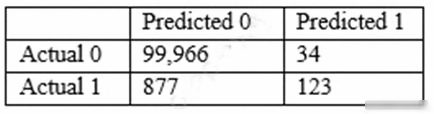
A Data Scientist is developing a machine learning model to classify whether a financial transaction is fraudulent. The labeled data available for training consists of 100,000 non-fraudulent observations and 1,000 fraudulent observations. The Data Scientist applies the XGBoost algorithm to the data, resulting in the following confusion matrix when the trained model is applied to a previously unseen validation dataset. The accuracy of the model is 99.1%, but the Data Scientist needs to reduce the number of false negatives. Which combination of steps should the Data Scientist take to reduce the number of false negative predictions by the model? (Choose two.)

Exhibit 1 for question 123
  • AChange the XGBoost eval_metric parameter to optimize based on Root Mean Square Error (RMSE).
  • BIncrease the XGBoost scale_pos_weight parameter to adjust the balance of positive and negative weights. (correct answer)
  • CIncrease the XGBoost max_depth parameter because the model is currently underfitting the data.
  • DChange the XGBoost eval_metric parameter to optimize based on Area Under the ROC Curve (AUC). (correct answer)
  • EDecrease the XGBoost max_depth parameter because the model is currently overfitting the data.
Reveal answer & explanation
Correct answer: B, D

The correct answer is B, D. Option B: Increase the XGBoost scale_pos_weight parameter to adjust the balance of positive and negative weights. Option D: Change the XGBoost eval_metric parameter to optimize based on Area Under the ROC Curve (AUC).

Topic 1 Β· Question 124

A data scientist has developed a machine learning translation model for English to Japanese by using Amazon SageMaker's built-in seq2seq algorithm with 500,000 aligned sentence pairs. While testing with sample sentences, the data scientist finds that the translation quality is reasonable for an example as short as five words. However, the quality becomes unacceptable if the sentence is 100 words long. Which action will resolve the problem?

  • AChange preprocessing to use n-grams.
  • BAdd more nodes to the recurrent neural network (RNN) than the largest sentence's word count.
  • CAdjust hyperparameters related to the attention mechanism. (correct answer)
  • DChoose a different weight initialization type.
Reveal answer & explanation
Correct answer: C

The correct answer is C. Option C: Adjust hyperparameters related to the attention mechanism.

Topic 1 Β· Question 125 Β· Select all that apply

A financial company is trying to detect credit card fraud. The company observed that, on average, 2% of credit card transactions were fraudulent. A data scientist trained a classifier on a year's worth of credit card transactions data. The model needs to identify the fraudulent transactions (positives) from the regular ones (negatives). The company's goal is to accurately capture as many positives as possible. Which metrics should the data scientist use to optimize the model? (Choose two.)

  • ASpecificity
  • BFalse positive rate
  • CAccuracy
  • DArea under the precision-recall curve (correct answer)
  • ETrue positive rate (correct answer)
Reveal answer & explanation
Correct answer: D, E

The correct answer is D, E. Option D: Area under the precision-recall curve Option E: True positive rate.

Topic 1 Β· Question 126

A machine learning specialist is developing a proof of concept for government users whose primary concern is security. The specialist is using Amazon SageMaker to train a convolutional neural network (CNN) model for a photo classifier application. The specialist wants to protect the data so that it cannot be accessed and transferred to a remote host by malicious code accidentally installed on the training container. Which action will provide the MOST secure protection?

  • ARemove Amazon S3 access permissions from the SageMaker execution role.
  • BEncrypt the weights of the CNN model.
  • CEncrypt the training and validation dataset.
  • DEnable network isolation for training jobs. (correct answer)
Reveal answer & explanation
Correct answer: D

The correct answer is D. Option D: Enable network isolation for training jobs.

Topic 1 Β· Question 127

A medical imaging company wants to train a computer vision model to detect areas of concern on patients' CT scans. The company has a large collection of unlabeled CT scans that are linked to each patient and stored in an Amazon S3 bucket. The scans must be accessible to authorized users only. A machine learning engineer needs to build a labeling pipeline. Which set of steps should the engineer take to build the labeling pipeline with the LEAST effort?

  • ACreate a workforce with AWS Identity and Access Management (IAM). Build a labeling tool on Amazon EC2 Queue images for labeling by using Amazon Simple Queue Service (Amazon SQS). Write the labeling instructions.
  • BCreate an Amazon Mechanical Turk workforce and manifest file. Create a labeling job by using the built-in image classification task type in Amazon SageMaker Ground Truth. Write the labeling instructions.
  • CCreate a private workforce and manifest file. Create a labeling job by using the built-in bounding box task type in Amazon SageMaker Ground Truth. Write the labeling instructions. (correct answer)
  • DCreate a workforce with Amazon Cognito. Build a labeling web application with AWS Amplify. Build a labeling workflow backend using AWS Lambda. Write the labeling instructions.
Reveal answer & explanation
Correct answer: C

The correct answer is C. Option C: Create a private workforce and manifest file. Create a labeling job by using the built-in bounding box task type in Amazon SageMaker Ground Truth. Write the labeling instructions.

Explanation

Amazon SageMaker builds, trains and deploys machine learning models in a fully managed service.

Topic 1 Β· Question 128

A company is using Amazon Textract to extract textual data from thousands of scanned text-heavy legal documents daily. The company uses this information to process loan applications automatically. Some of the documents fail business validation and are returned to human reviewers, who investigate the errors. This activity increases the time to process the loan applications. What should the company do to reduce the processing time of loan applications?

  • AConfigure Amazon Textract to route low-confidence predictions to Amazon SageMaker Ground Truth. Perform a manual review on those words before performing a business validation.
  • BUse an Amazon Textract synchronous operation instead of an asynchronous operation.
  • CConfigure Amazon Textract to route low-confidence predictions to Amazon Augmented AI (Amazon A2I). Perform a manual review on those words before performing a business validation. (correct answer)
  • DUse Amazon Rekognition's feature to detect text in an image to extract the data from scanned images. Use this information to process the loan applications.
Reveal answer & explanation
Correct answer: C

The correct answer is C. Option C: Configure Amazon Textract to route low-confidence predictions to Amazon Augmented AI (Amazon A2I). Perform a manual review on those words before performing a business validation.

Explanation

Amazon RDS is a managed relational database that handles patching, backups and failover. Amazon Textract extracts text and data from scanned documents. AWS Config tracks resource configuration changes and evaluates compliance.

Topic 1 Β· Question 129

A company ingests machine learning (ML) data from web advertising clicks into an Amazon S3 data lake. Click data is added to an Amazon Kinesis data stream by using the Kinesis Producer Library (KPL). The data is loaded into the S3 data lake from the data stream by using an Amazon Kinesis Data Firehose delivery stream. As the data volume increases, an ML specialist notices that the rate of data ingested into Amazon S3 is relatively constant. There also is an increasing backlog of data for Kinesis Data Streams and Kinesis Data Firehose to ingest. Which next step is MOST likely to improve the data ingestion rate into Amazon S3?

  • AIncrease the number of S3 prefixes for the delivery stream to write to.
  • BDecrease the retention period for the data stream.
  • CIncrease the number of shards for the data stream. (correct answer)
  • DAdd more consumers using the Kinesis Client Library (KCL).
Reveal answer & explanation
Correct answer: C

The correct answer is C. Option C: Increase the number of shards for the data stream.

Explanation

Amazon RDS is a managed relational database that handles patching, backups and failover.

Topic 1 Β· Question 130

A data scientist must build a custom recommendation model in Amazon SageMaker for an online retail company. Due to the nature of the company's products, customers buy only 4-5 products every 5-10 years. So, the company relies on a steady stream of new customers. When a new customer signs up, the company collects data on the customer's preferences. Below is a sample of the data available to the data scientist. How should the data scientist split the dataset into a training and test set for this use case?

Exhibit 1 for question 130
  • AShuffle all interaction data. Split off the last 10% of the interaction data for the test set.
  • BIdentify the most recent 10% of interactions for each user. Split off these interactions for the test set. (correct answer)
  • CIdentify the 10% of users with the least interaction data. Split off all interaction data from these users for the test set.
  • DRandomly select 10% of the users. Split off all interaction data from these users for the test set.
Reveal answer & explanation
Correct answer: B

The correct answer is B. Option B: Identify the most recent 10% of interactions for each user. Split off these interactions for the test set.

Topic 1 Β· Question 131 Β· Select all that apply

A financial services company wants to adopt Amazon SageMaker as its default data science environment. The company's data scientists run machine learning (ML) models on confidential financial data. The company is worried about data egress and wants an ML engineer to secure the environment. Which mechanisms can the ML engineer use to control data egress from SageMaker? (Choose three.)

  • AConnect to SageMaker by using a VPC interface endpoint powered by AWS PrivateLink. (correct answer)
  • BUse SCPs to restrict access to SageMaker.
  • CDisable root access on the SageMaker notebook instances.
  • DEnable network isolation for training jobs and models. (correct answer)
  • ERestrict notebook presigned URLs to specific IPs used by the company. (correct answer)
  • FProtect data with encryption at rest and in transit. Use AWS Key Management Service (AWS KMS) to manage encryption keys.
Reveal answer & explanation
Correct answer: A, D, E

The correct answer is A, D, E. Option A: Connect to SageMaker by using a VPC interface endpoint powered by AWS PrivateLink. Option D: Enable network isolation for training jobs and models. Option E: Restrict notebook presigned URLs to specific IPs used by the company.

Explanation

AWS PrivateLink exposes services privately inside the VPC without internet exposure. Amazon SageMaker builds, trains and deploys machine learning models in a fully managed service.

Topic 1 Β· Question 132

A company needs to quickly make sense of a large amount of data and gain insight from it. The data is in different formats, the schemas change frequently, and new data sources are added regularly. The company wants to use AWS services to explore multiple data sources, suggest schemas, and enrich and transform the data. The solution should require the least possible coding effort for the data flows and the least possible infrastructure management. Which combination of AWS services will meet these requirements? A. β€’ Amazon EMR for data discovery, enrichment, and transformation β€’ Amazon Athena for querying and analyzing the results in Amazon S3 using standard SQL β€’ Amazon QuickSight for reporting and getting insights B. β€’ Amazon Kinesis Data Analytics for data ingestion β€’ Amazon EMR for data discovery, enrichment, and transformation β€’ Amazon Redshift for querying and analyzing the results in Amazon S3 C. β€’ AWS Glue for data discovery, enrichment, and transformation β€’ Amazon Athena for querying and analyzing the results in Amazon S3 using standard SQL β€’ Amazon QuickSight for reporting and getting insights D. β€’ AWS Data Pipeline for data transfer β€’ AWS Step Functions for orchestrating AWS Lambda jobs for data discovery, enrichment, and transformation β€’ Amazon Athena for querying and analyzing the results in Amazon S3 using standard SQL β€’ Amazon QuickSight for reporting and getting insights

  • Aβ€’ Amazon EMR for data discovery, enrichment, and transformation β€’ Amazon Athena for querying and analyzing the results in Amazon S3 using standard SQL β€’ Amazon QuickSight for reporting and getting insights (correct answer)
  • Bβ€’ Amazon Kinesis Data Analytics for data ingestion β€’ Amazon EMR for data discovery, enrichment, and transformation β€’ Amazon Redshift for querying and analyzing the results in Amazon S3
  • Cβ€’ AWS Glue for data discovery, enrichment, and transformation β€’ Amazon Athena for querying and analyzing the results in Amazon S3 using standard SQL β€’ Amazon QuickSight for reporting and getting insights
  • Dβ€’ AWS Data Pipeline for data transfer β€’ AWS Step Functions for orchestrating AWS Lambda jobs for data discovery, enrichment, and transformation β€’ Amazon Athena for querying and analyzing the results in Amazon S3 using standard SQL β€’ Amazon QuickSight for reporting and getting insights
Reveal answer & explanation
Correct answer: A

The correct answer is A. Option A: β€’ Amazon EMR for data discovery, enrichment, and transformation β€’ Amazon Athena for querying and analyzing the results in Amazon S3 using standard SQL β€’ Amazon QuickSight for reporting and getting insights

Explanation

Amazon S3 provides durable, scalable object storage that is fully managed. Amazon Athena runs serverless SQL queries directly on data in Amazon S3 with no infrastructure to manage. Amazon EMR runs big-data frameworks like Spark and Hadoop on managed clusters.

Topic 1 Β· Question 133

A company is converting a large number of unstructured paper receipts into images. The company wants to create a model based on natural language processing (NLP) to find relevant entities such as date, location, and notes, as well as some custom entities such as receipt numbers. The company is using optical character recognition (OCR) to extract text for data labeling. However, documents are in different structures and formats, and the company is facing challenges with setting up the manual workflows for each document type. Additionally, the company trained a named entity recognition (NER) model for custom entity detection using a small sample size. This model has a very low confidence score and will require retraining with a large dataset. Which solution for text extraction and entity detection will require the LEAST amount of effort?

  • AExtract text from receipt images by using Amazon Textract. Use the Amazon SageMaker BlazingText algorithm to train on the text for entities and custom entities.
  • BExtract text from receipt images by using a deep learning OCR model from the AWS Marketplace. Use the NER deep learning model to extract entities.
  • CExtract text from receipt images by using Amazon Textract. Use Amazon Comprehend for entity detection, and use Amazon Comprehend custom entity recognition for custom entity detection. (correct answer)
  • DExtract text from receipt images by using a deep learning OCR model from the AWS Marketplace. Use Amazon Comprehend for entity detection, and use Amazon Comprehend custom entity recognition for custom entity detection.
Reveal answer & explanation
Correct answer: C

The correct answer is C. Option C: Extract text from receipt images by using Amazon Textract. Use Amazon Comprehend for entity detection, and use Amazon Comprehend custom entity recognition for custom entity detection.

Explanation

Amazon Comprehend extracts insights and entities from text using NLP. Amazon Textract extracts text and data from scanned documents.

Topic 1 Β· Question 134

A company is building a predictive maintenance model based on machine learning (ML). The data is stored in a fully private Amazon S3 bucket that is encrypted at rest with AWS Key Management Service (AWS KMS) CMKs. An ML specialist must run data preprocessing by using an Amazon SageMaker Processing job that is triggered from code in an Amazon SageMaker notebook. The job should read data from Amazon S3, process it, and upload it back to the same S3 bucket. The preprocessing code is stored in a container image in Amazon Elastic Container Registry (Amazon ECR). The ML specialist needs to grant permissions to ensure a smooth data preprocessing workflow. Which set of actions should the ML specialist take to meet these requirements?

  • ACreate an IAM role that has permissions to create Amazon SageMaker Processing jobs, S3 read and write access to the relevant S3 bucket, and appropriate KMS and ECR permissions. Attach the role to the SageMaker notebook instance. Create an Amazon SageMaker Processing job from the notebook.
  • BCreate an IAM role that has permissions to create Amazon SageMaker Processing jobs. Attach the role to the SageMaker notebook instance. Create an Amazon SageMaker Processing job with an IAM role that has read and write permissions to the relevant S3 bucket, and appropriate KMS and ECR permissions. (correct answer)
  • CCreate an IAM role that has permissions to create Amazon SageMaker Processing jobs and to access Amazon ECR. Attach the role to the SageMaker notebook instance. Set up both an S3 endpoint and a KMS endpoint in the default VPC. Create Amazon SageMaker Processing jobs from the notebook.
  • DCreate an IAM role that has permissions to create Amazon SageMaker Processing jobs. Attach the role to the SageMaker notebook instance. Set up an S3 endpoint in the default VPC. Create Amazon SageMaker Processing jobs with the access key and secret key of the IAM user with appropriate KMS and ECR permissions.
Reveal answer & explanation
Correct answer: B

The correct answer is B. Option B: Create an IAM role that has permissions to create Amazon SageMaker Processing jobs. Attach the role to the SageMaker notebook instance. Create an Amazon SageMaker Processing job with an IAM role that has read and writ...

Explanation

Amazon S3 provides durable, scalable object storage that is fully managed. Amazon SageMaker builds, trains and deploys machine learning models in a fully managed service. An IAM role grants temporary, least-privilege permissions to AWS resources without long-term credentials.

Topic 1 Β· Question 135

A data scientist has been running an Amazon SageMaker notebook instance for a few weeks. During this time, a new version of Jupyter Notebook was released along with additional software updates. The security team mandates that all running SageMaker notebook instances use the latest security and software updates provided by SageMaker. How can the data scientist meet this requirements?

  • ACall the CreateNotebookInstanceLifecycleConfig API operation
  • BCreate a new SageMaker notebook instance and mount the Amazon Elastic Block Store (Amazon EBS) volume from the original instance
  • CStop and then restart the SageMaker notebook instance (correct answer)
  • DCall the UpdateNotebookInstanceLifecycleConfig API operation
Reveal answer & explanation
Correct answer: C

The correct answer is C. Option C: Stop and then restart the SageMaker notebook instance

Explanation

Amazon SageMaker builds, trains and deploys machine learning models in a fully managed service.

Topic 1 Β· Question 136

A library is developing an automatic book-borrowing system that uses Amazon Rekognition. Images of library members' faces are stored in an Amazon S3 bucket. When members borrow books, the Amazon Rekognition CompareFaces API operation compares real faces against the stored faces in Amazon S3. The library needs to improve security by making sure that images are encrypted at rest. Also, when the images are used with Amazon Rekognition. they need to be encrypted in transit. The library also must ensure that the images are not used to improve Amazon Rekognition as a service. How should a machine learning specialist architect the solution to satisfy these requirements?

  • AEnable server-side encryption on the S3 bucket. Submit an AWS Support ticket to opt out of allowing images to be used for improving the service, and follow the process provided by AWS Support. (correct answer)
  • BSwitch to using an Amazon Rekognition collection to store the images. Use the IndexFaces and SearchFacesByImage API operations instead of the CompareFaces API operation.
  • CSwitch to using the AWS GovCloud (US) Region for Amazon S3 to store images and for Amazon Rekognition to compare faces. Set up a VPN connection and only call the Amazon Rekognition API operations through the VPN.
  • DEnable client-side encryption on the S3 bucket. Set up a VPN connection and only call the Amazon Rekognition API operations through the VPN.
Reveal answer & explanation
Correct answer: A

The correct answer is A. Option A: Enable server-side encryption on the S3 bucket. Submit an AWS Support ticket to opt out of allowing images to be used for improving the service, and follow the process provided by AWS Support.

Explanation

Amazon S3 provides durable, scalable object storage that is fully managed.

Topic 1 Β· Question 137

A company is building a line-counting application for use in a quick-service restaurant. The company wants to use video cameras pointed at the line of customers at a given register to measure how many people are in line and deliver notifications to managers if the line grows too long. The restaurant locations have limited bandwidth for connections to external services and cannot accommodate multiple video streams without impacting other operations. Which solution should a machine learning specialist implement to meet these requirements?

  • AInstall cameras compatible with Amazon Kinesis Video Streams to stream the data to AWS over the restaurant's existing internet connection. Write an AWS Lambda function to take an image and send it to Amazon Rekognition to count the number of faces in the image. Send an Amazon Simple Notification Service (Amazon SNS) notification if the line is too long.
  • BDeploy AWS DeepLens cameras in the restaurant to capture video. Enable Amazon Rekognition on the AWS DeepLens device, and use it to trigger a local AWS Lambda function when a person is recognized. Use the Lambda function to send an Amazon Simple Notification Service (Amazon SNS) notification if the line is too long.
  • CBuild a custom model in Amazon SageMaker to recognize the number of people in an image. Install cameras compatible with Amazon Kinesis Video Streams in the restaurant. Write an AWS Lambda function to take an image. Use the SageMaker endpoint to call the model to count people. Send an Amazon Simple Notification Service (Amazon SNS) notification if the line is too long.
  • DBuild a custom model in Amazon SageMaker to recognize the number of people in an image. Deploy AWS DeepLens cameras in the restaurant. Deploy the model to the cameras. Deploy an AWS Lambda function to the cameras to use the model to count people and send an Amazon Simple Notification Service (Amazon SNS) notification if the line is too long. (correct answer)
Reveal answer & explanation
Correct answer: D

The correct answer is D. Option D: Build a custom model in Amazon SageMaker to recognize the number of people in an image. Deploy AWS DeepLens cameras in the restaurant. Deploy the model to the cameras. Deploy an AWS Lambda function to the cameras to u...

Explanation

AWS Lambda runs code without provisioning servers and scales automatically, which minimizes operational overhead. Amazon SNS is a managed pub/sub service for fan-out notifications to many subscribers. Amazon SageMaker builds, trains and deploys machine learning models in a fully managed service.

Topic 1 Β· Question 138

A company has set up and deployed its machine learning (ML) model into production with an endpoint using Amazon SageMaker hosting services. The ML team has configured automatic scaling for its SageMaker instances to support workload changes. During testing, the team notices that additional instances are being launched before the new instances are ready. This behavior needs to change as soon as possible. How can the ML team solve this issue?

  • ADecrease the cooldown period for the scale-in activity. Increase the configured maximum capacity of instances.
  • BReplace the current endpoint with a multi-model endpoint using SageMaker.
  • CSet up Amazon API Gateway and AWS Lambda to trigger the SageMaker inference endpoint.
  • DIncrease the cooldown period for the scale-out activity. (correct answer)
Reveal answer & explanation
Correct answer: D

The correct answer is D. Option D: Increase the cooldown period for the scale-out activity.

Topic 1 Β· Question 139

A telecommunications company is developing a mobile app for its customers. The company is using an Amazon SageMaker hosted endpoint for machine learning model inferences. Developers want to introduce a new version of the model for a limited number of users who subscribed to a preview feature of the app. After the new version of the model is tested as a preview, developers will evaluate its accuracy. If a new version of the model has better accuracy, developers need to be able to gradually release the new version for all users over a fixed period of time. How can the company implement the testing model with the LEAST amount of operational overhead?

  • AUpdate the ProductionVariant data type with the new version of the model by using the CreateEndpointConfig operation with the InitialVariantWeight parameter set to 0. Specify the TargetVariant parameter for InvokeEndpoint calls for users who subscribed to the preview feature. When the new version of the model is ready for release, gradually increase InitialVariantWeight until all users have the updated version.
  • BConfigure two SageMaker hosted endpoints that serve the different versions of the model. Create an Application Load Balancer (ALB) to route traffic to both endpoints based on the TargetVariant query string parameter. Reconfigure the app to send the TargetVariant query string parameter for users who subscribed to the preview feature. When the new version of the model is ready for release, change the ALB's routing algorithm to weighted until all users have the updated version.
  • CUpdate the DesiredWeightsAndCapacity data type with the new version of the model by using the UpdateEndpointWeightsAndCapacities operation with the DesiredWeight parameter set to 0. Specify the TargetVariant parameter for InvokeEndpoint calls for users who subscribed to the preview feature. When the new version of the model is ready for release, gradually increase DesiredWeight until all users have the updated version. (correct answer)
  • DConfigure two SageMaker hosted endpoints that serve the different versions of the model. Create an Amazon Route 53 record that is configured with a simple routing policy and that points to the current version of the model. Configure the mobile app to use the endpoint URL for users who subscribed to the preview feature and to use the Route 53 record for other users. When the new version of the model is ready for release, add a new model version endpoint to Route 53, and switch the policy to weighted until all users have the updated version.
Reveal answer & explanation
Correct answer: C

The correct answer is C. Option C: Update the DesiredWeightsAndCapacity data type with the new version of the model by using the UpdateEndpointWeightsAndCapacities operation with the DesiredWeight parameter set to 0. Specify the TargetVariant parameter...

Topic 1 Β· Question 140

A company offers an online shopping service to its customers. The company wants to enhance the site's security by requesting additional information when customers access the site from locations that are different from their normal location. The company wants to update the process to call a machine learning (ML) model to determine when additional information should be requested. The company has several terabytes of data from its existing ecommerce web servers containing the source IP addresses for each request made to the web server. For authenticated requests, the records also contain the login name of the requesting user. Which approach should an ML specialist take to implement the new security feature in the web application?

  • AUse Amazon SageMaker Ground Truth to label each record as either a successful or failed access attempt. Use Amazon SageMaker to train a binary classification model using the factorization machines (FM) algorithm.
  • BUse Amazon SageMaker to train a model using the IP Insights algorithm. Schedule updates and retraining of the model using new log data nightly. (correct answer)
  • CUse Amazon SageMaker Ground Truth to label each record as either a successful or failed access attempt. Use Amazon SageMaker to train a binary classification model using the IP Insights algorithm.
  • DUse Amazon SageMaker to train a model using the Object2Vec algorithm. Schedule updates and retraining of the model using new log data nightly.
Reveal answer & explanation
Correct answer: B

The correct answer is B. Option B: Use Amazon SageMaker to train a model using the IP Insights algorithm. Schedule updates and retraining of the model using new log data nightly.

Explanation

Amazon SageMaker builds, trains and deploys machine learning models in a fully managed service.

Showing questions 121–140 of 369 Β· Page 7 of 19