πŸ”

MLS-C01 β€” questions

Page 9 of 19 Β· 369 total questions.

Topic 1 Β· Question 161

A company wants to use automatic speech recognition (ASR) to transcribe messages that are less than 60 seconds long from a voicemail-style application. The company requires the correct identification of 200 unique product names, some of which have unique spellings or pronunciations. The company has 4,000 words of Amazon SageMaker Ground Truth voicemail transcripts it can use to customize the chosen ASR model. The company needs to ensure that everyone can update their customizations multiple times each hour. Which approach will maximize transcription accuracy during the development phase?

  • AUse a voice-driven Amazon Lex bot to perform the ASR customization. Create customer slots within the bot that specifically identify each of the required product names. Use the Amazon Lex synonym mechanism to provide additional variations of each product name as mis-transcriptions are identified in development.
  • BUse Amazon Transcribe to perform the ASR customization. Analyze the word confidence scores in the transcript, and automatically create or update a custom vocabulary file with any word that has a confidence score below an acceptable threshold value. Use this updated custom vocabulary file in all future transcription tasks.
  • CCreate a custom vocabulary file containing each product name with phonetic pronunciations, and use it with Amazon Transcribe to perform the ASR customization. Analyze the transcripts and manually update the custom vocabulary file to include updated or additional entries for those names that are not being correctly identified. (correct answer)
  • DUse the audio transcripts to create a training dataset and build an Amazon Transcribe custom language model. Analyze the transcripts and update the training dataset with a manually corrected version of transcripts where product names are not being transcribed correctly. Create an updated custom language model.
Reveal answer & explanation
Correct answer: C

The correct answer is C. Option C: Create a custom vocabulary file containing each product name with phonetic pronunciations, and use it with Amazon Transcribe to perform the ASR customization. Analyze the transcripts and manually update the custom voc...

Explanation

Amazon Transcribe converts speech to text.
Topic 1 Β· Question 162

A company is building a demand forecasting model based on machine learning (ML). In the development stage, an ML specialist uses an Amazon SageMaker notebook to perform feature engineering during work hours that consumes low amounts of CPU and memory resources. A data engineer uses the same notebook to perform data preprocessing once a day on average that requires very high memory and completes in only 2 hours. The data preprocessing is not configured to use GPU. All the processes are running well on an ml.m5.4xlarge notebook instance. The company receives an AWS Budgets alert that the billing for this month exceeds the allocated budget. Which solution will result in the MOST cost savings?

  • AChange the notebook instance type to a memory optimized instance with the same vCPU number as the ml.m5.4xlarge instance has. Stop the notebook when it is not in use. Run both data preprocessing and feature engineering development on that instance.
  • BKeep the notebook instance type and size the same. Stop the notebook when it is not in use. Run data preprocessing on a P3 instance type with the same memory as the ml.m5.4xlarge instance by using Amazon SageMaker Processing.
  • CChange the notebook instance type to a smaller general purpose instance. Stop the notebook when it is not in use. Run data preprocessing on an ml.r5 instance with the same memory size as the ml.m5.4xlarge instance by using Amazon SageMaker Processing. (correct answer)
  • DChange the notebook instance type to a smaller general purpose instance. Stop the notebook when it is not in use. Run data preprocessing on an R5 instance with the same memory size as the ml.m5.4xlarge instance by using the Reserved Instance option.
Reveal answer & explanation
Correct answer: C

The correct answer is C. Option C: Change the notebook instance type to a smaller general purpose instance. Stop the notebook when it is not in use. Run data preprocessing on an ml.r5 instance with the same memory size as the ml.m5.4xlarge instance by...

Explanation

Amazon SageMaker builds, trains and deploys machine learning models in a fully managed service.

Topic 1 Β· Question 163 Β· Select all that apply

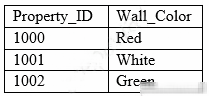
A machine learning specialist is developing a regression model to predict rental rates from rental listings. A variable named Wall_Color represents the most prominent exterior wall color of the property. The following is the sample data, excluding all other variables: The specialist chose a model that needs numerical input data. Which feature engineering approaches should the specialist use to allow the regression model to learn from the Wall_Color data? (Choose two.)

Exhibit 1 for question 163
  • AApply integer transformation and set Red = 1, White = 5, and Green = 10.
  • BAdd new columns that store one-hot representation of colors. (correct answer)
  • CReplace the color name string by its length.
  • DCreate three columns to encode the color in RGB format.
  • EReplace each color name by its training set frequency. (correct answer)
Reveal answer & explanation
Correct answer: B, E

The correct answer is B, E. Option B: Add new columns that store one-hot representation of colors. Option E: Replace each color name by its training set frequency.

Topic 1 Β· Question 164

A data scientist is working on a public sector project for an urban traffic system. While studying the traffic patterns, it is clear to the data scientist that the traffic behavior at each light is correlated, subject to a small stochastic error term. The data scientist must model the traffic behavior to analyze the traffic patterns and reduce congestion. How will the data scientist MOST effectively model the problem?

  • AThe data scientist should obtain a correlated equilibrium policy by formulating this problem as a multi-agent reinforcement learning problem. (correct answer)
  • BThe data scientist should obtain the optimal equilibrium policy by formulating this problem as a single-agent reinforcement learning problem.
  • CRather than finding an equilibrium policy, the data scientist should obtain accurate predictors of traffic flow by using historical data through a supervised learning approach.
  • DRather than finding an equilibrium policy, the data scientist should obtain accurate predictors of traffic flow by using unlabeled simulated data representing the new traffic patterns in the city and applying an unsupervised learning approach.
Reveal answer & explanation
Correct answer: A

The correct answer is A. Option A: The data scientist should obtain a correlated equilibrium policy by formulating this problem as a multi-agent reinforcement learning problem.

Topic 1 Β· Question 165

A data scientist is using the Amazon SageMaker Neural Topic Model (NTM) algorithm to build a model that recommends tags from blog posts. The raw blog post data is stored in an Amazon S3 bucket in JSON format. During model evaluation, the data scientist discovered that the model recommends certain stopwords such as "a," "an," and "the" as tags to certain blog posts, along with a few rare words that are present only in certain blog entries. After a few iterations of tag review with the content team, the data scientist notices that the rare words are unusual but feasible. The data scientist also must ensure that the tag recommendations of the generated model do not include the stopwords. What should the data scientist do to meet these requirements?

  • AUse the Amazon Comprehend entity recognition API operations. Remove the detected words from the blog post data. Replace the blog post data source in the S3 bucket.
  • BRun the SageMaker built-in principal component analysis (PCA) algorithm with the blog post data from the S3 bucket as the data source. Replace the blog post data in the S3 bucket with the results of the training job.
  • CUse the SageMaker built-in Object Detection algorithm instead of the NTM algorithm for the training job to process the blog post data.
  • DRemove the stopwords from the blog post data by using the CountVectorizer function in the scikit-learn library. Replace the blog post data in the S3 bucket with the results of the vectorizer. (correct answer)
Reveal answer & explanation
Correct answer: D

The correct answer is D. Option D: Remove the stopwords from the blog post data by using the CountVectorizer function in the scikit-learn library. Replace the blog post data in the S3 bucket with the results of the vectorizer.

Explanation

Amazon S3 provides durable, scalable object storage that is fully managed. Amazon RDS is a managed relational database that handles patching, backups and failover.

Topic 1 Β· Question 166

A company wants to create a data repository in the AWS Cloud for machine learning (ML) projects. The company wants to use AWS to perform complete ML lifecycles and wants to use Amazon S3 for the data storage. All of the company's data currently resides on premises and is 40 ׀’׀’ in size. The company wants a solution that can transfer and automatically update data between the on-premises object storage and Amazon S3. The solution must support encryption, scheduling, monitoring, and data integrity validation. Which solution meets these requirements?

  • AUse the S3 sync command to compare the source S3 bucket and the destination S3 bucket. Determine which source files do not exist in the destination S3 bucket and which source files were modified.
  • BUse AWS Transfer for FTPS to transfer the files from the on-premises storage to Amazon S3.
  • CUse AWS DataSync to make an initial copy of the entire dataset. Schedule subsequent incremental transfers of changing data until the final cutover from on premises to AWS. (correct answer)
  • DUse S3 Batch Operations to pull data periodically from the on-premises storage. Enable S3 Versioning on the S3 bucket to protect against accidental overwrites.
Reveal answer & explanation
Correct answer: C

The correct answer is C. Option C: Use AWS DataSync to make an initial copy of the entire dataset. Schedule subsequent incremental transfers of changing data until the final cutover from on premises to AWS.

Explanation

AWS DataSync automates and accelerates online data transfer to AWS with minimal effort.

Topic 1 Β· Question 167

A company has video feeds and images of a subway train station. The company wants to create a deep learning model that will alert the station manager if any passenger crosses the yellow safety line when there is no train in the station. The alert will be based on the video feeds. The company wants the model to detect the yellow line, the passengers who cross the yellow line, and the trains in the video feeds. This task requires labeling. The video data must remain confidential. A data scientist creates a bounding box to label the sample data and uses an object detection model. However, the object detection model cannot clearly demarcate the yellow line, the passengers who cross the yellow line, and the trains. Which labeling approach will help the company improve this model?

  • AUse Amazon Rekognition Custom Labels to label the dataset and create a custom Amazon Rekognition object detection model. Create a private workforce. Use Amazon Augmented AI (Amazon A2I) to review the low-confidence predictions and retrain the custom Amazon Rekognition model.
  • BUse an Amazon SageMaker Ground Truth object detection labeling task. Use Amazon Mechanical Turk as the labeling workforce.
  • CUse Amazon Rekognition Custom Labels to label the dataset and create a custom Amazon Rekognition object detection model. Create a workforce with a third-party AWS Marketplace vendor. Use Amazon Augmented AI (Amazon A2I) to review the low-confidence predictions and retrain the custom Amazon Rekognition model.
  • DUse an Amazon SageMaker Ground Truth semantic segmentation labeling task. Use a private workforce as the labeling workforce. (correct answer)
Reveal answer & explanation
Correct answer: D

The correct answer is D. Option D: Use an Amazon SageMaker Ground Truth semantic segmentation labeling task. Use a private workforce as the labeling workforce.

Explanation

Amazon SageMaker builds, trains and deploys machine learning models in a fully managed service.

Topic 1 Β· Question 168 Β· Select all that apply

A data engineer at a bank is evaluating a new tabular dataset that includes customer data. The data engineer will use the customer data to create a new model to predict customer behavior. After creating a correlation matrix for the variables, the data engineer notices that many of the 100 features are highly correlated with each other. Which steps should the data engineer take to address this issue? (Choose two.)

  • AUse a linear-based algorithm to train the model.
  • BApply principal component analysis (PCA). (correct answer)
  • CRemove a portion of highly correlated features from the dataset. (correct answer)
  • DApply min-max feature scaling to the dataset.
  • EApply one-hot encoding category-based variables.
Reveal answer & explanation
Correct answer: B, C

The correct answer is B, C. Option B: Apply principal component analysis (PCA). Option C: Remove a portion of highly correlated features from the dataset.

Topic 1 Β· Question 169

A company is building a new version of a recommendation engine. Machine learning (ML) specialists need to keep adding new data from users to improve personalized recommendations. The ML specialists gather data from the users' interactions on the platform and from sources such as external websites and social media. The pipeline cleans, transforms, enriches, and compresses terabytes of data daily, and this data is stored in Amazon S3. A set of Python scripts was coded to do the job and is stored in a large Amazon EC2 instance. The whole process takes more than 20 hours to finish, with each script taking at least an hour. The company wants to move the scripts out of Amazon EC2 into a more managed solution that will eliminate the need to maintain servers. Which approach will address all of these requirements with the LEAST development effort?

  • ALoad the data into an Amazon Redshift cluster. Execute the pipeline by using SQL. Store the results in Amazon S3.
  • BLoad the data into Amazon DynamoDB. Convert the scripts to an AWS Lambda function. Execute the pipeline by triggering Lambda executions. Store the results in Amazon S3.
  • CCreate an AWS Glue job. Convert the scripts to PySpark. Execute the pipeline. Store the results in Amazon S3. (correct answer)
  • DCreate a set of individual AWS Lambda functions to execute each of the scripts. Build a step function by using the AWS Step Functions Data Science SDK. Store the results in Amazon S3.
Reveal answer & explanation
Correct answer: C

The correct answer is C. Option C: Create an AWS Glue job. Convert the scripts to PySpark. Execute the pipeline. Store the results in Amazon S3.

Explanation

Amazon S3 provides durable, scalable object storage that is fully managed. AWS Glue is a serverless ETL and data-catalog service that prepares and integrates data. This option needs the least custom development effort.

Topic 1 Β· Question 170 Β· Select all that apply

A retail company is selling products through a global online marketplace. The company wants to use machine learning (ML) to analyze customer feedback and identify specific areas for improvement. A developer has built a tool that collects customer reviews from the online marketplace and stores them in an Amazon S3 bucket. This process yields a dataset of 40 reviews. A data scientist building the ML models must identify additional sources of data to increase the size of the dataset. Which data sources should the data scientist use to augment the dataset of reviews? (Choose three.)

  • AEmails exchanged by customers and the company's customer service agents (correct answer)
  • BSocial media posts containing the name of the company or its products (correct answer)
  • CA publicly available collection of news articles
  • DA publicly available collection of customer reviews (correct answer)
  • EProduct sales revenue figures for the company
  • FInstruction manuals for the company's products
Reveal answer & explanation
Correct answer: A, B, D

The correct answer is A, B, D. Option A: Emails exchanged by customers and the company's customer service agents Option B: Social media posts containing the name of the company or its products Option D: A publicly available collection of customer reviews.

Topic 1 Β· Question 171

A machine learning (ML) specialist wants to create a data preparation job that uses a PySpark script with complex window aggregation operations to create data for training and testing. The ML specialist needs to evaluate the impact of the number of features and the sample count on model performance. Which approach should the ML specialist use to determine the ideal data transformations for the model?

  • AAdd an Amazon SageMaker Debugger hook to the script to capture key metrics. Run the script as an AWS Glue job.
  • BAdd an Amazon SageMaker Experiments tracker to the script to capture key metrics. Run the script as an AWS Glue job.
  • CAdd an Amazon SageMaker Debugger hook to the script to capture key parameters. Run the script as a SageMaker processing job.
  • DAdd an Amazon SageMaker Experiments tracker to the script to capture key parameters. Run the script as a SageMaker processing job. (correct answer)
Reveal answer & explanation
Correct answer: D

The correct answer is D. Option D: Add an Amazon SageMaker Experiments tracker to the script to capture key parameters. Run the script as a SageMaker processing job.

Explanation

Amazon SageMaker builds, trains and deploys machine learning models in a fully managed service.

Topic 1 Β· Question 172

A data scientist has a dataset of machine part images stored in Amazon Elastic File System (Amazon EFS). The data scientist needs to use Amazon SageMaker to create and train an image classification machine learning model based on this dataset. Because of budget and time constraints, management wants the data scientist to create and train a model with the least number of steps and integration work required. How should the data scientist meet these requirements?

  • AMount the EFS file system to a SageMaker notebook and run a script that copies the data to an Amazon FSx for Lustre file system. Run the SageMaker training job with the FSx for Lustre file system as the data source.
  • BLaunch a transient Amazon EMR cluster. Configure steps to mount the EFS file system and copy the data to an Amazon S3 bucket by using S3DistCp. Run the SageMaker training job with Amazon S3 as the data source.
  • CMount the EFS file system to an Amazon EC2 instance and use the AWS CLI to copy the data to an Amazon S3 bucket. Run the SageMaker training job with Amazon S3 as the data source.
  • DRun a SageMaker training job with an EFS file system as the data source. (correct answer)
Reveal answer & explanation
Correct answer: D

The correct answer is D. Option D: Run a SageMaker training job with an EFS file system as the data source.

Explanation

Amazon EFS is a shared, elastic NFS file system that multiple instances can mount concurrently across AZs. Amazon SageMaker builds, trains and deploys machine learning models in a fully managed service.

Topic 1 Β· Question 173

A retail company uses a machine learning (ML) model for daily sales forecasting. The company's brand manager reports that the model has provided inaccurate results for the past 3 weeks. At the end of each day, an AWS Glue job consolidates the input data that is used for the forecasting with the actual daily sales data and the predictions of the model. The AWS Glue job stores the data in Amazon S3. The company's ML team is using an Amazon SageMaker Studio notebook to gain an understanding about the source of the model's inaccuracies. What should the ML team do on the SageMaker Studio notebook to visualize the model's degradation MOST accurately?

  • ACreate a histogram of the daily sales over the last 3 weeks. In addition, create a histogram of the daily sales from before that period.
  • BCreate a histogram of the model errors over the last 3 weeks. In addition, create a histogram of the model errors from before that period.
  • CCreate a line chart with the weekly mean absolute error (MAE) of the model. (correct answer)
  • DCreate a scatter plot of daily sales versus model error for the last 3 weeks. In addition, create a scatter plot of daily sales versus model error from before that period.
Reveal answer & explanation
Correct answer: C

The correct answer is C. Option C: Create a line chart with the weekly mean absolute error (MAE) of the model.

Topic 1 Β· Question 174

An ecommerce company sends a weekly email newsletter to all of its customers. Management has hired a team of writers to create additional targeted content. A data scientist needs to identify five customer segments based on age, income, and location. The customers' current segmentation is unknown. The data scientist previously built an XGBoost model to predict the likelihood of a customer responding to an email based on age, income, and location. Why does the XGBoost model NOT meet the current requirements, and how can this be fixed?

  • AThe XGBoost model provides a true/false binary output. Apply principal component analysis (PCA) with five feature dimensions to predict a segment.
  • BThe XGBoost model provides a true/false binary output. Increase the number of classes the XGBoost model predicts to five classes to predict a segment.
  • CThe XGBoost model is a supervised machine learning algorithm. Train a k-Nearest-Neighbors (kNN) model with K = 5 on the same dataset to predict a segment.
  • DThe XGBoost model is a supervised machine learning algorithm. Train a k-means model with K = 5 on the same dataset to predict a segment. (correct answer)
Reveal answer & explanation
Correct answer: D

The correct answer is D. Option D: The XGBoost model is a supervised machine learning algorithm. Train a k-means model with K = 5 on the same dataset to predict a segment.

Topic 1 Β· Question 175

A global financial company is using machine learning to automate its loan approval process. The company has a dataset of customer information. The dataset contains some categorical fields, such as customer location by city and housing status. The dataset also includes financial fields in different units, such as account balances in US dollars and monthly interest in US cents. The company's data scientists are using a gradient boosting regression model to infer the credit score for each customer. The model has a training accuracy of 99% and a testing accuracy of 75%. The data scientists want to improve the model's testing accuracy. Which process will improve the testing accuracy the MOST?

  • AUse a one-hot encoder for the categorical fields in the dataset. Perform standardization on the financial fields in the dataset. Apply L1 regularization to the data. (correct answer)
  • BUse tokenization of the categorical fields in the dataset. Perform binning on the financial fields in the dataset. Remove the outliers in the data by using the z- score.
  • CUse a label encoder for the categorical fields in the dataset. Perform L1 regularization on the financial fields in the dataset. Apply L2 regularization to the data.
  • DUse a logarithm transformation on the categorical fields in the dataset. Perform binning on the financial fields in the dataset. Use imputation to populate missing values in the dataset.
Reveal answer & explanation
Correct answer: A

The correct answer is A. Option A: Use a one-hot encoder for the categorical fields in the dataset. Perform standardization on the financial fields in the dataset. Apply L1 regularization to the data.

Topic 1 Β· Question 176 Β· Select all that apply

A machine learning (ML) specialist needs to extract embedding vectors from a text series. The goal is to provide a ready-to-ingest feature space for a data scientist to develop downstream ML predictive models. The text consists of curated sentences in English. Many sentences use similar words but in different contexts. There are questions and answers among the sentences, and the embedding space must differentiate between them. Which options can produce the required embedding vectors that capture word context and sequential QA information? (Choose two.)

  • AAmazon SageMaker seq2seq algorithm (correct answer)
  • BAmazon SageMaker BlazingText algorithm in Skip-gram mode
  • CAmazon SageMaker Object2Vec algorithm (correct answer)
  • DAmazon SageMaker BlazingText algorithm in continuous bag-of-words (CBOW) mode
  • ECombination of the Amazon SageMaker BlazingText algorithm in Batch Skip-gram mode with a custom recurrent neural network (RNN)
Reveal answer & explanation
Correct answer: A, C

The correct answer is A, C. Option A: Amazon SageMaker seq2seq algorithm Option C: Amazon SageMaker Object2Vec algorithm

Explanation

Amazon SageMaker builds, trains and deploys machine learning models in a fully managed service.

Topic 1 Β· Question 177

A retail company wants to update its customer support system. The company wants to implement automatic routing of customer claims to different queues to prioritize the claims by category. Currently, an operator manually performs the category assignment and routing. After the operator classifies and routes the claim, the company stores the claim's record in a central database. The claim's record includes the claim's category. The company has no data science team or experience in the field of machine learning (ML). The company's small development team needs a solution that requires no ML expertise. Which solution meets these requirements?

  • AExport the database to a .csv file with two columns: claim_label and claim_text. Use the Amazon SageMaker Object2Vec algorithm and the .csv file to train a model. Use SageMaker to deploy the model to an inference endpoint. Develop a service in the application to use the inference endpoint to process incoming claims, predict the labels, and route the claims to the appropriate queue.
  • BExport the database to a .csv file with one column: claim_text. Use the Amazon SageMaker Latent Dirichlet Allocation (LDA) algorithm and the .csv file to train a model. Use the LDA algorithm to detect labels automatically. Use SageMaker to deploy the model to an inference endpoint. Develop a service in the application to use the inference endpoint to process incoming claims, predict the labels, and route the claims to the appropriate queue.
  • CUse Amazon Textract to process the database and automatically detect two columns: claim_label and claim_text. Use Amazon Comprehend custom classification and the extracted information to train the custom classifier. Develop a service in the application to use the Amazon Comprehend API to process incoming claims, predict the labels, and route the claims to the appropriate queue.
  • DExport the database to a .csv file with two columns: claim_label and claim_text. Use Amazon Comprehend custom classification and the .csv file to train the custom classifier. Develop a service in the application to use the Amazon Comprehend API to process incoming claims, predict the labels, and route the claims to the appropriate queue. (correct answer)
Reveal answer & explanation
Correct answer: D

The correct answer is D. Option D: Export the database to a.csv file with two columns: claim_label and claim_text. Use Amazon Comprehend custom classification and the.csv file to train the custom classifier. Develop a service in the application to us...

Explanation

Amazon Comprehend extracts insights and entities from text using NLP.

Topic 1 Β· Question 178

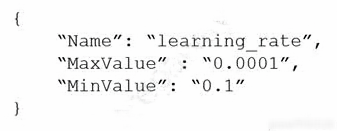
A machine learning (ML) specialist is using Amazon SageMaker hyperparameter optimization (HPO) to improve a model's accuracy. The learning rate parameter is specified in the following HPO configuration: During the results analysis, the ML specialist determines that most of the training jobs had a learning rate between 0.01 and 0.1. The best result had a learning rate of less than 0.01. Training jobs need to run regularly over a changing dataset. The ML specialist needs to find a tuning mechanism that uses different learning rates more evenly from the provided range between MinValue and MaxValue. Which solution provides the MOST accurate result?

Exhibit 1 for question 178
  • AModify the HPO configuration as follows: Select the most accurate hyperparameter configuration form this HPO job.
  • BRun three different HPO jobs that use different learning rates form the following intervals for MinValue and MaxValue while using the same number of training jobs for each HPO job: β€’ [0.01, 0.1] β€’ [0.001, 0.01] β€’ [0.0001, 0.001] Select the most accurate hyperparameter configuration form these three HPO jobs.
  • CModify the HPO configuration as follows: Select the most accurate hyperparameter configuration form this training job. (correct answer)
  • DRun three different HPO jobs that use different learning rates form the following intervals for MinValue and MaxValue. Divide the number of training jobs for each HPO job by three: β€’ [0.01, 0.1] β€’ [0.001, 0.01] [0.0001, 0.001] Select the most accurate hyperparameter configuration form these three HPO jobs.
Reveal answer & explanation
Correct answer: C

The correct answer is C. Option C: Modify the HPO configuration as follows: Select the most accurate hyperparameter configuration form this training job.

Explanation

AWS Config tracks resource configuration changes and evaluates compliance.

Topic 1 Β· Question 179

A manufacturing company wants to use machine learning (ML) to automate quality control in its facilities. The facilities are in remote locations and have limited internet connectivity. The company has 20 ׀’׀’ of training data that consists of labeled images of defective product parts. The training data is in the corporate on- premises data center. The company will use this data to train a model for real-time defect detection in new parts as the parts move on a conveyor belt in the facilities. The company needs a solution that minimizes costs for compute infrastructure and that maximizes the scalability of resources for training. The solution also must facilitate the company's use of an ML model in the low-connectivity environments. Which solution will meet these requirements?

  • AMove the training data to an Amazon S3 bucket. Train and evaluate the model by using Amazon SageMaker. Optimize the model by using SageMaker Neo. Deploy the model on a SageMaker hosting services endpoint.
  • BTrain and evaluate the model on premises. Upload the model to an Amazon S3 bucket. Deploy the model on an Amazon SageMaker hosting services endpoint.
  • CMove the training data to an Amazon S3 bucket. Train and evaluate the model by using Amazon SageMaker. Optimize the model by using SageMaker Neo. Set up an edge device in the manufacturing facilities with AWS IoT Greengrass. Deploy the model on the edge device. (correct answer)
  • DTrain the model on premises. Upload the model to an Amazon S3 bucket. Set up an edge device in the manufacturing facilities with AWS IoT Greengrass. Deploy the model on the edge device.
Reveal answer & explanation
Correct answer: C

The correct answer is C. Option C: Move the training data to an Amazon S3 bucket. Train and evaluate the model by using Amazon SageMaker. Optimize the model by using SageMaker Neo. Set up an edge device in the manufacturing facilities with AWS IoT Gree...

Explanation

Amazon S3 provides durable, scalable object storage that is fully managed. Amazon SageMaker builds, trains and deploys machine learning models in a fully managed service. This option meets the real-time / low-latency performance requirement.

Topic 1 Β· Question 180 Β· Select all that apply

A company has an ecommerce website with a product recommendation engine built in TensorFlow. The recommendation engine endpoint is hosted by Amazon SageMaker. Three compute-optimized instances support the expected peak load of the website. Response times on the product recommendation page are increasing at the beginning of each month. Some users are encountering errors. The website receives the majority of its traffic between 8 AM and 6 PM on weekdays in a single time zone. Which of the following options are the MOST effective in solving the issue while keeping costs to a minimum? (Choose two.)

  • AConfigure the endpoint to use Amazon Elastic Inference (EI) accelerators. (correct answer)
  • BCreate a new endpoint configuration with two production variants.
  • CConfigure the endpoint to automatically scale with the InvocationsPerInstance metric. (correct answer)
  • DDeploy a second instance pool to support a blue/green deployment of models.
  • EReconfigure the endpoint to use burstable instances.
Reveal answer & explanation
Correct answer: A, C

The correct answer is A, C. Option A: Configure the endpoint to use Amazon Elastic Inference (EI) accelerators. Option C: Configure the endpoint to automatically scale with the InvocationsPerInstance metric.

Explanation

AWS Config tracks resource configuration changes and evaluates compliance.

Showing questions 161–180 of 369 Β· Page 9 of 19