🔍

PAS-C01 — questions

Page 2 of 7 · 130 total questions.

Topic 1 · Question 21 · Select all that apply

A company’s basis administrator is planning to deploy SAP on AWS in Linux. The basis administrator must set up the proper storage to store SAP HANA data and log volumes. Which storage options should the basis administrator choose to meet these requirements? (Choose two.)

  • AAmazon Elastic Block Store (Amazon EBS) Throughput Optimized HDD (st1)
  • BAmazon Elastic Block Store (Amazon EBS) Provisioned OPS SSD (io1, io2) (correct answer)
  • CAmazon S3
  • DAmazon Elastic File System (Amazon EFS)
  • EAmazon Elastic Block Store (Amazon EBS) General Purpose SSD (gp2, gp3) (correct answer)
Reveal answer & explanation
Correct answer: B, E

The correct answer is B, E. Option B: Amazon Elastic Block Store (Amazon EBS) Provisioned OPS SSD (io1, io2) Option E: Amazon Elastic Block Store (Amazon EBS) General Purpose SSD (gp2, gp3)

Explanation

Amazon EBS provides block storage attached to a single EC2 instance.
Topic 1 · Question 22 · Select all that apply

A company has deployed a highly available SAP NetWeaver system on SAP HANA into a VPC. The system is distributed across multiple Availability Zones within a single AWS Region. SAP NetWeaver is running on SUSE Linux Enterprise Server for SAP. SUSE Linux Enterprise High Availability Extension is configured to protect SAP ASCS and ERS instances and uses the overlay IP address concept. The SAP shared files /sapmnt and /usr/sap/trans are hosted on an Amazon Elastic File System (Amazon EFS) file system. The company needs a solution that uses already-existing private connectivity to the VPC. The SAP NetWeaver system must be accessible through the SAP GUI client tool. Which solutions will meet these requirements? (Choose two.)

  • ADeploy an Application Load Balancer. Configure the overlay IP address as a target.
  • BDeploy a Network Load Balancer. Configure the overlay IP address as a target. (correct answer)
  • CUse an Amazon Route 53 private zone. Create an A record that has the overlay IP address as a target.
  • DUse AWS Transit Gateway. Configure the overlay IP address as a static route in the transit gateway route table. Specify the VPC as a target. (correct answer)
  • EUse a NAT gateway. Configure the overlay IP address as a target.
Reveal answer & explanation
Correct answer: B, D

The correct answer is B, D. Option B: Deploy a Network Load Balancer. Configure the overlay IP address as a target. Option D: Use AWS Transit Gateway. Configure the overlay IP address as a static route in the transit gateway route table. Specify the VPC as a target.

Explanation

A Network Load Balancer handles very high throughput TCP/UDP traffic with ultra-low latency and static IPs. A load balancer distributes traffic across targets in multiple AZs for availability and scale. AWS Transit Gateway centrally connects many VPCs and on-premises networks at scale. By spanning multiple Availability Zones / adding redundancy, this option provides the high availability and resilience required.

Topic 1 · Question 23

A company is planning to move all its SAP applications to Amazon EC2 instances in a VPC. Recently, the company signed a multiyear contract with a payroll software-as-a-service (SaaS) provider. Integration with the payroll SaaS solution is available only through public web APIs. Corporate security guidelines state that all outbound traffic must be validated against an allow list. The payroll SaaS provider provides only fully qualified domain name (FQDN) addresses and no IP addresses or IP address ranges. Currently, an on-premises firewall appliance filters FQDNs. The company needs to connect an SAP Process Orchestration (SAP PO) system to the payroll SaaS provider. What must the company do on AWS to meet these requirements?

  • AAdd an outbound rule to the security group of the SAP PO system to allow the FQDN of the payroll SaaS provider and deny all other outbound traffic.
  • BAdd an outbound rule to the network ACL of the subnet that contains the SAP PO system to allow the FQDN of the payroll SaaS provider and deny all other outbound traffic.
  • CAdd an AWS WAF web ACL to the VPAdd an outbound rule to allow the SAP PO system to connect to the FQDN of the payroll SaaS provider.
  • DAdd an AWS Network Firewall firewall to the VPC. Add an outbound rule to allow the SAP PO system to connect to the FQDN of the payroll SaaS provider. (correct answer)
Reveal answer & explanation
Correct answer: D

The correct answer is D. Option D: Add an AWS Network Firewall firewall to the VPC. Add an outbound rule to allow the SAP PO system to connect to the FQDN of the payroll SaaS provider.

Topic 1 · Question 24

A company is planning to migrate its on-premises SAP application to AWS. The application runs on VMware vSphere. The SAP ERP Central Component (SAP ECC) server runs on an IBM Db2 database that is 2 TB in size. The company wants to migrate the database to SAP HANA. Which migration strategy will meet these requirements?

  • AUse AWS Application Migration Service (CloudEndure Migration).
  • BUse SAP Software Update Manager (SUM) Database Migration Option (DMO) with System Move. (correct answer)
  • CUse AWS Server Migration Service (AWS SMS).
  • DUse AWS Database Migration Service (AWS DMS).
Reveal answer & explanation
Correct answer: B

The correct answer is B. Option B: Use SAP Software Update Manager (SUM) Database Migration Option (DMO) with System Move.

Topic 1 · Question 25

A company hosts multiple SAP applications on Amazon EC2 instances in a VPC. While monitoring the environment, the company notices that multiple port scans are attempting to connect to SAP portals inside the VPC. These port scans are originating from the same IP address block. The company must deny access to the VPC from all the offending IP addresses for the next 24 hours. Which solution will meet this requirement?

  • AModify network ACLs that are associated with all public subnets in the VPC to deny access from the IP address block. (correct answer)
  • BAdd a rule in the security group of the EC2 instances to deny access from the IP address block.
  • CCreate a policy in AWS Identity and Access Management (IAM) to deny access from the IP address block.
  • DConfigure the firewall in the operating system of the EC2 instances to deny access from the IP address block.
Reveal answer & explanation
Correct answer: A

The correct answer is A. Option A: Modify network ACLs that are associated with all public subnets in the VPC to deny access from the IP address block.

Topic 1 · Question 26

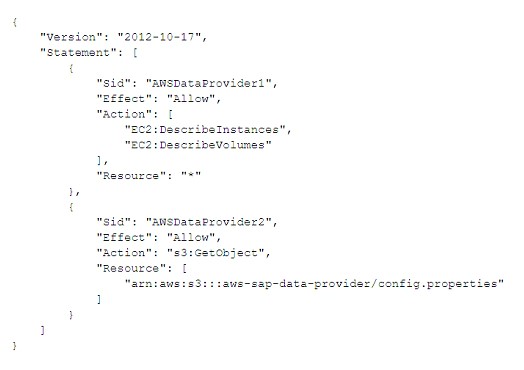
A company has deployed SAP workloads on AWS. The AWS Data Provider for SAP is installed on the Amazon EC2 instance where the SAP application is running. An SAP solutions architect has attached an IAM role to the EC2 instance with the following policy: The AWS Data Provider for SAP is not returning any metrics to the SAP application. Which change should the SAP solutions architect make to the IAM permissions to resolve this issue?

Exhibit 1 for question 26
  • AAdd the cloudwatch:ListMetrics action to the policy statement with Sid AWSDataProvider1.
  • BAdd the cloudwatch:GetMetricStatistics action to the policy statement with Sid AWSDataProvider1. (correct answer)
  • CAdd the cloudwatch:GetMetricStream action to the policy statement with Sid AWSDataProvider1.
  • DAdd the cloudwatch:DescribeAlarmsForMetric action to the policy statement with Sid AWSDataProvider1.
Reveal answer & explanation
Correct answer: B

The correct answer is B. Option B: Add the cloudwatch:GetMetricStatistics action to the policy statement with Sid AWSDataProvider1.

Explanation

Amazon CloudWatch collects metrics, logs and alarms to monitor and react to operational health.

Topic 1 · Question 27 · Select all that apply

A company wants to deploy an SAP HANA database on AWS by using AWS Launch Wizard for SAP. An SAP solutions architect needs to run a custom post-deployment script on the Amazon EC2 instance that Launch Wizard provisions. Which actions can the SAP solutions architect take to provide the post-deployment script in the Launch Wizard console? (Choose two.)

  • AProvide the FTP URL of the script.
  • BProvide the HTTPS URL of the script on a web server.
  • CProvide the Amazon S3 URL of the script. (correct answer)
  • DWrite the script inline.
  • EUpload the script. (correct answer)
Reveal answer & explanation
Correct answer: C, E

The correct answer is C, E. Option C: Provide the Amazon S3 URL of the script. Option E: Upload the script.

Explanation

Amazon S3 provides durable, scalable object storage that is fully managed.

Topic 1 · Question 28 · Select all that apply

A company is planning to move its on-premises SAP HANA database to AWS. The company needs to migrate this environment to AWS as quickly as possible. An SAP solutions architect will use AWS Launch Wizard for SAP to deploy this SAP HANA workload. Which combination of steps should the SAP solutions architect follow to start the deployment of this workload on AWS? (Choose three.)

  • ADownload the SAP HANA software. (correct answer)
  • BDownload the AWS CloudFormation template for the SAP HANA deployment.
  • CDownload and extract the SAP HANA software. Upload the SAP HANA software to an FTP server that Launch Wizard can access.
  • DUpload the unextracted SAP HANA software to an Amazon S3 destination bucket. Follow the S3 file path syntax for the software in accordance with Launch Wizard recommendations. (correct answer)
  • EBring the operating system AMI by using the Bring Your Own Image (BYOI) model, or purchase the subscription for the operating system AMI from AWS Marketplace. (correct answer)
  • FCreate the SAP file system by using Amazon Elastic Block Store (Amazon EBS) before the deployment.
Reveal answer & explanation
Correct answer: A, D, E

The correct answer is A, D, E. Option A: Download the SAP HANA software. Option D: Upload the unextracted SAP HANA software to an Amazon S3 destination bucket. Follow the S3 file path syntax for the software in accordance with Launch Wizard recommendations. Option E: Bring the operating system AMI by using the Bring Your Own Image (BYOI) model, or purchase the subscription for the operating system AMI from AWS Marketplace.

Explanation

Amazon S3 provides durable, scalable object storage that is fully managed.

Topic 1 · Question 29 · Select all that apply

A company wants to implement SAP HANA on AWS with the Multi-AZ deployment option by using AWS Launch Wizard for SAP. The solution will use SUSE Linux Enterprise High Availability Extension for the high availability deployment. An SAP solutions architect must ensure that all the prerequisites are met. The SAP solutions architect also must ensure that the user inputs to start the guided deployment of Launch Wizard are valid. Which combination of steps should the SAP solutions architect take to meet these requirements? (Choose two.)

  • ABefore starting the Launch Wizard deployment, create the underlying Amazon Elastic Block Store (Amazon EBS) volume types to use for SAP HANA data and log volumes based on the performance requirements.
  • BUse a value for the PaceMakerTag parameter that is not used by any other Amazon EC2 instances in the AWS Region where the system is being deployed. (correct answer)
  • CEnsure that the virtual hostname for the SAP HANA database that is used for the SUSE Linux Enterprise High Availability Extension configuration is not used in any other deployed accounts.
  • DEnsure that the VirtuallPAddress parameter is outside the VPC CIDR and is not being used in the route table that is associated with the subnets where primary and secondary SAP HANA instances will be deployed. (correct answer)
  • EBefore starting the Launch Wizard deployment, set up the SUSE Linux Enterprise High Availability Extension network configuration and security group.
Reveal answer & explanation
Correct answer: B, D

The correct answer is B, D. Option B: Use a value for the PaceMakerTag parameter that is not used by any other Amazon EC2 instances in the AWS Region where the system is being deployed. Option D: Ensure that the VirtuallPAddress parameter is outside the VPC CIDR and is not being used in the route table that is associated with the subnets where primary and secondary SAP HANA instances will be deployed.

Explanation

Amazon EC2 provides resizable virtual servers when you need full control of the operating system. By spanning multiple Availability Zones / adding redundancy, this option provides the high availability and resilience required.

Topic 1 · Question 30 · Select all that apply

A company that has SAP workloads on premises plans to migrate an SAP environment to AWS. The company is new to AWS and has no prior setup. The company has the following requirements: The application server and database server must be placed in isolated network configurations. SAP systems must be accessible to the on-premises end users over the internet. The cost of communications between the application server and the database server must be minimized. Which combination of steps should an SAP solutions architect take to meet these requirements? (Choose two.)

  • AConfigure a Network Load Balancer for incoming connections from end users.
  • BSet up an AWS Site-to-Site VPN connection between the company’s on-premises network and AWS. (correct answer)
  • CSeparate the application server and the database server by using different VPCs.
  • DSeparate the application server and the database server by using different subnets and network security groups within the same VPC. (correct answer)
  • ESet up an AWS Direct Connect connection with a private VIF between the company’s on-premises network and AWS.
Reveal answer & explanation
Correct answer: B, D

The correct answer is B, D. Option B: Set up an AWS Site-to-Site VPN connection between the company’s on-premises network and AWS. Option D: Separate the application server and the database server by using different subnets and network security groups within the same VPC.

Explanation

AWS Site-to-Site VPN provides encrypted connectivity between on premises and a VPC.

Topic 1 · Question 31

A company is running its SAP workload on AWS. The company’s security team has implemented the following requirements: All Amazon EC2 instances for SAP must be SAP certified instance types. Encryption must be enabled for all Amazon S3 buckets and Amazon Elastic Block Store (Amazon EBS) volumes. AWS CloudTrail must be activated. SAP system parameters must be compliant with business rules. Detailed monitoring must be enabled for all instances. The company wants to develop an automated process to review the systems for compliance with the security team’s requirements. The process also must provide notification about any deviation from these standards. Which solution will meet these requirements?

  • AUse AWS AppConfig to model configuration data in an AWS Systems Manager Automation runbook. Schedule this Systems Manager Automation runbook to monitor for compliance with all the requirements. Integrate AWS AppConfig with Amazon CloudWatch for notification purposes.
  • BUse AWS Config managed rules to monitor for compliance with all the requirements. Use Amazon EventBridge (Amazon CloudWatch Events) and Amazon Simple Notification Service (Amazon SNS) for email notification when a resource is flagged as noncompliant.
  • CUse AWS Trusted Advisor to monitor for compliance with all the requirements. Use Trusted Advisor preferences for email notification when a resource is flagged as noncompliant.
  • DUse AWS Config managed rules to monitor for compliance with the requirements, except for the SAP system parameters. Create AWS Config custom rules to validate the SAP system parameters. Use Amazon EventBridge (Amazon CloudWatch Events) and Amazon Simple Notification Service (Amazon SNS) for email notification when a resource is flagged as noncompliant. (correct answer)
Reveal answer & explanation
Correct answer: D

The correct answer is D. Option D: Use AWS Config managed rules to monitor for compliance with the requirements, except for the SAP system parameters. Create AWS Config custom rules to validate the SAP system parameters. Use Amazon EventBridge (Amazon...

Explanation

Amazon SNS is a managed pub/sub service for fan-out notifications to many subscribers. Amazon EventBridge routes events between services with rules, enabling event-driven, decoupled architectures. Amazon CloudWatch collects metrics, logs and alarms to monitor and react to operational health.

Topic 1 · Question 32

A company is hosting its SAP workloads on AWS. An SAP solutions architect is designing high availability architecture for the company’s production SAP S/4HANA and SAP BW/4HANA workloads. These workloads have the following requirements: Redundant SAP application servers that consist of a primary application server (PAS) and an additional application server (AAS) ASCS and ERS instances that use a failover cluster Database high availability with a primary DB instance and a secondary DB instance How should the SAP solutions architect design the architecture to meet these requirements?

  • ADeploy ASCS and ERS cluster nodes in different subnets within the same Availability Zone. Deploy the PAS instance and AAS instance in different subnets within the same Availability Zone. Deploy the primary DB instance and secondary DB instance in different subnets within the same Availability Zone. Deploy all the components in the same VPC.
  • BDeploy ASCS and ERS cluster nodes in different subnets within the same Availability Zone. Deploy the PAS instance and AAS instance in different subnets within the same Availability Zone. Deploy the primary DB instance and secondary DB instance in different subnets within the same Availability Zone. Deploy the ASCS instance, PAS instance, and primary DB instance in one VPC. Deploy the ERS instance, AAS instance, and secondary DB instance in a different VPC.
  • CDeploy ASCS and ERS cluster nodes in different subnets across two Availability Zones. Deploy the PAS instance and AAS instance in different subnets across two Availability Zones. Deploy the primary DB instance and secondary DB instance in different subnets across two Availability Zones. Deploy all the components in the same VPC. (correct answer)
  • DDeploy ASCS and ERS cluster nodes in different subnets across two Availability Zones. Deploy the PAS instance and AAS instance in different subnets across two Availability Zones. Deploy the primary DB instance and secondary DB instance in different subnets across two Availability Zones. Deploy the ASCS instance, PAS instance, and primary DB instance in one VPC. Deploy the ERS instance, AAS instance, and secondary DB instance in a different VPC.
Reveal answer & explanation
Correct answer: C

The correct answer is C. Option C: Deploy ASCS and ERS cluster nodes in different subnets across two Availability Zones. Deploy the PAS instance and AAS instance in different subnets across two Availability Zones. Deploy the primary DB instance and sec...

Topic 1 · Question 33

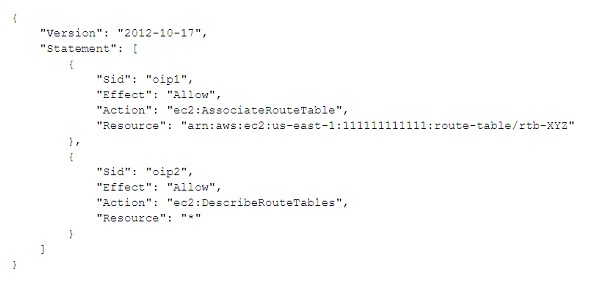
A company has deployed SAP HANA in the AWS Cloud. The company needs its SAP HANA database to be highly available. An SAP solutions architect has deployed the SAP HANA database in separate Availability Zones in a single AWS Region. SUSE Linux Enterprise High Availability Extension is configured with an overlay IP address. The overlay IP resource agent has the following IAM policy: During a test of failover, the SAP solutions architect finds that the overlay IP address does not change to the secondary Availability Zone. Which change should the SAP solutions architect make in the policy statement for Sid oip1 to fix this error?

Exhibit 1 for question 33
  • AChange the Action element to ec2:CreateRoute.
  • BChange the Action element to ec2:ReplaceRoute. (correct answer)
  • CChange the Action element to ec2:ReplaceRouteTableAssociation.
  • DChange the Action element to ec2:ReplaceTransitGatewayRoute.
Reveal answer & explanation
Correct answer: B

The correct answer is B. Option B: Change the Action element to ec2:ReplaceRoute.

Explanation

Amazon EC2 provides resizable virtual servers when you need full control of the operating system. By spanning multiple Availability Zones / adding redundancy, this option provides the high availability and resilience required.

Topic 1 · Question 34

A company wants to improve the RPO and RTO for its SAP disaster recovery (DR) solution by running the DR solution on AWS. The company is running SAP ERP Central Component (SAP ECC) on SAP HANA. The company has set an RPO of 15 minutes and an RTO of 4 hours. The production SAP HANA database is running on a physical appliance that has x86 architecture. The appliance has 1 TB of memory, and the SAP HANA global allocation limit is set to 768 GB. The SAP application servers are running as VMs on VMware, and they store data on an NFS file system. The company does not want to change any existing SAP HANA parameters that are related to data and log backup for its on-premises systems. What should an SAP solutions architect do to meet the DR objectives MOST cost-effectively?

  • AFor the SAP HANA database, change the log backup frequency to 5 minutes. Move the data and log backups to Amazon S3 by using the AWS CLI or AWS DataSync. Launch the SAP HANA database. For the SAP application servers, export the VMs as AMIs by using the VM Import/Export feature from AWS. For NFS file shares /sapmnt and /usr/sap/trans, establish real-time synchronization from DataSync to Amazon Elastic File System (Amazon EFS).
  • BFor the SAP HANA database, change the log backup frequency to 5 minutes. Move the data and log backups to Amazon S3 by using AWS Storage Gateway File Gateway. For the SAP application servers, export the VMs as AMIs by using the VM Import/Export feature from AWS. For NFS file shares /sapmnt and /usr/sap/trans, establish real-time synchronization from AWS DataSync to Amazon Elastic File System (Amazon EFS).
  • CFor the SAP HANA database, SAP application servers, and NFS file shares, use CloudEndure Disaster Recovery to replicate the data continuously from on premises to AWS. Use CloudEndure Disaster Recovery to launch target instances in the event of a disaster.
  • DFor the SAP HANA database, use a smaller SAP certified Amazon EC2 instance. Use SAP HANA system replication with ASYNC replication mode to replicate the data continuously from on premises to AWS. For the SAP application servers, use CloudEndure Disaster Recovery for continuous data replication. For NFS file shares /sapmnt and /usr/sap/trans, establish real-time synchronization from AWS DataSync to Amazon Elastic File System (Amazon EFS). (correct answer)
Reveal answer & explanation
Correct answer: D

The correct answer is D. Option D: For the SAP HANA database, use a smaller SAP certified Amazon EC2 instance. Use SAP HANA system replication with ASYNC replication mode to replicate the data continuously from on premises to AWS. For the SAP applicati...

Explanation

Amazon EC2 provides resizable virtual servers when you need full control of the operating system. Amazon EFS is a shared, elastic NFS file system that multiple instances can mount concurrently across AZs. AWS DataSync automates and accelerates online data transfer to AWS with minimal effort. This option delivers the requirement at the lowest cost.

Topic 1 · Question 35

A company is planning to migrate its on-premises SAP applications to AWS. The applications are based on Windows operating systems. A file share stores the transport directories and third-party application data on the network-attached storage of the company’s on-premises data center. The company’s plan is to lift and shift the SAP applications and the file share to AWS. The company must follow AWS best practices for the migration. Which AWS service should the company use to host the transport directories and third-party application data on AWS?

  • AAmazon Elastic Block Store (Amazon EBS)
  • BAWS Storage Gateway
  • CAmazon Elastic File System (Amazon EFS)
  • DAmazon FSx for Windows File Server (correct answer)
Reveal answer & explanation
Correct answer: D

The correct answer is D. Option D: Amazon FSx for Windows File Server

Explanation

Amazon FSx for Windows File Server provides fully managed SMB/Windows shared file storage. Amazon FSx provides fully managed third-party file systems.

Topic 1 · Question 36

A company hosts an SAP HANA database on an Amazon EC2 instance in the us-east-1 Region. The company needs to implement a disaster recovery (DR) site in the us-west-1 Region. The company needs a cost-optimized solution that offers a guaranteed capacity reservation, an RPO of less than 30 minutes, and an RTO of less than 30 minutes. Which solution will meet these requirements?

  • ADeploy a single EC2 instance to support the secondary database in us-west-1 with additional storage. Use this secondary database instance to support QA and production. Configure the primary SAP HANA database in us-east-1 to constantly replicate the data to the secondary SAP HANA database in us-west-1 by using SAP HANA system replication with preload off. During DR, shut down the QA SAP HANA instance and restart the production services at the secondary site. (correct answer)
  • BDeploy a secondary staging server on an EC2 instance in us-west-1. Use CloudEndure Disaster Recovery to replicate changes at the database level from us-east-1 to the secondary staging server on an ongoing basis. During DR, initiate cutover, increase the size of the secondary EC2 instance to match the primary EC2 instance, and start the secondary EC2 instance.
  • CSet up the primary SAP HANA database in us-east-1 to constantly replicate the data to a secondary SAP HANA database in us-west-1 by using SAP HANA system replication with preload on. Keep the secondary SAP HANA instance as a hot standby that is ready to take over in case of failure.
  • DCreate an SAP HANA database AMI by using Amazon Elastic Block Store (Amazon EBS) snapshots. Replicate the database and log backup files from a primary Amazon S3 bucket in us-east-1 to a secondary S3 bucket in us-west-1. During DR, launch the EC2 instance in us-west-1 based on AMIs that are replicated. Update host information. Download database and log backups from the secondary S3 bucket. Perform a point-in-time recovery.
Reveal answer & explanation
Correct answer: A

The correct answer is A. Option A: Deploy a single EC2 instance to support the secondary database in us-west-1 with additional storage. Use this secondary database instance to support QA and production. Configure the primary SAP HANA database in us-eas...

Explanation

Amazon EC2 provides resizable virtual servers when you need full control of the operating system. AWS Config tracks resource configuration changes and evaluates compliance. By spanning multiple Availability Zones / adding redundancy, this option provides the high availability and resilience required.

Topic 1 · Question 37

An SAP solutions architect is leading the SAP basis team for a company. The company’s SAP landscape includes SAP HANA database instances for the following systems: sandbox, development, quality assurance test (QAT), system performance test (SPT), and production. The sandbox, development, and QAT systems are running on Amazon EC2 On-Demand Instances. The SPT and production systems are running on EC2 Reserved instances. All the EC2 instances are using Provisioned IOPS SSO (io2) Amazon Elastic Block Store (Amazon EBS) volumes. The entire development team is in the same time zone and works from 8 AM to 6 PM. The sandbox system is for research and testing that are not critical. The SPT and production systems are business critical. The company runs load-testing jobs and stress-testing jobs on the QAT systems overnight to reduce testing duration. The company wants to optimize infrastructure cost for the existing AWS resources. How can the SAP solutions architect meet these requirements with the LEAST amount of administrative effort?

  • AUse a Spot Fleet instead of the Reserved Instances and On-Demand Instances.
  • BUse Amazon EventBridge (Amazon CloudWatch Events) and Amazon CloudWatch alarms to stop the development and sandbox EC2 instances from 7 PM every night to 7 AM the next day. (correct answer)
  • CMake the SAP basis team available 24 hours a day, 7 days a week to use the AWS CLI to stop and start the development and sandbox EC2 instances manually.
  • DChange the EBS volume type to Throughput Optimized HDD (st1) for the /hana/data and /hana/log file systems for the production and non-production SAP HANA databases.
Reveal answer & explanation
Correct answer: B

The correct answer is B. Option B: Use Amazon EventBridge (Amazon CloudWatch Events) and Amazon CloudWatch alarms to stop the development and sandbox EC2 instances from 7 PM every night to 7 AM the next day.

Explanation

Amazon EC2 provides resizable virtual servers when you need full control of the operating system. Amazon EventBridge routes events between services with rules, enabling event-driven, decoupled architectures. Amazon CloudWatch collects metrics, logs and alarms to monitor and react to operational health.

Topic 1 · Question 38

A company is hosting an SAP HANA database on AWS. The company is automating operational tasks, including backup and system refreshes. The company wants to use SAP HANA Studio to perform data backup of an SAP HANA tenant database to a backint interface. The SAP HANA database is running in multi-tenant database container (MDC) mode. The company receives the following error message during an attempt to perform the backup: What should an SAP solutions architect do to resolve this issue?

Exhibit 1 for question 38
  • ASet the execute permission for AWS Backint agent binary aws-backint-agent and for the launcher script aws-backint-agent-launcher.sh in the installation directory.
  • BVerify the installation steps. Create symbolic links (symlinks).
  • CEnsure that the catalog_backup_using_backint SAP HANA parameter is set to true. Ensure that the data_backup_parameter_file and log_backup_parameter_file parameters have the correct path location in the global.ini file.
  • DAdd the SAP HANA system to SAP HANA Studio. Select multiple container mode, and then try to initiate the backup again. (correct answer)
Reveal answer & explanation
Correct answer: D

The correct answer is D. Option D: Add the SAP HANA system to SAP HANA Studio. Select multiple container mode, and then try to initiate the backup again.

Explanation

AWS Backup centrally automates and manages backups across AWS services.

Topic 1 · Question 39

A company is planning to migrate its on-premises SAP ERP Central Component (SAP ECC) system on SAP HANA to AWS. Each month, the system experiences two peaks in usage. The first peak is on the 21st day of the month when the company runs payroll. The second peak is on the last day of the month when the company processes and exports credit data. Both peak workloads are of high importance and cannot be rescheduled. The current SAP ECC system has six application servers, all of a similar size. During normal operation outside of peak usage, four application servers would suffice. Which purchasing option will meet the company’s requirements MOST cost-effectively on AWS?

  • AFour Reserved Instances and two Spot Instances
  • BSix On-Demand Instances
  • CSix Reserved Instances
  • DFour Reserved Instances and two On-Demand Instances (correct answer)
Reveal answer & explanation
Correct answer: D

The correct answer is D. Option D: Four Reserved Instances and two On-Demand Instances

Explanation

Reserved Instances lower cost for steady-state, predictable long-running workloads. This option delivers the requirement at the lowest cost.

Topic 1 · Question 40

A company has an SAP environment that runs on AWS. The company wants to enhance security by restricting Amazon EC2 Instance Metadata Service (IMDS) to IMDSv2 only. The company’s current configuration option supports both IMDSv1 and IMDSv2. The security enhancement must not create an SAP outage. What should the company do before it applies the security enhancement on EC2 instances that are running the SAP environment?

  • AEnsure that the SAP kernel versions are 7.45 or later.
  • BEnsure that the EC2 instances are Nitro based. (correct answer)
  • CEnsure that the AWS Data Provider for SAP is installed on each EC2 instance.
  • DStop the EC2 instances.
Reveal answer & explanation
Correct answer: B

The correct answer is B. Option B: Ensure that the EC2 instances are Nitro based.

Explanation

Amazon EC2 provides resizable virtual servers when you need full control of the operating system.

Showing questions 2140 of 130 · Page 2 of 7