
πŸ”

SAA-C03 β€” questions

Page 22 of 51 Β· 1019 total questions.

Topic 1 Β· Question 421

A company runs a highly available SFTP service. The SFTP service uses two Amazon EC2 Linux instances that run with elastic IP addresses to accept traffic from trusted IP sources on the internet. The SFTP service is backed by shared storage that is attached to the instances. User accounts are created and managed as Linux users in the SFTP servers. The company wants a serverless option that provides high IOPS performance and highly configurable security. The company also wants to maintain control over user permissions. Which solution will meet these requirements?

  • ACreate an encrypted Amazon Elastic Block Store (Amazon EBS) volume. Create an AWS Transfer Family SFTP service with a public endpoint that allows only trusted IP addresses. Attach the EBS volume to the SFTP service endpoint. Grant users access to the SFTP service.
  • BCreate an encrypted Amazon Elastic File System (Amazon EFS) volume. Create an AWS Transfer Family SFTP service with elastic IP addresses and a VPC endpoint that has internet-facing access. Attach a security group to the endpoint that allows only trusted IP addresses. Attach the EFS volume to the SFTP service endpoint. Grant users access to the SFTP service. (correct answer)
  • CCreate an Amazon S3 bucket with default encryption enabled. Create an AWS Transfer Family SFTP service with a public endpoint that allows only trusted IP addresses. Attach the S3 bucket to the SFTP service endpoint. Grant users access to the SFTP service.
  • DCreate an Amazon S3 bucket with default encryption enabled. Create an AWS Transfer Family SFTP service with a VPC endpoint that has internal access in a private subnet. Attach a security group that allows only trusted IP addresses. Attach the S3 bucket to the SFTP service endpoint. Grant users access to the SFTP service.
Reveal answer & explanation
Correct answer: B

The correct answer is B. Option B: Create an encrypted Amazon Elastic File System (Amazon EFS) volume. Create an AWS Transfer Family SFTP service with elastic IP addresses and a VPC endpoint that has internet-facing access. Attach a security group to t...

Explanation

Amazon EFS is a shared, elastic NFS file system that multiple instances can mount concurrently across AZs. A VPC endpoint provides private connectivity to AWS services without traversing the public internet. AWS Transfer Family provides managed SFTP/FTPS/FTP access to S3 and EFS. By spanning multiple Availability Zones / adding redundancy, this option provides the high availability and resilience required.

Topic 1 Β· Question 422

A company is developing a new machine learning (ML) model solution on AWS. The models are developed as independent microservices that fetch approximately 1 GB of model data from Amazon S3 at startup and load the data into memory. Users access the models through an asynchronous API. Users can send a request or a batch of requests and specify where the results should be sent. The company provides models to hundreds of users. The usage patterns for the models are irregular. Some models could be unused for days or weeks. Other models could receive batches of thousands of requests at a time. Which design should a solutions architect recommend to meet these requirements?

  • ADirect the requests from the API to a Network Load Balancer (NLB). Deploy the models as AWS Lambda functions that are invoked by the NLB.
  • BDirect the requests from the API to an Application Load Balancer (ALB). Deploy the models as Amazon Elastic Container Service (Amazon ECS) services that read from an Amazon Simple Queue Service (Amazon SQS) queue. Use AWS App Mesh to scale the instances of the ECS cluster based on the SQS queue size.
  • CDirect the requests from the API into an Amazon Simple Queue Service (Amazon SQS) queue. Deploy the models as AWS Lambda functions that are invoked by SQS events. Use AWS Auto Scaling to increase the number of vCPUs for the Lambda functions based on the SQS queue size.
  • DDirect the requests from the API into an Amazon Simple Queue Service (Amazon SQS) queue. Deploy the models as Amazon Elastic Container Service (Amazon ECS) services that read from the queue. Enable AWS Auto Scaling on Amazon ECS for both the cluster and copies of the service based on the queue size. (correct answer)
Reveal answer & explanation
Correct answer: D

The correct answer is D. Option D: Direct the requests from the API into an Amazon Simple Queue Service (Amazon SQS) queue. Deploy the models as Amazon Elastic Container Service (Amazon ECS) services that read from the queue. Enable AWS Auto Scaling on...

Explanation

Auto Scaling adjusts capacity automatically to match demand, improving availability and cost efficiency. Amazon ECS orchestrates containers and integrates natively with AWS networking and IAM. Amazon SQS is a fully managed message queue that decouples components and absorbs traffic spikes. This option decouples the components so they scale independently and absorb load spikes.

Topic 1 Β· Question 423 Β· Select all that apply

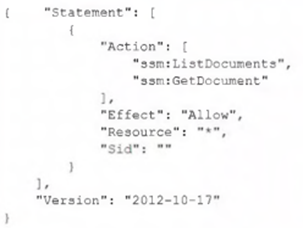
A solutions architect wants to use the following JSON text as an identity-based policy to grant specific permissions: Which IAM principals can the solutions architect attach this policy to? (Choose two.)

Exhibit 1 for question 423
  • ARole (correct answer)
  • BGroup (correct answer)
  • COrganization
  • DAmazon Elastic Container Service (Amazon ECS) resource
  • EAmazon EC2 resource
Reveal answer & explanation
Correct answer: A, B

The correct answer is A, B. Option A: Role Option B: Group.

Topic 1 Β· Question 424

A company is running a custom application on Amazon EC2 On-Demand Instances. The application has frontend nodes that need to run 24 hours a day, 7 days a week and backend nodes that need to run only for a short time based on workload. The number of backend nodes varies during the day. The company needs to scale out and scale in more instances based on workload. Which solution will meet these requirements MOST cost-effectively?

  • AUse Reserved Instances for the frontend nodes. Use AWS Fargate for the backend nodes.
  • BUse Reserved Instances for the frontend nodes. Use Spot Instances for the backend nodes. (correct answer)
  • CUse Spot Instances for the frontend nodes. Use Reserved Instances for the backend nodes.
  • DUse Spot Instances for the frontend nodes. Use AWS Fargate for the backend nodes.
Reveal answer & explanation
Correct answer: B

The correct answer is B. Option B: Use Reserved Instances for the frontend nodes. Use Spot Instances for the backend nodes.

Explanation

Spot Instances use spare capacity at a large discount, ideal for fault-tolerant or interruptible workloads. Reserved Instances lower cost for steady-state, predictable long-running workloads. This option delivers the requirement at the lowest cost.

Topic 1 Β· Question 425

A company uses high block storage capacity to runs its workloads on premises. The company's daily peak input and output transactions per second are not more than 15,000 IOPS. The company wants to migrate the workloads to Amazon EC2 and to provision disk performance independent of storage capacity. Which Amazon Elastic Block Store (Amazon EBS) volume type will meet these requirements MOST cost-effectively?

  • AGP2 volume type
  • Bio2 volume type
  • CGP3 volume type (correct answer)
  • Dio1 volume type
Reveal answer & explanation
Correct answer: C

The correct answer is C. Option C: GP3 volume type This option delivers the requirement at the lowest cost.

Topic 1 Β· Question 426

A company needs to store data from its healthcare application. The application’s data frequently changes. A new regulation requires audit access at all levels of the stored data. The company hosts the application on an on-premises infrastructure that is running out of storage capacity. A solutions architect must securely migrate the existing data to AWS while satisfying the new regulation. Which solution will meet these requirements?

  • AUse AWS DataSync to move the existing data to Amazon S3. Use AWS CloudTrail to log data events. (correct answer)
  • BUse AWS Snowcone to move the existing data to Amazon S3. Use AWS CloudTrail to log management events.
  • CUse Amazon S3 Transfer Acceleration to move the existing data to Amazon S3. Use AWS CloudTrail to log data events.
  • DUse AWS Storage Gateway to move the existing data to Amazon S3. Use AWS CloudTrail to log management events.
Reveal answer & explanation
Correct answer: A

The correct answer is A. Option A: Use AWS DataSync to move the existing data to Amazon S3. Use AWS CloudTrail to log data events.

Explanation

Amazon S3 provides durable, scalable object storage that is fully managed. AWS DataSync automates and accelerates online data transfer to AWS with minimal effort. AWS CloudTrail records API activity for auditing and governance.

Topic 1 Β· Question 427

A solutions architect is implementing a complex Java application with a MySQL database. The Java application must be deployed on Apache Tomcat and must be highly available. What should the solutions architect do to meet these requirements?

  • ADeploy the application in AWS Lambda. Configure an Amazon API Gateway API to connect with the Lambda functions.
  • BDeploy the application by using AWS Elastic Beanstalk. Configure a load-balanced environment and a rolling deployment policy. (correct answer)
  • CMigrate the database to Amazon ElastiCache. Configure the ElastiCache security group to allow access from the application.
  • DLaunch an Amazon EC2 instance. Install a MySQL server on the EC2 instance. Configure the application on the server. Create an AMI. Use the AMI to create a launch template with an Auto Scaling group.
Reveal answer & explanation
Correct answer: B

The correct answer is B. Option B: Deploy the application by using AWS Elastic Beanstalk. Configure a load-balanced environment and a rolling deployment policy.

Explanation

AWS Elastic Beanstalk provisions and manages the underlying environment for you with little operational effort. AWS Config tracks resource configuration changes and evaluates compliance. By spanning multiple Availability Zones / adding redundancy, this option provides the high availability and resilience required.

Topic 1 Β· Question 428

A serverless application uses Amazon API Gateway, AWS Lambda, and Amazon DynamoDB. The Lambda function needs permissions to read and write to the DynamoDB table. Which solution will give the Lambda function access to the DynamoDB table MOST securely?

  • ACreate an IAM user with programmatic access to the Lambda function. Attach a policy to the user that allows read and write access to the DynamoDB table. Store the access_key_id and secret_access_key parameters as part of the Lambda environment variables. Ensure that other AWS users do not have read and write access to the Lambda function configuration.
  • BCreate an IAM role that includes Lambda as a trusted service. Attach a policy to the role that allows read and write access to the DynamoDB table. Update the configuration of the Lambda function to use the new role as the execution role. (correct answer)
  • CCreate an IAM user with programmatic access to the Lambda function. Attach a policy to the user that allows read and write access to the DynamoDB table. Store the access_key_id and secret_access_key parameters in AWS Systems Manager Parameter Store as secure string parameters. Update the Lambda function code to retrieve the secure string parameters before connecting to the DynamoDB table.
  • DCreate an IAM role that includes DynamoDB as a trusted service. Attach a policy to the role that allows read and write access from the Lambda function. Update the code of the Lambda function to attach to the new role as an execution role.
Reveal answer & explanation
Correct answer: B

The correct answer is B. Option B: Create an IAM role that includes Lambda as a trusted service. Attach a policy to the role that allows read and write access to the DynamoDB table. Update the configuration of the Lambda function to use the new role as...

Explanation

AWS Lambda runs code without provisioning servers and scales automatically, which minimizes operational overhead. Amazon DynamoDB is a fully managed, serverless NoSQL database with single-digit millisecond latency and automatic scaling. An IAM role grants temporary, least-privilege permissions to AWS resources without long-term credentials.

Topic 1 Β· Question 429

The following IAM policy is attached to an IAM group. This is the only policy applied to the group. What are the effective IAM permissions of this policy for group members?

Exhibit 1 for question 429
  • AGroup members are permitted any Amazon EC2 action within the us-east-1 Region. Statements after the Allow permission are not applied.
  • BGroup members are denied any Amazon EC2 permissions in the us-east-1 Region unless they are logged in with multi-factor authentication (MFA).
  • CGroup members are allowed the ec2:StopInstances and ec2:TerminateInstances permissions for all Regions when logged in with multi-factor authentication (MFA). Group members are permitted any other Amazon EC2 action.
  • DGroup members are allowed the ec2:StopInstances and ec2:TerminateInstances permissions for the us-east-1 Region only when logged in with multi-factor authentication (MFA). Group members are permitted any other Amazon EC2 action within the us-east-1 Region. (correct answer)
Reveal answer & explanation
Correct answer: D

The correct answer is D. Option D: Group members are allowed the ec2:StopInstances and ec2:TerminateInstances permissions for the us-east-1 Region only when logged in with multi-factor authentication (MFA). Group members are permitted any other Amazon...

Explanation

Amazon EC2 provides resizable virtual servers when you need full control of the operating system.

Topic 1 Β· Question 430 Β· Select all that apply

A manufacturing company has machine sensors that upload .csv files to an Amazon S3 bucket. These .csv files must be converted into images and must be made available as soon as possible for the automatic generation of graphical reports. The images become irrelevant after 1 month, but the .csv files must be kept to train machine learning (ML) models twice a year. The ML trainings and audits are planned weeks in advance. Which combination of steps will meet these requirements MOST cost-effectively? (Choose two.)

  • ALaunch an Amazon EC2 Spot Instance that downloads the .csv files every hour, generates the image files, and uploads the images to the S3 bucket.
  • BDesign an AWS Lambda function that converts the .csv files into images and stores the images in the S3 bucket. Invoke the Lambda function when a .csv file is uploaded. (correct answer)
  • CCreate S3 Lifecycle rules for .csv files and image files in the S3 bucket. Transition the .csv files from S3 Standard to S3 Glacier 1 day after they are uploaded. Expire the image files after 30 days. (correct answer)
  • DCreate S3 Lifecycle rules for .csv files and image files in the S3 bucket. Transition the .csv files from S3 Standard to S3 One Zone-Infrequent Access (S3 One Zone-IA) 1 day after they are uploaded. Expire the image files after 30 days.
  • ECreate S3 Lifecycle rules for .csv files and image files in the S3 bucket. Transition the .csv files from S3 Standard to S3 Standard-Infrequent Access (S3 Standard-IA) 1 day after they are uploaded. Keep the image files in Reduced Redundancy Storage (RRS).
Reveal answer & explanation
Correct answer: B, C

The correct answer is B, C. Option B: Design an AWS Lambda function that converts the.csv files into images and stores the images in the S3 bucket. Invoke the Lambda function when a.csv file is uploaded. Option C: Create S3 Lifecycle rules for.csv files and image files in the S3 bucket. Transition the.csv files from S3 Standard to S3 Glacier 1 day after they are uploaded. Expire the image files after 30 days.

Explanation

AWS Lambda runs code without provisioning servers and scales automatically, which minimizes operational overhead. Amazon S3 Glacier offers low-cost archival storage for infrequently accessed data. S3 Lifecycle policies automatically transition or expire objects to control storage cost. This option delivers the requirement at the lowest cost.

Topic 1 Β· Question 431

A company has developed a new video game as a web application. The application is in a three-tier architecture in a VPC with Amazon RDS for MySQL in the database layer. Several players will compete concurrently online. The game’s developers want to display a top-10 scoreboard in near-real time and offer the ability to stop and restore the game while preserving the current scores. What should a solutions architect do to meet these requirements?

  • ASet up an Amazon ElastiCache for Memcached cluster to cache the scores for the web application to display.
  • BSet up an Amazon ElastiCache for Redis cluster to compute and cache the scores for the web application to display. (correct answer)
  • CPlace an Amazon CloudFront distribution in front of the web application to cache the scoreboard in a section of the application.
  • DCreate a read replica on Amazon RDS for MySQL to run queries to compute the scoreboard and serve the read traffic to the web application.
Reveal answer & explanation
Correct answer: B

The correct answer is B. Option B: Set up an Amazon ElastiCache for Redis cluster to compute and cache the scores for the web application to display.

Explanation

Amazon ElastiCache provides in-memory caching (Redis/Memcached) to reduce latency and offload the database. This option meets the real-time / low-latency performance requirement.

Topic 1 Β· Question 432

An ecommerce company wants to use machine learning (ML) algorithms to build and train models. The company will use the models to visualize complex scenarios and to detect trends in customer data. The architecture team wants to integrate its ML models with a reporting platform to analyze the augmented data and use the data directly in its business intelligence dashboards. Which solution will meet these requirements with the LEAST operational overhead?

  • AUse AWS Glue to create an ML transform to build and train models. Use Amazon OpenSearch Service to visualize the data.
  • BUse Amazon SageMaker to build and train models. Use Amazon QuickSight to visualize the data. (correct answer)
  • CUse a pre-built ML Amazon Machine Image (AMI) from the AWS Marketplace to build and train models. Use Amazon OpenSearch Service to visualize the data.
  • DUse Amazon QuickSight to build and train models by using calculated fields. Use Amazon QuickSight to visualize the data.
Reveal answer & explanation
Correct answer: B

The correct answer is B. Option B: Use Amazon SageMaker to build and train models. Use Amazon QuickSight to visualize the data.

Explanation

Amazon QuickSight is a serverless business-intelligence and dashboard service. Amazon SageMaker builds, trains and deploys machine learning models in a fully managed service.

Topic 1 Β· Question 433

A company is running its production and nonproduction environment workloads in multiple AWS accounts. The accounts are in an organization in AWS Organizations. The company needs to design a solution that will prevent the modification of cost usage tags. Which solution will meet these requirements?

  • ACreate a custom AWS Config rule to prevent tag modification except by authorized principals.
  • BCreate a custom trail in AWS CloudTrail to prevent tag modification.
  • CCreate a service control policy (SCP) to prevent tag modification except by authorized principals. (correct answer)
  • DCreate custom Amazon CloudWatch logs to prevent tag modification.
Reveal answer & explanation
Correct answer: C

The correct answer is C. Option C: Create a service control policy (SCP) to prevent tag modification except by authorized principals.

Explanation

Service Control Policies set guardrails on what accounts in an organization can do.

Topic 1 Β· Question 434

A company hosts its application in the AWS Cloud. The application runs on Amazon EC2 instances behind an Elastic Load Balancer in an Auto Scaling group and with an Amazon DynamoDB table. The company wants to ensure the application can be made available in anotherAWS Region with minimal downtime. What should a solutions architect do to meet these requirements with the LEAST amount of downtime?

  • ACreate an Auto Scaling group and a load balancer in the disaster recovery Region. Configure the DynamoDB table as a global table. Configure DNS failover to point to the new disaster recovery Region's load balancer. (correct answer)
  • BCreate an AWS CloudFormation template to create EC2 instances, load balancers, and DynamoDB tables to be launched when needed Configure DNS failover to point to the new disaster recovery Region's load balancer.
  • CCreate an AWS CloudFormation template to create EC2 instances and a load balancer to be launched when needed. Configure the DynamoDB table as a global table. Configure DNS failover to point to the new disaster recovery Region's load balancer.
  • DCreate an Auto Scaling group and load balancer in the disaster recovery Region. Configure the DynamoDB table as a global table. Create an Amazon CloudWatch alarm to trigger an AWS Lambda function that updates Amazon Route 53 pointing to the disaster recovery load balancer.
Reveal answer & explanation
Correct answer: A

The correct answer is A. Option A: Create an Auto Scaling group and a load balancer in the disaster recovery Region. Configure the DynamoDB table as a global table. Configure DNS failover to point to the new disaster recovery Region's load balancer.

Explanation

Auto Scaling adjusts capacity automatically to match demand, improving availability and cost efficiency. Amazon DynamoDB is a fully managed, serverless NoSQL database with single-digit millisecond latency and automatic scaling. A load balancer distributes traffic across targets in multiple AZs for availability and scale.

Topic 1 Β· Question 435

A company needs to migrate a MySQL database from its on-premises data center to AWS within 2 weeks. The database is 20 TB in size. The company wants to complete the migration with minimal downtime. Which solution will migrate the database MOST cost-effectively?

  • AOrder an AWS Snowball Edge Storage Optimized device. Use AWS Database Migration Service (AWS DMS) with AWS Schema Conversion Tool (AWS SCT) to migrate the database with replication of ongoing changes. Send the Snowball Edge device to AWS to finish the migration and continue the ongoing replication. (correct answer)
  • BOrder an AWS Snowmobile vehicle. Use AWS Database Migration Service (AWS DMS) with AWS Schema Conversion Tool (AWS SCT) to migrate the database with ongoing changes. Send the Snowmobile vehicle back to AWS to finish the migration and continue the ongoing replication.
  • COrder an AWS Snowball Edge Compute Optimized with GPU device. Use AWS Database Migration Service (AWS DMS) with AWS Schema Conversion Tool (AWS SCT) to migrate the database with ongoing changes. Send the Snowball device to AWS to finish the migration and continue the ongoing replication
  • DOrder a 1 GB dedicated AWS Direct Connect connection to establish a connection with the data center. Use AWS Database Migration Service (AWS DMS) with AWS Schema Conversion Tool (AWS SCT) to migrate the database with replication of ongoing changes.
Reveal answer & explanation
Correct answer: A

The correct answer is A. Option A: Order an AWS Snowball Edge Storage Optimized device. Use AWS Database Migration Service (AWS DMS) with AWS Schema Conversion Tool (AWS SCT) to migrate the database with replication of ongoing changes. Send the Snowbal...

Explanation

AWS Snowball physically ships data to AWS, ideal when bandwidth is limited or data is very large. AWS Database Migration Service migrates databases with minimal downtime. This option delivers the requirement at the lowest cost.

Topic 1 Β· Question 436

A company moved its on-premises PostgreSQL database to an Amazon RDS for PostgreSQL DB instance. The company successfully launched a new product. The workload on the database has increased. The company wants to accommodate the larger workload without adding infrastructure. Which solution will meet these requirements MOST cost-effectively?

  • ABuy reserved DB instances for the total workload. Make the Amazon RDS for PostgreSQL DB instance larger. (correct answer)
  • BMake the Amazon RDS for PostgreSQL DB instance a Multi-AZ DB instance.
  • CBuy reserved DB instances for the total workload. Add another Amazon RDS for PostgreSQL DB instance.
  • DMake the Amazon RDS for PostgreSQL DB instance an on-demand DB instance.
Reveal answer & explanation
Correct answer: A

The correct answer is A. Option A: Buy reserved DB instances for the total workload. Make the Amazon RDS for PostgreSQL DB instance larger.

Explanation

Amazon RDS is a managed relational database that handles patching, backups and failover. This option delivers the requirement at the lowest cost.

Topic 1 Β· Question 437

A company operates an ecommerce website on Amazon EC2 instances behind an Application Load Balancer (ALB) in an Auto Scaling group. The site is experiencing performance issues related to a high request rate from illegitimate external systems with changing IP addresses. The security team is worried about potential DDoS attacks against the website. The company must block the illegitimate incoming requests in a way that has a minimal impact on legitimate users. What should a solutions architect recommend?

  • ADeploy Amazon Inspector and associate it with the ALB.
  • BDeploy AWS WAF, associate it with the ALB, and configure a rate-limiting rule. (correct answer)
  • CDeploy rules to the network ACLs associated with the ALB to block the incomingtraffic.
  • DDeploy Amazon GuardDuty and enable rate-limiting protection when configuring GuardDuty.
Reveal answer & explanation
Correct answer: B

The correct answer is B. Option B: Deploy AWS WAF, associate it with the ALB, and configure a rate-limiting rule.

Explanation

AWS WAF protects web applications from common exploits and malicious requests. AWS Config tracks resource configuration changes and evaluates compliance.

Topic 1 Β· Question 438

A company wants to share accounting data with an external auditor. The data is stored in an Amazon RDS DB instance that resides in a private subnet. The auditor has its own AWS account and requires its own copy of the database. What is the MOST secure way for the company to share the database with the auditor?

  • ACreate a read replica of the database. Configure IAM standard database authentication to grant the auditor access.
  • BExport the database contents to text files. Store the files in an Amazon S3 bucket. Create a new IAM user for the auditor. Grant the user access to the S3 bucket.
  • CCopy a snapshot of the database to an Amazon S3 bucket. Create an IAM user. Share the user's keys with the auditor to grant access to the object in the S3 bucket.
  • DCreate an encrypted snapshot of the database. Share the snapshot with the auditor. Allow access to the AWS Key Management Service (AWS KMS) encryption key. (correct answer)
Reveal answer & explanation
Correct answer: D

The correct answer is D. Option D: Create an encrypted snapshot of the database. Share the snapshot with the auditor. Allow access to the AWS Key Management Service (AWS KMS) encryption key.

Explanation

AWS KMS manages encryption keys and integrates with most AWS services for encryption at rest.

Topic 1 Β· Question 439

A solutions architect configured a VPC that has a small range of IP addresses. The number of Amazon EC2 instances that are in the VPC is increasing, and there is an insufficient number of IP addresses for future workloads. Which solution resolves this issue with the LEAST operational overhead?

  • AAdd an additional IPv4 CIDR block to increase the number of IP addresses and create additional subnets in the VPC. Create new resources in the new subnets by using the new CIDR. (correct answer)
  • BCreate a second VPC with additional subnets. Use a peering connection to connect the second VPC with the first VPC Update the routes and create new resources in the subnets of the second VPC.
  • CUse AWS Transit Gateway to add a transit gateway and connect a second VPC with the first VPUpdate the routes of the transit gateway and VPCs. Create new resources in the subnets of the second VPC.
  • DCreate a second VPC. Create a Site-to-Site VPN connection between the first VPC and the second VPC by using a VPN-hosted solution on Amazon EC2 and a virtual private gateway. Update the route between VPCs to the traffic through the VPN. Create new resources in the subnets of the second VPC.
Reveal answer & explanation
Correct answer: A

The correct answer is A. Option A: Add an additional IPv4 CIDR block to increase the number of IP addresses and create additional subnets in the VPC. Create new resources in the new subnets by using the new CIDR.

Topic 1 Β· Question 440 Β· Select all that apply

A company used an Amazon RDS for MySQL DB instance during application testing. Before terminating the DB instance at the end of the test cycle, a solutions architect created two backups. The solutions architect created the first backup by using the mysqldump utility to create a database dump. The solutions architect created the second backup by enabling the final DB snapshot option on RDS termination. The company is now planning for a new test cycle and wants to create a new DB instance from the most recent backup. The company has chosen a MySQL-compatible edition ofAmazon Aurora to host the DB instance. Which solutions will create the new DB instance? (Choose two.)

  • AImport the RDS snapshot directly into Aurora. (correct answer)
  • BUpload the RDS snapshot to Amazon S3. Then import the RDS snapshot into Aurora.
  • CUpload the database dump to Amazon S3. Then import the database dump into Aurora. (correct answer)
  • DUse AWS Database Migration Service (AWS DMS) to import the RDS snapshot into Aurora.
  • EUpload the database dump to Amazon S3. Then use AWS Database Migration Service (AWS DMS) to import the database dump into Aurora.
Reveal answer & explanation
Correct answer: A, C

The correct answer is A, C. Option A: Import the RDS snapshot directly into Aurora. Option C: Upload the database dump to Amazon S3. Then import the database dump into Aurora.

Explanation

Amazon S3 provides durable, scalable object storage that is fully managed. Amazon Aurora is a high-performance managed relational database with built-in replication and failover. Amazon RDS is a managed relational database that handles patching, backups and failover.

Showing questions 421–440 of 1019 Β· Page 22 of 51