
🔍

DATA-ENGINEER-ASSOCIATE — questions

Page 2 of 9 · 169 total questions.

Topic 1 · Question 21

A data engineering team has two tables. The first table march_transactions is a collection of all retail transactions in the month of March. The second table april_transactions is a collection of all retail transactions in the month of April. There are no duplicate records between the tables. Which of the following commands should be run to create a new table all_transactions that contains all records from march_transactions and april_transactions without duplicate records?

  • ACREATE TABLE all_transactions AS SELECT * FROM march_transactions INNER JOIN SELECT * FROM april_transactions;
  • BCREATE TABLE all_transactions AS SELECT * FROM march_transactions UNION SELECT * FROM april_transactions; (correct answer)
  • CCREATE TABLE all_transactions AS SELECT * FROM march_transactions OUTER JOIN SELECT * FROM april_transactions;
  • DCREATE TABLE all_transactions AS SELECT * FROM march_transactions INTERSECT SELECT * from april_transactions;
  • ECREATE TABLE all_transactions AS SELECT * FROM march_transactions MERGE SELECT * FROM april_transactions;
Reveal answer & explanation
Correct answer: B

The correct answer is B. Option B: CREATE TABLE all_transactions AS SELECT * FROM march_transactions UNION SELECT * FROM april_transactions;
Topic 1 · Question 22

A data engineer only wants to execute the final block of a Python program if the Python variable day_of_week is equal to 1 and the Python variable review_period is True. Which of the following control flow statements should the data engineer use to begin this conditionally executed code block?

  • Aif day_of_week = 1 and review_period:
  • Bif day_of_week = 1 and review_period = "True":
  • Cif day_of_week == 1 and review_period == "True":
  • Dif day_of_week == 1 and review_period: (correct answer)
  • Eif day_of_week = 1 & review_period: = "True":
Reveal answer & explanation
Correct answer: D

The correct answer is D. Option D: if day_of_week == 1 and review_period:

Topic 1 · Question 23

A data engineer is attempting to drop a Spark SQL table my_table. The data engineer wants to delete all table metadata and data. They run the following command: DROP TABLE IF EXISTS my_table - While the object no longer appears when they run SHOW TABLES, the data files still exist. Which of the following describes why the data files still exist and the metadata files were deleted?

  • AThe table’s data was larger than 10 GB
  • BThe table’s data was smaller than 10 GB
  • CThe table was external (correct answer)
  • DThe table did not have a location
  • EThe table was managed
Reveal answer & explanation
Correct answer: C

The correct answer is C. Option C: The table was external

Topic 1 · Question 24

A data engineer wants to create a data entity from a couple of tables. The data entity must be used by other data engineers in other sessions. It also must be saved to a physical location. Which of the following data entities should the data engineer create?

  • ADatabase
  • BFunction
  • CView
  • DTemporary view
  • ETable (correct answer)
Reveal answer & explanation
Correct answer: E

The correct answer is E. Option E: Table

Topic 1 · Question 25

A data engineer is maintaining a data pipeline. Upon data ingestion, the data engineer notices that the source data is starting to have a lower level of quality. The data engineer would like to automate the process of monitoring the quality level. Which of the following tools can the data engineer use to solve this problem?

  • AUnity Catalog
  • BData Explorer
  • CDelta Lake
  • DDelta Live Tables (correct answer)
  • EAuto Loader
Reveal answer & explanation
Correct answer: D

The correct answer is D. Option D: Delta Live Tables

Explanation

Delta Live Tables declaratively builds reliable data pipelines with managed dependency ordering, data-quality expectations, and monitoring.

Topic 1 · Question 26

A Delta Live Table pipeline includes two datasets defined using STREAMING LIVE TABLE. Three datasets are defined against Delta Lake table sources using LIVE TABLE. The table is configured to run in Production mode using the Continuous Pipeline Mode. Assuming previously unprocessed data exists and all definitions are valid, what is the expected outcome after clicking Start to update the pipeline?

  • AAll datasets will be updated at set intervals until the pipeline is shut down. The compute resources will persist to allow for additional testing.
  • BAll datasets will be updated once and the pipeline will persist without any processing. The compute resources will persist but go unused.
  • CAll datasets will be updated at set intervals until the pipeline is shut down. The compute resources will be deployed for the update and terminated when the pipeline is stopped. (correct answer)
  • DAll datasets will be updated once and the pipeline will shut down. The compute resources will be terminated.
  • EAll datasets will be updated once and the pipeline will shut down. The compute resources will persist to allow for additional testing.
Reveal answer & explanation
Correct answer: C

The correct answer is C. Option C: All datasets will be updated at set intervals until the pipeline is shut down. The compute resources will be deployed for the update and terminated when the pipeline is stopped. This option meets the real-time / low-latency performance requirement.

Topic 1 · Question 27

In order for Structured Streaming to reliably track the exact progress of the processing so that it can handle any kind of failure by restarting and/or reprocessing, which of the following two approaches is used by Spark to record the offset range of the data being processed in each trigger?

  • ACheckpointing and Write-ahead Logs (correct answer)
  • BStructured Streaming cannot record the offset range of the data being processed in each trigger.
  • CReplayable Sources and Idempotent Sinks
  • DWrite-ahead Logs and Idempotent Sinks
  • ECheckpointing and Idempotent Sinks
Reveal answer & explanation
Correct answer: A

The correct answer is A. Option A: Checkpointing and Write-ahead Logs

Explanation

A streaming checkpoint stores progress and state so a query can recover without reprocessing committed data. This option meets the real-time / low-latency performance requirement.

Topic 1 · Question 28

Which of the following describes the relationship between Gold tables and Silver tables?

  • AGold tables are more likely to contain aggregations than Silver tables. (correct answer)
  • BGold tables are more likely to contain valuable data than Silver tables.
  • CGold tables are more likely to contain a less refined view of data than Silver tables.
  • DGold tables are more likely to contain more data than Silver tables.
  • EGold tables are more likely to contain truthful data than Silver tables.
Reveal answer & explanation
Correct answer: A

The correct answer is A. Option A: Gold tables are more likely to contain aggregations than Silver tables.

Explanation

The silver layer contains validated, deduplicated, and conformed data suitable for downstream analysis. The gold layer contains business-level aggregates and curated datasets optimized for analytics and reporting.

Topic 1 · Question 29

Which of the following describes the relationship between Bronze tables and raw data?

  • ABronze tables contain less data than raw data files.
  • BBronze tables contain more truthful data than raw data.
  • CBronze tables contain aggregates while raw data is unaggregated.
  • DBronze tables contain a less refined view of data than raw data.
  • EBronze tables contain raw data with a schema applied. (correct answer)
Reveal answer & explanation
Correct answer: E

The correct answer is E. Option E: Bronze tables contain raw data with a schema applied.

Explanation

The bronze layer preserves raw ingested data for replay, auditing, and downstream refinement.

Topic 1 · Question 30

Which of the following tools is used by Auto Loader process data incrementally?

  • ACheckpointing
  • BSpark Structured Streaming (correct answer)
  • CData Explorer
  • DUnity Catalog
  • EDatabricks SQL
Reveal answer & explanation
Correct answer: B

The correct answer is B. Option B: Spark Structured Streaming

Explanation

Structured Streaming provides fault-tolerant incremental processing with checkpointing using the Spark DataFrame API.

Topic 1 · Question 31

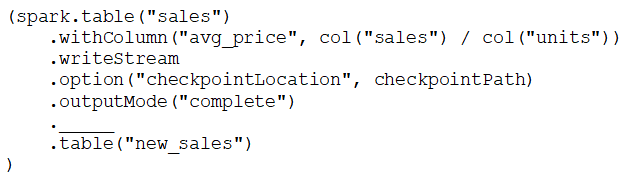
A data engineer has configured a Structured Streaming job to read from a table, manipulate the data, and then perform a streaming write into a new table. The cade block used by the data engineer is below: If the data engineer only wants the query to execute a micro-batch to process data every 5 seconds, which of the following lines of code should the data engineer use to fill in the blank?

Exhibit 1 for question 31
  • Atrigger("5 seconds")
  • Btrigger()
  • Ctrigger(once="5 seconds")
  • Dtrigger(processingTime="5 seconds") (correct answer)
  • Etrigger(continuous="5 seconds")
Reveal answer & explanation
Correct answer: D

The correct answer is D. Option D: trigger(processingTime="5 seconds") This option meets the real-time / low-latency performance requirement.

Topic 1 · Question 32

A dataset has been defined using Delta Live Tables and includes an expectations clause: CONSTRAINT valid_timestamp EXPECT (timestamp > '2020-01-01') ON VIOLATION DROP ROW What is the expected behavior when a batch of data containing data that violates these constraints is processed?

  • ARecords that violate the expectation are dropped from the target dataset and loaded into a quarantine table.
  • BRecords that violate the expectation are added to the target dataset and flagged as invalid in a field added to the target dataset.
  • CRecords that violate the expectation are dropped from the target dataset and recorded as invalid in the event log. (correct answer)
  • DRecords that violate the expectation are added to the target dataset and recorded as invalid in the event log.
  • ERecords that violate the expectation cause the job to fail.
Reveal answer & explanation
Correct answer: C

The correct answer is C. Option C: Records that violate the expectation are dropped from the target dataset and recorded as invalid in the event log.

Topic 1 · Question 33

Which of the following describes when to use the CREATE STREAMING LIVE TABLE (formerly CREATE INCREMENTAL LIVE TABLE) syntax over the CREATE LIVE TABLE syntax when creating Delta Live Tables (DLT) tables using SQL?

  • ACREATE STREAMING LIVE TABLE should be used when the subsequent step in the DLT pipeline is static.
  • BCREATE STREAMING LIVE TABLE should be used when data needs to be processed incrementally. (correct answer)
  • CCREATE STREAMING LIVE TABLE is redundant for DLT and it does not need to be used.
  • DCREATE STREAMING LIVE TABLE should be used when data needs to be processed through complicated aggregations.
  • ECREATE STREAMING LIVE TABLE should be used when the previous step in the DLT pipeline is static.
Reveal answer & explanation
Correct answer: B

The correct answer is B. Option B: CREATE STREAMING LIVE TABLE should be used when data needs to be processed incrementally. This option meets the real-time / low-latency performance requirement.

Topic 1 · Question 34

A data engineer is designing a data pipeline. The source system generates files in a shared directory that is also used by other processes. As a result, the files should be kept as is and will accumulate in the directory. The data engineer needs to identify which files are new since the previous run in the pipeline, and set up the pipeline to only ingest those new files with each run. Which of the following tools can the data engineer use to solve this problem?

  • AUnity Catalog
  • BDelta Lake
  • CDatabricks SQL
  • DData Explorer
  • EAuto Loader (correct answer)
Reveal answer & explanation
Correct answer: E

The correct answer is E. Option E: Auto Loader

Explanation

Auto Loader incrementally and efficiently ingests new cloud files using checkpointed discovery and exactly-once processing with Delta Lake.

Topic 1 · Question 35

Which of the following Structured Streaming queries is performing a hop from a Silver table to a Gold table?

  • A
  • B
  • C
  • D
  • E (correct answer)
Reveal answer & explanation
Correct answer: E

The correct answer is E. This option meets the real-time / low-latency performance requirement.

Topic 1 · Question 36

A data engineer has three tables in a Delta Live Tables (DLT) pipeline. They have configured the pipeline to drop invalid records at each table. They notice that some data is being dropped due to quality concerns at some point in the DLT pipeline. They would like to determine at which table in their pipeline the data is being dropped. Which of the following approaches can the data engineer take to identify the table that is dropping the records?

  • AThey can set up separate expectations for each table when developing their DLT pipeline.
  • BThey cannot determine which table is dropping the records.
  • CThey can set up DLT to notify them via email when records are dropped.
  • DThey can navigate to the DLT pipeline page, click on each table, and view the data quality statistics. (correct answer)
  • EThey can navigate to the DLT pipeline page, click on the “Error” button, and review the present errors.
Reveal answer & explanation
Correct answer: D

The correct answer is D. Option D: They can navigate to the DLT pipeline page, click on each table, and view the data quality statistics.

Topic 1 · Question 37

A data engineer has a single-task Job that runs each morning before they begin working. After identifying an upstream data issue, they need to set up another task to run a new notebook prior to the original task. Which of the following approaches can the data engineer use to set up the new task?

  • AThey can clone the existing task in the existing Job and update it to run the new notebook.
  • BThey can create a new task in the existing Job and then add it as a dependency of the original task. (correct answer)
  • CThey can create a new task in the existing Job and then add the original task as a dependency of the new task.
  • DThey can create a new job from scratch and add both tasks to run concurrently.
  • EThey can clone the existing task to a new Job and then edit it to run the new notebook.
Reveal answer & explanation
Correct answer: B

The correct answer is B. Option B: They can create a new task in the existing Job and then add it as a dependency of the original task.

Topic 1 · Question 38

An engineering manager wants to monitor the performance of a recent project using a Databricks SQL query. For the first week following the project’s release, the manager wants the query results to be updated every minute. However, the manager is concerned that the compute resources used for the query will be left running and cost the organization a lot of money beyond the first week of the project’s release. Which of the following approaches can the engineering team use to ensure the query does not cost the organization any money beyond the first week of the project’s release?

  • AThey can set a limit to the number of DBUs that are consumed by the SQL Endpoint.
  • BThey can set the query’s refresh schedule to end after a certain number of refreshes.
  • CThey cannot ensure the query does not cost the organization money beyond the first week of the project’s release.
  • DThey can set a limit to the number of individuals that are able to manage the query’s refresh schedule.
  • EThey can set the query’s refresh schedule to end on a certain date in the query scheduler. (correct answer)
Reveal answer & explanation
Correct answer: E

The correct answer is E. Option E: They can set the query’s refresh schedule to end on a certain date in the query scheduler.

Topic 1 · Question 39

A data analysis team has noticed that their Databricks SQL queries are running too slowly when connected to their always-on SQL endpoint. They claim that this issue is present when many members of the team are running small queries simultaneously. They ask the data engineering team for help. The data engineering team notices that each of the team’s queries uses the same SQL endpoint. Which of the following approaches can the data engineering team use to improve the latency of the team’s queries?

  • AThey can increase the cluster size of the SQL endpoint.
  • BThey can increase the maximum bound of the SQL endpoint’s scaling range. (correct answer)
  • CThey can turn on the Auto Stop feature for the SQL endpoint.
  • DThey can turn on the Serverless feature for the SQL endpoint.
  • EThey can turn on the Serverless feature for the SQL endpoint and change the Spot Instance Policy to “Reliability Optimized.”
Reveal answer & explanation
Correct answer: B

The correct answer is B. Option B: They can increase the maximum bound of the SQL endpoint’s scaling range.

Topic 1 · Question 40

A data engineer wants to schedule their Databricks SQL dashboard to refresh once per day, but they only want the associated SQL endpoint to be running when it is necessary. Which of the following approaches can the data engineer use to minimize the total running time of the SQL endpoint used in the refresh schedule of their dashboard?

  • AThey can ensure the dashboard’s SQL endpoint matches each of the queries’ SQL endpoints.
  • BThey can set up the dashboard’s SQL endpoint to be serverless.
  • CThey can turn on the Auto Stop feature for the SQL endpoint. (correct answer)
  • DThey can reduce the cluster size of the SQL endpoint.
  • EThey can ensure the dashboard’s SQL endpoint is not one of the included query’s SQL endpoint.
Reveal answer & explanation
Correct answer: C

The correct answer is C. Option C: They can turn on the Auto Stop feature for the SQL endpoint.

Showing questions 2140 of 169 · Page 2 of 9