πŸ”

DATA-ENGINEER-PROFESSIONAL β€” questions

Page 2 of 6 Β· 110 total questions.

Topic 1 Β· Question 21

The data architect has decided that once data has been ingested from external sources into the Databricks Lakehouse, table access controls will be leveraged to manage permissions for all production tables and views. The following logic was executed to grant privileges for interactive queries on a production database to the core engineering group. GRANT USAGE ON DATABASE prod TO eng; GRANT SELECT ON DATABASE prod TO eng; Assuming these are the only privileges that have been granted to the eng group and that these users are not workspace administrators, which statement describes their privileges?

  • AGroup members have full permissions on the prod database and can also assign permissions to other users or groups.
  • BGroup members are able to list all tables in the prod database but are not able to see the results of any queries on those tables.
  • CGroup members are able to query and modify all tables and views in the prod database, but cannot create new tables or views.
  • DGroup members are able to query all tables and views in the prod database, but cannot create or edit anything in the database. (correct answer)
  • EGroup members are able to create, query, and modify all tables and views in the prod database, but cannot define custom functions.
Reveal answer & explanation
Correct answer: D

The correct answer is D. Option D: Group members are able to query all tables and views in the prod database, but cannot create or edit anything in the database.

Topic 1 Β· Question 22

A distributed team of data analysts share computing resources on an interactive cluster with autoscaling configured. In order to better manage costs and query throughput, the workspace administrator is hoping to evaluate whether cluster upscaling is caused by many concurrent users or resource-intensive queries. In which location can one review the timeline for cluster resizing events?

  • AWorkspace audit logs
  • BDriver's log file
  • CGanglia
  • DCluster Event Log (correct answer)
  • EExecutor's log file
Reveal answer & explanation
Correct answer: D

The correct answer is D. Option D: Cluster Event Log

Topic 1 Β· Question 23

The data engineering team has been tasked with configuring connections to an external database that does not have a supported native connector with Databricks. The external database already has data security configured by group membership. These groups map directly to user groups already created in Databricks that represent various teams within the company. A new login credential has been created for each group in the external database. The Databricks Utilities Secrets module will be used to make these credentials available to Databricks users. Assuming that all the credentials are configured correctly on the external database and group membership is properly configured on Databricks, which statement describes how teams can be granted the minimum necessary access to using these credentials?

  • A"Manage" permissions should be set on a secret key mapped to those credentials that will be used by a given team.
  • B"Read" permissions should be set on a secret key mapped to those credentials that will be used by a given team.
  • C"Read" permissions should be set on a secret scope containing only those credentials that will be used by a given team. (correct answer)
  • D"Manage" permissions should be set on a secret scope containing only those credentials that will be used by a given team. No additional configuration is necessary as long as all users are configured as administrators in the workspace where secrets have been added.
Reveal answer & explanation
Correct answer: C

The correct answer is C. Option C: "Read" permissions should be set on a secret scope containing only those credentials that will be used by a given team. This option keeps traffic private / properly secured as required.

Topic 1 Β· Question 24

Which indicators would you look for in the Spark UI’s Storage tab to signal that a cached table is not performing optimally? Assume you are using Spark’s MEMORY_ONLY storage level.

  • ASize on Disk is < Size in Memory
  • BThe RDD Block Name includes the β€œ*” annotation signaling a failure to cache
  • CSize on Disk is > 0 (correct answer)
  • DThe number of Cached Partitions > the number of Spark Partitions
  • EOn Heap Memory Usage is within 75% of Off Heap Memory Usage
Reveal answer & explanation
Correct answer: C

The correct answer is C. Option C: Size on Disk is > 0

Topic 1 Β· Question 25

What is the first line of a Databricks Python notebook when viewed in a text editor?

  • A%python
  • B// Databricks notebook source
  • C# Databricks notebook source (correct answer)
  • D-- Databricks notebook source
  • E# MAGIC %python
Reveal answer & explanation
Correct answer: C

The correct answer is C. Option C: # Databricks notebook source

Topic 1 Β· Question 26

Which statement describes a key benefit of an end-to-end test?

  • AMakes it easier to automate your test suite
  • BPinpoints errors in the building blocks of your application
  • CProvides testing coverage for all code paths and branches
  • DClosely simulates real world usage of your application (correct answer)
  • EEnsures code is optimized for a real-life workflow
Reveal answer & explanation
Correct answer: D

The correct answer is D. Option D: Closely simulates real world usage of your application

Topic 1 Β· Question 27

The Databricks CLI is used to trigger a run of an existing job by passing the job_id parameter. The response that the job run request has been submitted successfully includes a field run_id. Which statement describes what the number alongside this field represents?

  • AThe job_id and number of times the job has been run are concatenated and returned.
  • BThe total number of jobs that have been run in the workspace.
  • CThe number of times the job definition has been run in this workspace.
  • DThe job_id is returned in this field.
  • EThe globally unique ID of the newly triggered run. (correct answer)
Reveal answer & explanation
Correct answer: E

The correct answer is E. Option E: The globally unique ID of the newly triggered run.

Topic 1 Β· Question 28

The data science team has created and logged a production model using MLflow. The model accepts a list of column names and returns a new column of type DOUBLE. The following code correctly imports the production model, loads the customers table containing the customer_id key column into a DataFrame, and defines the feature columns needed for the model. Which code block will output a DataFrame with the schema "customer_id LONG, predictions DOUBLE"?

Exhibit 1 for question 28
  • Adf.map(lambda x:model(x[columns])).select("customer_id, predictions")
  • Bdf.select("customer_id", model(*columns).alias("predictions")) (correct answer)
  • Cmodel.predict(df, columns)
  • Ddf.select("customer_id", pandas_udf(model, columns).alias("predictions"))
  • Edf.apply(model, columns).select("customer_id, predictions")
Reveal answer & explanation
Correct answer: B

The correct answer is B. Option B: df.select("customer_id", model(*columns).alias("predictions"))

Topic 1 Β· Question 29

A nightly batch job is configured to ingest all data files from a cloud object storage container where records are stored in a nested directory structure YYYY/MM/DD. The data for each date represents all records that were processed by the source system on that date, noting that some records may be delayed as they await moderator approval. Each entry represents a user review of a product and has the following schema: user_id STRING, review_id BIGINT, product_id BIGINT, review_timestamp TIMESTAMP, review_text STRING The ingestion job is configured to append all data for the previous date to a target table reviews_raw with an identical schema to the source system. The next step in the pipeline is a batch write to propagate all new records inserted into reviews_raw to a table where data is fully deduplicated, validated, and enriched. Which solution minimizes the compute costs to propagate this batch of data?

  • APerform a batch read on the reviews_raw table and perform an insert-only merge using the natural composite key user_id, review_id, product_id, review_timestamp. (correct answer)
  • BConfigure a Structured Streaming read against the reviews_raw table using the trigger once execution mode to process new records as a batch job.
  • CUse Delta Lake version history to get the difference between the latest version of reviews_raw and one version prior, then write these records to the next table.
  • DFilter all records in the reviews_raw table based on the review_timestamp; batch append those records produced in the last 48 hours.
  • EReprocess all records in reviews_raw and overwrite the next table in the pipeline.
Reveal answer & explanation
Correct answer: A

The correct answer is A. Option A: Perform a batch read on the reviews_raw table and perform an insert-only merge using the natural composite key user_id, review_id, product_id, review_timestamp.

Topic 1 Β· Question 30

Which statement describes Delta Lake optimized writes?

  • ABefore a Jobs cluster terminates, OPTIMIZE is executed on all tables modified during the most recent job.
  • BAn asynchronous job runs after the write completes to detect if files could be further compacted; if yes, an OPTIMIZE job is executed toward a default of 1 GB.
  • CData is queued in a messaging bus instead of committing data directly to memory; all data is committed from the messaging bus in one batch once the job is complete.
  • DOptimized writes use logical partitions instead of directory partitions; because partition boundaries are only represented in metadata, fewer small files are written.
  • EA shuffle occurs prior to writing to try to group similar data together resulting in fewer files instead of each executor writing multiple files based on directory partitions. (correct answer)
Reveal answer & explanation
Correct answer: E

The correct answer is E. Option E: A shuffle occurs prior to writing to try to group similar data together resulting in fewer files instead of each executor writing multiple files based on directory partitions.

Topic 1 Β· Question 31

Which statement describes the default execution mode for Databricks Auto Loader?

  • ACloud vendor-specific queue storage and notification services are configured to track newly arriving files; the target table is materialized by directly querying all valid files in the source directory.
  • BNew files are identified by listing the input directory; the target table is materialized by directly querying all valid files in the source directory.
  • CWebhooks trigger a Databricks job to run anytime new data arrives in a source directory; new data are automatically merged into target tables using rules inferred from the data.
  • DNew files are identified by listing the input directory; new files are incrementally and idempotently loaded into the target Delta Lake table. (correct answer)
  • ECloud vendor-specific queue storage and notification services are configured to track newly arriving files; new files are incrementally and idempotently loaded into the target Delta Lake table.
Reveal answer & explanation
Correct answer: D

The correct answer is D. Option D: New files are identified by listing the input directory; new files are incrementally and idempotently loaded into the target Delta Lake table.

Explanation

Delta Lake adds ACID transactions, schema enforcement, time travel, and reliable batch and streaming operations to a data lake.

Topic 1 Β· Question 32

A Delta Lake table representing metadata about content posts from users has the following schema: user_id LONG, post_text STRING, post_id STRING, longitude FLOAT, latitude FLOAT, post_time TIMESTAMP, date DATE Based on the above schema, which column is a good candidate for partitioning the Delta Table?

  • Apost_time
  • Blatitude
  • Cpost_id
  • Duser_id
  • Edate (correct answer)
Reveal answer & explanation
Correct answer: E

The correct answer is E. Option E: date

Topic 1 Β· Question 33

A large company seeks to implement a near real-time solution involving hundreds of pipelines with parallel updates of many tables with extremely high volume and high velocity data. Which of the following solutions would you implement to achieve this requirement?

  • AUse Databricks High Concurrency clusters, which leverage optimized cloud storage connections to maximize data throughput.
  • BPartition ingestion tables by a small time duration to allow for many data files to be written in parallel. (correct answer)
  • CConfigure Databricks to save all data to attached SSD volumes instead of object storage, increasing file I/O significantly.
  • DIsolate Delta Lake tables in their own storage containers to avoid API limits imposed by cloud vendors.
  • EStore all tables in a single database to ensure that the Databricks Catalyst Metastore can load balance overall throughput.
Reveal answer & explanation
Correct answer: B

The correct answer is B. Option B: Partition ingestion tables by a small time duration to allow for many data files to be written in parallel. This option meets the real-time / low-latency performance requirement.

Topic 1 Β· Question 34

Which describes a method of installing a Python package scoped at the notebook level to all nodes in the currently active cluster?

  • ARun source env/bin/activate in a notebook setup script
  • BUse b in a notebook cell
  • CUse %pip install in a notebook cell (correct answer)
  • DUse %sh pip install in a notebook cell
  • EInstall libraries from PyPI using the cluster UI
Reveal answer & explanation
Correct answer: C

The correct answer is C. Option C: Use %pip install in a notebook cell

Topic 1 Β· Question 35

Each configuration below is identical to the extent that each cluster has 400 GB total of RAM 160 total cores and only one Executor per VM. Given an extremely long-running job for which completion must be guaranteed, which cluster configuration will be able to guarantee completion of the job in light of one or more VM failures?

  • Aβ€’ Total VMs: 8 β€’ 50 GB per Executor β€’ 20 Cores / Executor
  • Bβ€’ Total VMs: 16 β€’ 25 GB per Executor β€’ 10 Cores / Executor (correct answer)
  • Cβ€’ Total VMs: 1 β€’ 400 GB per Executor β€’ 160 Cores/Executor
  • Dβ€’ Total VMs: 4 β€’ 100 GB per Executor β€’ 40 Cores / Executor
  • Eβ€’ Total VMs: 2 β€’ 200 GB per Executor β€’ 80 Cores / Executor
Reveal answer & explanation
Correct answer: B

The correct answer is B. Option B: β€’ Total VMs: 16 β€’ 25 GB per Executor β€’ 10 Cores / Executor

Topic 1 Β· Question 36

A Delta Lake table in the Lakehouse named customer_churn_params is used in churn prediction by the machine learning team. The table contains information about customers derived from a number of upstream sources. Currently, the data engineering team populates this table nightly by overwriting the table with the current valid values derived from upstream data sources. Immediately after each update succeeds, the data engineering team would like to determine the difference between the new version and the previous version of the table. Given the current implementation, which method can be used?

  • AExecute a query to calculate the difference between the new version and the previous version using Delta Lake’s built-in versioning and lime travel functionality. (correct answer)
  • BParse the Delta Lake transaction log to identify all newly written data files.
  • CParse the Spark event logs to identify those rows that were updated, inserted, or deleted.
  • DExecute DESCRIBE HISTORY customer_churn_params to obtain the full operation metrics for the update, including a log of all records that have been added or modified.
  • EUse Delta Lake’s change data feed to identify those records that have been updated, inserted, or deleted.
Reveal answer & explanation
Correct answer: A

The correct answer is A. Option A: Execute a query to calculate the difference between the new version and the previous version using Delta Lake’s built-in versioning and lime travel functionality.

Explanation

Delta Lake adds ACID transactions, schema enforcement, time travel, and reliable batch and streaming operations to a data lake.

Topic 1 Β· Question 37

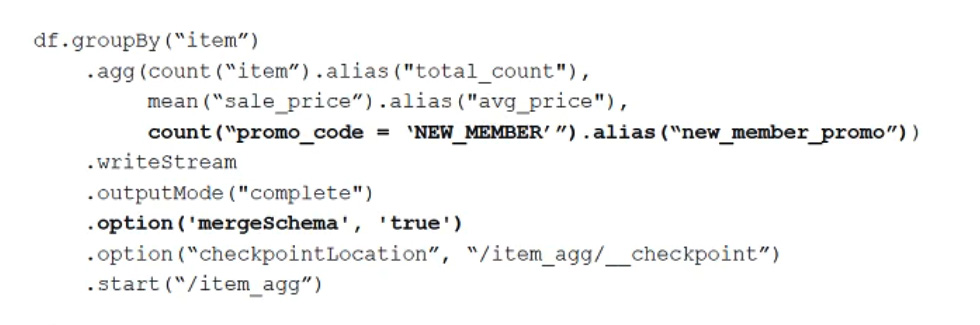
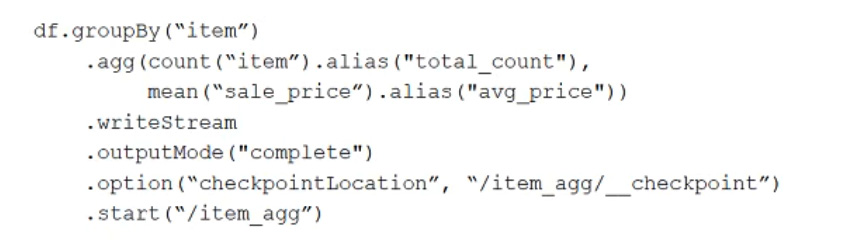
A data team’s Structured Streaming job is configured to calculate running aggregates for item sales to update a downstream marketing dashboard. The marketing team has introduced a new promotion, and they would like to add a new field to track the number of times this promotion code is used for each item. A junior data engineer suggests updating the existing query as follows. Note that proposed changes are in bold. Original query: Proposed query: Which step must also be completed to put the proposed query into production?

Exhibit 1 for question 37Exhibit 2 for question 37
  • ASpecify a new checkpointLocation (correct answer)
  • BRemove .option('mergeSchema', 'true') from the streaming write
  • CIncrease the shuffle partitions to account for additional aggregates
  • DRun REFRESH TABLE delta.β€›/item_aggβ€›
Reveal answer & explanation
Correct answer: A

The correct answer is A. Option A: Specify a new checkpointLocation

Explanation

A streaming checkpoint stores progress and state so a query can recover without reprocessing committed data. This option meets the real-time / low-latency performance requirement.

Topic 1 Β· Question 38

When using CLI or REST API to get results from jobs with multiple tasks, which statement correctly describes the response structure?

  • AEach run of a job will have a unique job_id; all tasks within this job will have a unique job_id
  • BEach run of a job will have a unique job_id; all tasks within this job will have a unique task_id
  • CEach run of a job will have a unique orchestration_id; all tasks within this job will have a unique run_id
  • DEach run of a job will have a unique run_id; all tasks within this job will have a unique task_id
  • EEach run of a job will have a unique run_id; all tasks within this job will also have a unique run_id (correct answer)
Reveal answer & explanation
Correct answer: E

The correct answer is E. Option E: Each run of a job will have a unique run_id; all tasks within this job will also have a unique run_id

Topic 1 Β· Question 39

The data engineering team is configuring environments for development, testing, and production before beginning migration on a new data pipeline. The team requires extensive testing on both the code and data resulting from code execution, and the team wants to develop and test against data as similar to production data as possible. A junior data engineer suggests that production data can be mounted to the development and testing environments, allowing pre-production code to execute against production data. Because all users have admin privileges in the development environment, the junior data engineer has offered to configure permissions and mount this data for the team. Which statement captures best practices for this situation?

  • AAll development, testing, and production code and data should exist in a single, unified workspace; creating separate environments for testing and development complicates administrative overhead.
  • BIn environments where interactive code will be executed, production data should only be accessible with read permissions; creating isolated databases for each environment further reduces risks. (correct answer)
  • CAs long as code in the development environment declares USE dev_db at the top of each notebook, there is no possibility of inadvertently committing changes back to production data sources.
  • DBecause Delta Lake versions all data and supports time travel, it is not possible for user error or malicious actors to permanently delete production data; as such, it is generally safe to mount production data anywhere.
  • EBecause access to production data will always be verified using passthrough credentials, it is safe to mount data to any Databricks development environment.
Reveal answer & explanation
Correct answer: B

The correct answer is B. Option B: In environments where interactive code will be executed, production data should only be accessible with read permissions; creating isolated databases for each environment further reduces risks.

Topic 1 Β· Question 40

A data engineer, User A, has promoted a pipeline to production by using the REST API to programmatically create several jobs. A DevOps engineer, User B, has configured an external orchestration tool to trigger job runs through the REST API. Both users authorized the REST API calls using their personal access tokens. A workspace admin, User C, inherits responsibility for managing this pipeline. User C uses the Databricks Jobs UI to take "Owner" privileges of each job. Jobs continue to be triggered using the credentials and tooling configured by User B. An application has been configured to collect and parse run information returned by the REST API. Which statement describes the value returned in the creator_user_name field?

  • AOnce User C takes "Owner" privileges, their email address will appear in this field; prior to this, User A’s email address will appear in this field.
  • BUser B’s email address will always appear in this field, as their credentials are always used to trigger the run.
  • CUser A’s email address will always appear in this field, as they still own the underlying notebooks. (correct answer)
  • DOnce User C takes "Owner" privileges, their email address will appear in this field; prior to this, User B’s email address will appear in this field.
  • EUser C will only ever appear in this field if they manually trigger the job, otherwise it will indicate User B.
Reveal answer & explanation
Correct answer: C

The correct answer is C. Option C: User A’s email address will always appear in this field, as they still own the underlying notebooks.

Showing questions 21–40 of 110 Β· Page 2 of 6