
πŸ”

PCDOE β€” questions

Page 5 of 11 Β· 210 total questions.

Topic 1 Β· Question 81

Your company follows Site Reliability Engineering principles. You are writing a postmortem for an incident, triggered by a software change that severely affected users. You want to prevent severe incident from happening in the future. What should you do?

  • AIdentify engineers responsible for the incident and escalate to the senior management.
  • BEnsure that test cases that catch errors of this type are run successfully before new software releases. (correct answer)
  • CFollow up with the employees who reviewed the changes and prescribe practices they should follow in the future.
  • DDesign a policy that will require on-call teams to immediately call engineers and management to discuss a plan of action if an incident occurs.
Reveal answer & explanation
Correct answer: B

The correct answer is B. Option B: Ensure that test cases that catch errors of this type are run successfully before new software releases.
Topic 1 Β· Question 82 Β· Select all that apply

Your organization uses a change advisory board (CAB) to approve all changes to an existing service. You want to revise this process to eliminate any negative impact on the software delivery performance. What should you do? (Choose two.)

  • AReplace the CAB with a senior manager to ensure continuous oversight from development to deployment.
  • BLet developers merge their own changes, but ensure that the team's deployment platform can roll back changes if any issues are discovered.
  • CMove to a peer-review based process for individual changes that is enforced at code check-in time and supported by automated tests. (correct answer)
  • DBatch changes into larger but less frequent software releases.
  • EEnsure that the team's development platform enables developers to get fast feedback on the impact of their changes. (correct answer)
Reveal answer & explanation
Correct answer: C, E

The correct answer is C, E. Option C: Move to a peer-review based process for individual changes that is enforced at code check-in time and supported by automated tests. Option E: Ensure that the team's development platform enables developers to get fast feedback on the impact of their changes.

Topic 1 Β· Question 83

Your organization has a containerized web application that runs on-premises. As part of the migration plan to Google Cloud, you need to select a deployment strategy and platform that meets the following acceptance criteria: 1. The platform must be able to direct traffic from Android devices to an Android-specific microservice. 2. The platform must allow for arbitrary percentage-based traffic splitting 3. The deployment strategy must allow for continuous testing of multiple versions of any microservice. What should you do?

  • ADeploy the canary release of the application to Cloud Run. Use traffic splitting to direct 10% of user traffic to the canary release based on the revision tag.
  • BDeploy the canary release of the application to App Engine. Use traffic splitting to direct a subset of user traffic to the new version based on the IP address.
  • CDeploy the canary release of the application to Compute Engine. Use Anthos Service Mesh with Compute Engine to direct 10% of user traffic to the canary release by configuring the virtual service.
  • DDeploy the canary release to Google Kubernetes Engine with Anthos Service Mesh. Use traffic splitting to direct 10% of user traffic to the new version based on the user-agent header configured in the virtual service. (correct answer)
Reveal answer & explanation
Correct answer: D

The correct answer is D. Option D: Deploy the canary release to Google Kubernetes Engine with Anthos Service Mesh. Use traffic splitting to direct 10% of user traffic to the new version based on the user-agent header configured in the virtual service.

Explanation

Google Kubernetes Engine runs managed Kubernetes for containerized workloads. Anthos runs and manages Kubernetes workloads consistently across on-premises and clouds.

Topic 1 Β· Question 84

Your team is running microservices in Google Kubernetes Engine (GKE). You want to detect consumption of an error budget to protect customers and define release policies. What should you do?

  • ACreate SLIs from metrics. Enable Alert Policies if the services do not pass.
  • BUse the metrics from Anthos Service Mesh to measure the health of the microservices.
  • CCreate a SLO. Create an Alert Policy on select_slo_burn_rate. (correct answer)
  • DCreate a SLO and configure uptime checks for your services. Enable Alert Policies if the services do not pass.
Reveal answer & explanation
Correct answer: C

The correct answer is C. Option C: Create a SLO. Create an Alert Policy on select_slo_burn_rate.

Topic 1 Β· Question 85

Your organization wants to collect system logs that will be used to generate dashboards in Cloud Operations for their Google Cloud project. You need to configure all current and future Compute Engine instances to collect the system logs, and you must ensure that the Ops Agent remains up to date. What should you do?

  • AUse the gcloud CLI to install the Ops Agent on each VM listed in the Cloud Asset Inventory,
  • BSelect all VMs with an Agent status of Not detected on the Cloud Operations VMs dashboard. Then select Install agents.
  • CUse the gcloud CLI to create an Agent Policy. (correct answer)
  • DInstall the Ops Agent on the Compute Engine image by using a startup script
Reveal answer & explanation
Correct answer: C

The correct answer is C. Option C: Use the gcloud CLI to create an Agent Policy.

Topic 1 Β· Question 86

Your company has a Google Cloud resource hierarchy with folders for production, test, and development. Your cyber security team needs to review your company's Google Cloud security posture to accelerate security issue identification and resolution. You need to centralize the logs generated by Google Cloud services from all projects only inside your production folder to allow for alerting and near-real time analysis. What should you do?

  • AEnable the Workflows API and route all the logs to Cloud Logging.
  • BCreate a central Cloud Monitoring workspace and attach all related projects.
  • CCreate an aggregated log sink associated with the production folder that uses a Pub/Sub topic as the destination.
  • DCreate an aggregated log sink associated with the production folder that uses a Cloud Logging bucket as the destination. (correct answer)
Reveal answer & explanation
Correct answer: D

The correct answer is D. Option D: Create an aggregated log sink associated with the production folder that uses a Cloud Logging bucket as the destination.

Explanation

Cloud Logging centralizes, stores, and analyzes logs across services. This option meets the real-time / low-latency performance requirement.

Topic 1 Β· Question 87

You are configuring the frontend tier of an application deployed in Google Cloud. The frontend tier is hosted in nginx and deployed using a managed instance group with an Envoy-based external HTTP(S) load balancer in front. The application is deployed entirely within the europe-west2 region, and only serves users based in the United Kingdom. You need to choose the most cost-effective network tier and load balancing configuration. What should you use?

  • APremium Tier with a global load balancer
  • BPremium Tier with a regional load balancer
  • CStandard Tier with a global load balancer
  • DStandard Tier with a regional load balancer (correct answer)
Reveal answer & explanation
Correct answer: D

The correct answer is D. Option D: Standard Tier with a regional load balancer

Explanation

A load balancer distributes traffic across healthy backends in multiple zones for availability and scale. This option delivers the requirement at the lowest cost.

Topic 1 Β· Question 88

You recently deployed your application in Google Kubernetes Engine (GKE) and now need to release a new version of the application. You need the ability to instantly roll back to the previous version of the application in case there are issues with the new version. Which deployment model should you use?

  • APerform a rolling deployment, and test your new application after the deployment is complete.
  • BPerform A/B testing, and test your application periodically after the deployment is complete.
  • CPerform a canary deployment, and test your new application periodically after the new version is deployed.
  • DPerform a blue/green deployment, and test your new application after the deployment is complete. (correct answer)
Reveal answer & explanation
Correct answer: D

The correct answer is D. Option D: Perform a blue/green deployment, and test your new application after the deployment is complete.

Topic 1 Β· Question 89

You are building and deploying a microservice on Cloud Run for your organization. Your service is used by many applications internally. You are deploying a new release, and you need to test the new version extensively in the staging and production environments. You must minimize user and developer impact. What should you do?

  • ADeploy the new version of the service to the staging environment. Split the traffic, and allow 1% of traffic through to the latest version. Test the latest version. If the test passes, gradually roll out the latest version to the staging and production environments.
  • BDeploy the new version of the service to the staging environment. Split the traffic, and allow 50% of traffic through to the latest version. Test the latest version. If the test passes, send all traffic to the latest version. Repeat for the production environment.
  • CDeploy the new version of the service to the staging environment with a new-release tag without serving traffic. Test the new-release version. If the test passes, gradually roll out this tagged version. Repeat for the production environment. (correct answer)
  • DDeploy a new environment with the green tag to use as the staging environment. Deploy the new version of the service to the green environment and test the new version. If the tests pass, send all traffic to the green environment and delete the existing staging environment. Repeat for the production environment.
Reveal answer & explanation
Correct answer: C

The correct answer is C. Option C: Deploy the new version of the service to the staging environment with a new-release tag without serving traffic. Test the new-release version. If the test passes, gradually roll out this tagged version. Repeat for the...

Topic 1 Β· Question 90

You work for a global organization and run a service with an availability target of 99% with limited engineering resources. For the current calendar month, you noticed that the service has 99.5% availability. You must ensure that your service meets the defined availability goals and can react to business changes, including the upcoming launch of new features. You also need to reduce technical debt while minimizing operational costs. You want to follow Google-recommended practices. What should you do?

  • AAdd N+1 redundancy to your service by adding additional compute resources to the service.
  • BIdentify, measure, and eliminate toil by automating repetitive tasks. (correct answer)
  • CDefine an error budget for your service level availability and minimize the remaining error budget.
  • DAllocate available engineers to the feature backlog while you ensure that the service remains within the availability target.
Reveal answer & explanation
Correct answer: B

The correct answer is B. Option B: Identify, measure, and eliminate toil by automating repetitive tasks.

Topic 1 Β· Question 91

You are developing the deployment and testing strategies for your CI/CD pipeline in Google Cloud. You must be able to: β€’ Reduce the complexity of release deployments and minimize the duration of deployment rollbacks. β€’ Test real production traffic with a gradual increase in the number of affected users. You want to select a deployment and testing strategy that meets your requirements. What should you do?

  • ARecreate deployment and canary testing
  • BBlue/green deployment and canary testing (correct answer)
  • CRolling update deployment and A/B testing
  • DRolling update deployment and shadow testing
Reveal answer & explanation
Correct answer: B

The correct answer is B. Option B: Blue/green deployment and canary testing.

Topic 1 Β· Question 92 Β· Select all that apply

You are creating a CI/CD pipeline to perform Terraform deployments of Google Cloud resources. Your CI/CD tooling is running in Google Kubernetes Engine (GKE) and uses an ephemeral Pod for each pipeline run. You must ensure that the pipelines that run in the Pods have the appropriate Identity and Access Management (IAM) permissions to perform the Terraform deployments. You want to follow Google-recommended practices for identity management. What should you do? (Choose two.)

  • ACreate a new Kubernetes service account, and assign the service account to the Pods. Use Workload Identity to authenticate as the Google service account. (correct answer)
  • BCreate a new JSON service account key for the Google service account, store the key as a Kubernetes secret, inject the key into the Pods, and set the GOOGLE_APPLICATION_CREDENTIALS environment variable.
  • CCreate a new Google service account, and assign the appropriate IAM permissions. (correct answer)
  • DCreate a new JSON service account key for the Google service account, store the key in the secret management store for the CI/CD tool, and configure Terraform to use this key for authentication.
  • EAssign the appropriate IAM permissions to the Google service account associated with the Compute Engine VM instances that run the Pods.
Reveal answer & explanation
Correct answer: A, C

The correct answer is A, C. Option A: Create a new Kubernetes service account, and assign the service account to the Pods. Use Workload Identity to authenticate as the Google service account. Option C: Create a new Google service account, and assign the appropriate IAM permissions.

Explanation

Workload Identity Federation lets workloads access Google Cloud without long-lived service account keys. A service account provides an identity for workloads to access Google Cloud APIs securely. Cloud IAM grants fine-grained, least-privilege access to Google Cloud resources.

Topic 1 Β· Question 93

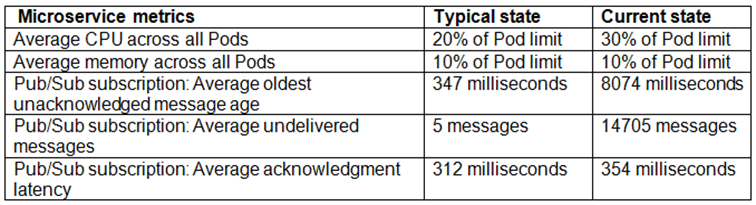
You are the on-call Site Reliability Engineer for a microservice that is deployed to a Google Kubernetes Engine (GKE) Autopilot cluster. Your company runs an online store that publishes order messages to Pub/Sub, and a microservice receives these messages and updates stock information in the warehousing system. A sales event caused an increase in orders, and the stock information is not being updated quickly enough. This is causing a large number of orders to be accepted for products that are out of stock. You check the metrics for the microservice and compare them to typical levels: You need to ensure that the warehouse system accurately reflects product inventory at the time orders are placed and minimize the impact on customers. What should you do?

Exhibit 1 for question 93
  • ADecrease the acknowledgment deadline on the subscription.
  • BAdd a virtual queue to the online store that allows typical traffic levels.
  • CIncrease the number of Pod replicas. (correct answer)
  • DIncrease the Pod CPU and memory limits.
Reveal answer & explanation
Correct answer: C

The correct answer is C. Option C: Increase the number of Pod replicas.

Topic 1 Β· Question 94

Your team deploys applications to three Google Kubernetes Engine (GKE) environments: development, staging, and production. You use GitHub repositories as your source of truth. You need to ensure that the three environments are consistent. You want to follow Google-recommended practices to enforce and install network policies and a logging DaemonSet on all the GKE clusters in those environments. What should you do?

  • AUse Google Cloud Deploy to deploy the network policies and the DaemonSet. Use Cloud Monitoring to trigger an alert if the network policies and DaemonSet drift from your source in the repository.
  • BUse Google Cloud Deploy to deploy the DaemonSet and use Policy Controller to configure the network policies. Use Cloud Monitoring to detect drifts from the source in the repository and Cloud Functions to correct the drifts.
  • CUse Cloud Build to render and deploy the network policies and the DaemonSet. Set up Config Sync to sync the configurations for the three environments. (correct answer)
  • DUse Cloud Build to render and deploy the network policies and the DaemonSet. Set up a Policy Controller to enforce the configurations for the three environments.
Reveal answer & explanation
Correct answer: C

The correct answer is C. Option C: Use Cloud Build to render and deploy the network policies and the DaemonSet. Set up Config Sync to sync the configurations for the three environments.

Explanation

Cloud Build runs managed CI pipelines to build, test, and package code.

Topic 1 Β· Question 95

You are using Terraform to manage infrastructure as code within a CI/CD pipeline. You notice that multiple copies of the entire infrastructure stack exist in your Google Cloud project, and a new copy is created each time a change to the existing infrastructure is made. You need to optimize your cloud spend by ensuring that only a single instance of your infrastructure stack exists at a time. You want to follow Google-recommended practices. What should you do?

  • ACreate a new pipeline to delete old infrastructure stacks when they are no longer needed.
  • BConfirm that the pipeline is storing and retrieving the terraform.tfstate file from Cloud Storage with the Terraform gcs backend. (correct answer)
  • CVerify that the pipeline is storing and retrieving the terraform.tfstate file from a source control.
  • DUpdate the pipeline to remove any existing infrastructure before you apply the latest configuration.
Reveal answer & explanation
Correct answer: B

The correct answer is B. Option B: Confirm that the pipeline is storing and retrieving the terraform.tfstate file from Cloud Storage with the Terraform gcs backend.

Explanation

Cloud Storage provides durable, scalable object storage that is fully managed. Terraform provisions Google Cloud infrastructure as code repeatably.

Topic 1 Β· Question 96

You are creating Cloud Logging sinks to export log entries from Cloud Logging to BigQuery for future analysis. Your organization has a Google Cloud folder named Dev that contains development projects and a folder named Prod that contains production projects. Log entries for development projects must be exported to dev_dataset, and log entries for production projects must be exported to prod_dataset. You need to minimize the number of log sinks created, and you want to ensure that the log sinks apply to future projects. What should you do?

  • ACreate a single aggregated log sink at the organization level.
  • BCreate a log sink in each project.
  • CCreate two aggregated log sinks at the organization level, and filter by project ID.
  • DCreate an aggregated log sink in the Dev and Prod folders. (correct answer)
Reveal answer & explanation
Correct answer: D

The correct answer is D. Option D: Create an aggregated log sink in the Dev and Prod folders.

Topic 1 Β· Question 97

Your company runs services by using multiple globally distributed Google Kubernetes Engine (GKE) clusters. Your operations team has set up workload monitoring that uses Prometheus-based tooling for metrics, alerts, and generating dashboards. This setup does not provide a method to view metrics globally across all clusters. You need to implement a scalable solution to support global Prometheus querying and minimize management overhead. What should you do?

  • AConfigure Prometheus cross-service federation for centralized data access.
  • BConfigure workload metrics within Cloud Operations for GKE.
  • CConfigure Prometheus hierarchical federation for centralized data access.
  • DConfigure Google Cloud Managed Service for Prometheus. (correct answer)
Reveal answer & explanation
Correct answer: D

The correct answer is D. Option D: Configure Google Cloud Managed Service for Prometheus.

Topic 1 Β· Question 98

You need to build a CI/CD pipeline for a containerized application in Google Cloud. Your development team uses a central Git repository for trunk-based development. You want to run all your tests in the pipeline for any new versions of the application to improve the quality. What should you do?

  • A1. Install a Git hook to require developers to run unit tests before pushing the code to a central repository.2. Trigger Cloud Build to build the application container. Deploy the application container to a testing environment, and run integration tests.3. If the integration tests are successful, deploy the application container to your production environment, and run acceptance tests.
  • B1. Install a Git hook to require developers to run unit tests before pushing the code to a central repository. If all tests are successful, build a container.2. Trigger Cloud Build to deploy the application container to a testing environment, and run integration tests and acceptance tests.3. If all tests are successful, tag the code as production ready. Trigger Cloud Build to build and deploy the application container to the production environment.
  • C1. Trigger Cloud Build to build the application container, and run unit tests with the container.2. If unit tests are successful, deploy the application container to a testing environment, and run integration tests.3. If the integration tests are successful, the pipeline deploys the application container to the production environment. After that, run acceptance tests.
  • D1. Trigger Cloud Build to run unit tests when the code is pushed. If all unit tests are successful, build and push the application container to a central registry.2. Trigger Cloud Build to deploy the container to a testing environment, and run integration tests and acceptance tests.3. If all tests are successful, the pipeline deploys the application to the production environment and runs smoke tests (correct answer)
Reveal answer & explanation
Correct answer: D

The correct answer is D. Option D: 1. Trigger Cloud Build to run unit tests when the code is pushed. If all unit tests are successful, build and push the application container to a central registry.2. Trigger Cloud Build to deploy the container to a te...

Explanation

Cloud Build runs managed CI pipelines to build, test, and package code.

Topic 1 Β· Question 99

The new version of your containerized application has been tested and is ready to be deployed to production on Google Kubernetes Engine (GKE). You could not fully load-test the new version in your pre-production environment, and you need to ensure that the application does not have performance problems after deployment. Your deployment must be automated. What should you do?

  • ADeploy the application through a continuous delivery pipeline by using canary deployments. Use Cloud Monitoring to look for performance issues, and ramp up traffic as supported by the metrics. (correct answer)
  • BDeploy the application through a continuous delivery pipeline by using blue/green deployments. Migrate traffic to the new version of the application and use Cloud Monitoring to look for performance issues.
  • CDeploy the application by using kubectl and use Config Connector to slowly ramp up traffic between versions. Use Cloud Monitoring to look for performance issues.
  • DDeploy the application by using kubectl and set the spec.updateStrategy.type field to RollingUpdate. Use Cloud Monitoring to look for performance issues, and run the kubectl rollback command if there are any issues.
Reveal answer & explanation
Correct answer: A

The correct answer is A. Option A: Deploy the application through a continuous delivery pipeline by using canary deployments. Use Cloud Monitoring to look for performance issues, and ramp up traffic as supported by the metrics.

Explanation

Cloud Monitoring collects metrics, dashboards, and alerts to observe system health.

Topic 1 Β· Question 100

You are managing an application that runs in Compute Engine. The application uses a custom HTTP server to expose an API that is accessed by other applications through an internal TCP/UDP load balancer. A firewall rule allows access to the API port from 0.0.0.0/0. You need to configure Cloud Logging to log each IP address that accesses the API by using the fewest number of steps. What should you do first?

  • AEnable Packet Mirroring on the VPC.
  • BInstall the Ops Agent on the Compute Engine instances.
  • CEnable logging on the firewall rule. (correct answer)
  • DEnable VPC Flow Logs on the subnet.
Reveal answer & explanation
Correct answer: C

The correct answer is C. Option C: Enable logging on the firewall rule.

Showing questions 81–100 of 210 Β· Page 5 of 11