
πŸ”

PCNE β€” questions

Page 9 of 13 Β· 255 total questions.

Topic 1 Β· Question 162

You are a network administrator at your company planning a migration to Google Cloud and you need to finish the migration as quickly as possible. To ease the transition, you decided to use the same architecture as your on-premises network: a hub-and-spoke model. Your on-premises architecture consists of over 50 spokes. Each spoke does not have connectivity to the other spokes, and all traffic is sent through the hub for security reasons. You need to ensure that the Google Cloud architecture matches your on-premises architecture. You want to implement a solution that minimizes management overhead and cost, and uses default networking quotas and limits. What should you do?

  • AConnect all the spokes to the hub with Cloud VPN.
  • BConnect all the spokes to the hub with VPC Network Peering.
  • CConnect all the spokes to the hub with Cloud VPN. Use a third-party network appliance as a default gateway to prevent connectivity between the spokes. (correct answer)
  • DConnect all the spokes to the hub with VPC Network Peering. Use a third-party network appliance as a default gateway to prevent connectivity between the spokes.
Reveal answer & explanation
Correct answer: C

The correct answer is C. Option C: Connect all the spokes to the hub with Cloud VPN. Use a third-party network appliance as a default gateway to prevent connectivity between the spokes.

Explanation

Cloud VPN provides encrypted IPsec connectivity between on premises and a VPC.
Topic 1 Β· Question 163

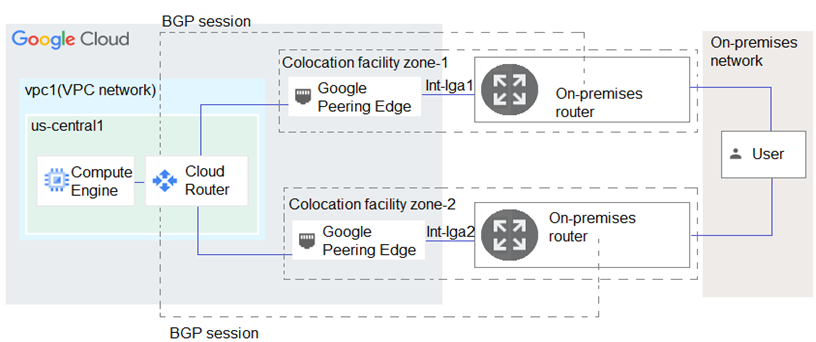
You have the networking configuration shown in the diagram. Two VLAN attachments associated with two Dedicated Interconnect connections terminate on the same Cloud Router (mycloudrouter). The Interconnect connections terminate on two separate on-premises routers. You advertise the same prefixes from the Border Gateway Protocol (BGP) sessions associated with each of the VLAN attachments. You notice an asymmetric traffic flow between the two Interconnect connections. Which of the following actions should you take to troubleshoot the asymmetric traffic flow?

Exhibit 1 for question 163
  • AFrom the Google Cloud console, navigate to Cloud Logging to view VPC Flow Logs and review the results.
  • BFrom the Cloud CLI, run gcloud compute –-project PROJECT_ID routers get-status mycloudrouter –-region REGION and review the results.
  • CFrom the Google Cloud console, navigate to the Hybrid Connectivity, select the Cloud Router, and view BGP sessions. (correct answer)
  • DFrom the Cloud CLI, run gcloud compute routers describe mycloudrouter –-region REGION and review the results.
Reveal answer & explanation
Correct answer: C

The correct answer is C. Option C: From the Google Cloud console, navigate to the Hybrid Connectivity, select the Cloud Router, and view BGP sessions.

Topic 1 Β· Question 164

You are responsible for designing a new connectivity solution between your organization's on-premises data center and your Google Cloud Virtual Private Cloud (VPC) network. Currently, there is no end-to-end connectivity. You must ensure a service level agreement (SLA) of 99.99% availability. What should you do?

  • AUse one Dedicated Interconnect connection in a single metropolitan area. Configure one Cloud Router and enable global routing in the VPC.
  • BUse a Direct Peering connection between your on-premises data center and Google Cloud. Configure Classic VPN with two tunnels and one Cloud Router.
  • CUse two Dedicated Interconnect connections in a single metropolitan area. Configure one Cloud Router and enable global routing in the VPC.
  • DUse HA VPN. Configure one tunnel from each interface of the VPN gateway to connect to the corresponding interfaces on the peer gateway on-premises. Configure one Cloud Router and enable global routing in the VPC. (correct answer)
Reveal answer & explanation
Correct answer: D

The correct answer is D. Option D: Use HA VPN. Configure one tunnel from each interface of the VPN gateway to connect to the corresponding interfaces on the peer gateway on-premises. Configure one Cloud Router and enable global routing in the VPC.

Explanation

A VPC provides a global, software-defined private network for your Google Cloud resources.

Topic 1 Β· Question 165

Your company is planning a migration to Google Kubernetes Engine. Your application team informed you that they require a minimum of 60 Pods per node and a maximum of 100 Pods per node. Which Pod per node CIDR range should you use?

  • A/24 (correct answer)
  • B/25
  • C/26
  • D/28
Reveal answer & explanation
Correct answer: A

The correct answer is A. Option A: /24.

Topic 1 Β· Question 166

You are designing a packet mirroring policy as part of your network security architecture for your gaming workload. Your infrastructure is located in the us-west2 region and deployed across several zones: us-west2-a, us-west2-b, and us-west2-c. The infrastructure is running a web-based application on TCP ports 80 and 443 with other game servers that utilize the UDP protocol. You need to deploy packet mirroring policies and collector instances to monitor web application traffic while minimizing inter-zonal network egress costs. Following Google-recommended practices, how should you deploy the packet mirroring policies and collector instances?

  • ACrate three packet mirroring policies: one for each zone. Create one group of collector instances for the us-west2 region. Configure each packet mirroring policy to match traffic for its zone based on instance-tags, and create a filter for TCP traffic.
  • BCreate one packet mirroring policy for the us-west2 region. Create one group of collector instances for the us-west2 region. Configure the packet mirroring policy to match traffic for web server instances based on instance-tags, and create a filter for TCP traffic.
  • CCreate three packet mirroring policies: one for each zone. Create three groups of collector instances: one group for each zone. Configure each policy to match traffic for its zone based on instance-tags, and create a filter for TCP traffic. (correct answer)
  • DCreate three packet mirroring policies: one for each zone. Create three groups of collector instances: one group for each zone. Configure each policy to match traffic for its zone based on subnets, and create a filter for TCP traffic.
Reveal answer & explanation
Correct answer: C

The correct answer is C. Option C: Create three packet mirroring policies: one for each zone. Create three groups of collector instances: one group for each zone. Configure each policy to match traffic for its zone based on instance-tags, and create a...

Topic 1 Β· Question 167

Your company recently migrated to Google Cloud. You configured separate Virtual Private Cloud (VPC) networks for Department A and Department B. You need to configure both VPC networks to have access to the same on-premises location through separate links with full isolation between the VPC networks. Your design must also query on-premises DNS servers from workloads in Google Cloud using conditional forwarding. You want to minimize operational overhead. What should you do?

  • ACustomize the operating system DNS configuration files to target the on-premises DNS servers.
  • BKeep the different VPC networks from both departments isolated with different on-premises links, and separate Cloud DNS private zones and Cloud DNS forwarding zones.
  • CPeer Department A's and Department B's VPC networks to have all on-premises connectivity via a single VPC network. Use separate Cloud DNS private zones and Cloud DNS forwarding zones.
  • DConfigure a Cloud DNS Peering zone in Department A's VPC network pointing to Department B's VPC and a Cloud DNS outbound forwarding zone in Department B's VPC network. Use separate on-premises links in each VPC network. (correct answer)
Reveal answer & explanation
Correct answer: D

The correct answer is D. Option D: Configure a Cloud DNS Peering zone in Department A's VPC network pointing to Department B's VPC and a Cloud DNS outbound forwarding zone in Department B's VPC network. Use separate on-premises links in each VPC network.

Explanation

Cloud DNS provides scalable, authoritative DNS with health checks and routing policies. A VPC provides a global, software-defined private network for your Google Cloud resources.

Topic 1 Β· Question 168

You are planning to use Terraform to deploy the Google Cloud infrastructure for your company. The design must meet the following requirements: β€’ Each Google Cloud project must represent an internal project that your team will work on. β€’ After an internal project is finished, the infrastructure must be deleted. β€’ Each internal project must have its own Google Cloud project owner to manage the Google Cloud resources. β€’ You have 10-100 projects deployed at a time. While you are writing the Terraform code, you need to ensure that the deployment is simple and the code is reusable with centralized management. What should you do?

  • ACreate a single project and single VPC for each internal project.
  • BCreate a single Shared VPC and attach each Google Cloud project as a service project. (correct answer)
  • CCreate a single project and additional VPCs for each internal project.D.O Create a Shared VPC and service project for each internal project.
Reveal answer & explanation
Correct answer: B

The correct answer is B. Option B: Create a single Shared VPC and attach each Google Cloud project as a service project.

Explanation

Shared VPC centralizes network administration by sharing one VPC across multiple projects. A VPC provides a global, software-defined private network for your Google Cloud resources.

Topic 1 Β· Question 169

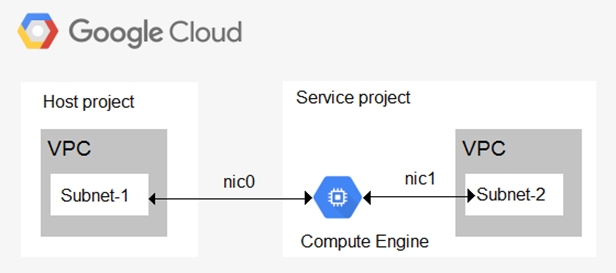
You have the following Shared VPC design. VPC Flow Logs is configured for Subnet-1 in the host VPC. You also want to monitor flow logs for Subnet-2. What should you do?

Exhibit 1 for question 169
  • AConfigure a VPC Flow Logs filter for Subnet-2 in the host project VPC.
  • BConfigure VPC Flow Logs in the service project VPC for Subnet-2. (correct answer)
  • CConfigure Packet Mirroring in both the host and service project VPCs.
  • DConfigure a firewall rule to permit Subnet-2 IP addresses outbound in the host project VPC.
Reveal answer & explanation
Correct answer: B

The correct answer is B. Option B: Configure VPC Flow Logs in the service project VPC for Subnet-2.

Explanation

A VPC provides a global, software-defined private network for your Google Cloud resources.

Topic 1 Β· Question 170 Β· Select all that apply

You are configuring your organization's Google Cloud environment to connect to your on-premises network, which does not support Border Gateway Protocol (BGP). Your on-premises network has 30 CIDR ranges that must be reachable from Google Cloud. Your VPN gateway creates a unique child security association (SA) per CIDR. You must ensure that the 30 CIDR ranges in your on-premises network are reachable from Google Cloud. Following Google-recommended practices, which two methods can you use to accomplish this? (Choose two.)

  • ACreate a single Cloud VPN tunnel that uses route-based VPN. (correct answer)
  • BCreate a single Cloud VPN tunnel that uses policy-based routing with 30 CIDRs as the remote traffic selectors.
  • CCreate multiple Cloud VPN tunnels that use policy-based routing so that each tunnel has one CIDR block for its local traffic selector and one CIDR block for its remote traffic selector. Connect each tunnel to unique peer IP addresses. (correct answer)
  • DCreate multiple Cloud VPN tunnels that use policy-based routing with 10 CIDR per tunnel as the remote traffic selectors.
  • ECreate multiple Cloud VPN tunnels that use policy-based routing so that each tunnel has one CIDR block for its local traffic selector and one CIDR block for its remote traffic selector. Connect each tunnel to the same peer IP address.
Reveal answer & explanation
Correct answer: A, C

The correct answer is A, C. Option A: Create a single Cloud VPN tunnel that uses route-based VPN. Option C: Create multiple Cloud VPN tunnels that use policy-based routing so that each tunnel has one CIDR block for its local traffic selector and one CIDR block for its remote traffic selector. Connect each tunnel to unique p...

Explanation

Cloud VPN provides encrypted IPsec connectivity between on premises and a VPC.
Topic 1 Β· Question 171

You have two VPCs: VPC A in Project A and VPC B in Project B. The VPCs are peered, and each VPC has VM instances in four zones. You are using the Network Intelligence Center Performance Dashboard to investigate the packet loss for traffic flows that start in VPC A and terminate in VPC B. You need the reported packet loss metric to have at least a 90% confidence level. What should you do?

  • AEnsure that each zone in each of the VPC networks has at least 10 compute instances. Look in Project A for the reported metric.
  • BEnsure that each zone in each of the VPC networks has at least 9 compute instances. Look in Project B for the reported metric.
  • CEnsure that each zone in each of the VPC networks has at least 9 compute instances. Look in Project A for the reported metric.
  • DEnsure that each zone in each of the VPC networks has at least 10 compute instances. Look in Project B for the reported metric. (correct answer)
Reveal answer & explanation
Correct answer: D

The correct answer is D. Option D: Ensure that each zone in each of the VPC networks has at least 10 compute instances. Look in Project B for the reported metric.

Explanation

A VPC provides a global, software-defined private network for your Google Cloud resources.

Topic 1 Β· Question 172

You are designing a new network infrastructure for your customer in Google Cloud. Your customer requires a connection between two Google Cloud VPCs that must include a VPN tunnel. You want to follow Google-recommended practices while ensuring maximum availability of the connection. Which VPN configuration should you choose?

  • APolicy-based VPN using Classic VPN between the two Google Cloud VPCs
  • BBorder Gateway Protocol (BGP)-based VPN using Classic VPN between the two Google Cloud VPCs
  • CRoute-based VPN using Classic VPN between the two Google Cloud VPCs
  • DBorder Gateway Protocol (BGP)-based VPN using HA VPN between the two Google Cloud VPCs (correct answer)
Reveal answer & explanation
Correct answer: D

The correct answer is D. Option D: Border Gateway Protocol (BGP)-based VPN using HA VPN between the two Google Cloud VPCs

Explanation

A VPC provides a global, software-defined private network for your Google Cloud resources.

Topic 1 Β· Question 173

Your company is moving to a hybrid cloud environment and needs to connect two on-premises data centers to Google Cloud. Your company has opted for no service level agreement (SLA) on the Dedicated Interconnect ports. You set up a single Dedicated Interconnect to connect each on-premises data center to Google Cloud: one Dedicated Interconnect in us-east1 and another Dedicated Interconnect in us-west1. You also configured a Cloud Router for each Dedicated Interconnect in each respective region. You now need to configure the Interconnect attachments to provide as much high availability diversity as possible based on this design. What should you do?

  • Aβ€’ Build one VLAN attachment from each Dedicated Interconnect corresponding to the Cloud Router in that region.β€’ Enable global routing at the VPC layer.
  • Bβ€’ Build one VLAN attachment from each Dedicated Interconnect corresponding to the Cloud Router in that region.β€’ Enable regional routing at the VPC layer.
  • Cβ€’ Build two VLAN attachments from each Dedicated Interconnect: one connecting to the Cloud Router in us-east1, and one connecting to the Cloud Router in us-west1.β€’ Enable regional routing at the VPC layer.
  • Dβ€’ Build two VLAN attachments from each Dedicated Interconnect: one connecting to the Cloud Router in us-east1, and one connecting to the Cloud Router in us-west1.β€’ Enable global routing at the VPC layer. (correct answer)
Reveal answer & explanation
Correct answer: D

The correct answer is D. Option D: β€’ Build two VLAN attachments from each Dedicated Interconnect: one connecting to the Cloud Router in us-east1, and one connecting to the Cloud Router in us-west1.β€’ Enable global routing at the VPC layer.

Explanation

Dedicated Interconnect provides a private physical connection into Google's network. A VPC provides a global, software-defined private network for your Google Cloud resources.

Topic 1 Β· Question 174

Your company runs an enterprise platform on-premises using virtual machines (VMs). Your internet customers have created tens of thousands of DNS domains pointing to your public IP addresses allocated to the VMs. Typically, your customers hard-code your IP addresses in their DNS records. You are now planning to migrate the platform to Compute Engine and you want to use Bring Your Own IP. You want to minimize disruption to the platform. What should you do?

  • ACreate a VPC and request static external IP addresses from Google Cloud. Assign the IP addresses to the Compute Engine instances. Notify your customers of the new IP addresses so they can update their DNS records.
  • BVerify ownership of your IP addresses. After the verification, Google Cloud advertises and provisions the IP prefix for you. Assign the IP addresses to the Compute Engine instances.
  • CCreate a VPC with the same IP address range as your on-premises network. Assign the IP addresses to the Compute Engine instances.
  • DVerify ownership of your IP addresses. Use live migration to import the prefix. Assign the IP addresses to the Compute Engine instances. (correct answer)
Reveal answer & explanation
Correct answer: D

The correct answer is D. Option D: Verify ownership of your IP addresses. Use live migration to import the prefix. Assign the IP addresses to the Compute Engine instances.

Explanation

Compute Engine provides configurable virtual machines when you need full control of the OS.

Topic 1 Β· Question 175

You need to create the technical architecture for hybrid connectivity from your data center to Google Cloud. This will be managed by a partner. You want to follow Google-recommended practices for production-level applications. What should you do?

  • AAsk the partner to install two security appliances in the data center. Configure one VPN connection from each of these devices to Google Cloud, and ensure that the VPN devices on-premises are in separate racks on separate power and cooling systems.
  • BConfigure two Partner Interconnect connections in one metropolitan area (metro). Make sure the Interconnect connections are placed in different metro edge availability domains. Configure two VLAN attachments in a single region, and configure regional dynamic routing on the VPC.
  • CConfigure two Partner Interconnect connections in one metro and two connections in another metro. Make sure the Interconnect connections are placed in different metro edge availability domains. Configure two VLAN attachments in one region and two VLAN attachments in another region, and configure global dynamic routing on the VPC. (correct answer)
  • DConfigure two Partner Interconnect connections in one metro and two connections in another metro. Make sure the Interconnect connections are placed in different metro edge availability domains. Configure two VLAN attachments in one region and two VLAN attachments in another region, and configure regional dynamic routing on the VPC.
Reveal answer & explanation
Correct answer: C

The correct answer is C. Option C: Configure two Partner Interconnect connections in one metro and two connections in another metro. Make sure the Interconnect connections are placed in different metro edge availability domains. Configure two VLAN atta...

Explanation

Partner Interconnect provides private connectivity to Google Cloud through a service provider. A VPC provides a global, software-defined private network for your Google Cloud resources.

Topic 1 Β· Question 176

You are deploying your infrastructure in the us-central1 region. Your on-premises data center is located in New York City, and the Google Cloud region closest to New York City is us-east4. Your Cloud Interconnect is located in Ashburn, Virginia (VA), United States. You need to use Cloud Interconnect to connect your application infrastructure with backend systems in your data center location. You do not expect the application bandwidth to exceed 500 Mbps. You want to minimize latency and cost. What should you do?

  • ACreate a Cloud Router and VLAN attachments in the us-east4 region attached to your physical Interconnect in Ashburn, VEnable global routing in your VPC. Set the bandwidth on the VLAN attachments to 500 Mbps.
  • BCreate a Cloud Router and VLAN attachments in the us-east4 region attached to your physical Interconnect in Ashburn, VA. Enable global routing in your VPC. (correct answer)
  • CCreate a Cloud Router in the us-central1 region and VLAN attachments in the us-east4 region attached to your physical Interconnect in Ashburn, VA. Enable global routing in your VPC.
  • DCreate a Cloud Router and VLAN attachments in the us-central1 region attached to your physical Interconnect in Ashburn, VA.
Reveal answer & explanation
Correct answer: B

The correct answer is B. Option B: Create a Cloud Router and VLAN attachments in the us-east4 region attached to your physical Interconnect in Ashburn, VA. Enable global routing in your VPC.

Explanation

A VPC provides a global, software-defined private network for your Google Cloud resources.

Topic 1 Β· Question 177 Β· Select all that apply

You have provisioned a Cloud Interconnect connection with a VLAN attachment. You configured Border Gateway Protocol (BGP) between your on-premises router and your Cloud Router. After deploying and testing the connection, you discover that the BGP session is not established between your on-premises router and the Cloud Router. Which two actions should you take to resolve this issue? (Choose two.)

  • AFrom the Google Cloud console, run gcloud compute routers get-status to verify the Address Resolution Protocol (ARP) learned.
  • BVerify that you have configured the on-premises router's subinterface with a subnet mask of /31. (correct answer)
  • CVerify that you have configured the on-premises router's eBGP multihop with a minimum hop length of 4.
  • DVerify that you have configured the on-premises router's BGP security parameters to use MD5 authentication.
  • EFrom the Google Cloud console, run gcloud compute interconnects get-diagnostics to verify the Address Resolution Protocol (ARP) learned. (correct answer)
Reveal answer & explanation
Correct answer: B, E

The correct answer is B, E. Option B: Verify that you have configured the on-premises router's subinterface with a subnet mask of /31. Option E: From the Google Cloud console, run gcloud compute interconnects get-diagnostics to verify the Address Resolution Protocol (ARP) learned.

Topic 1 Β· Question 178

Your company has a single on-premises data center that needs to be connected to a VPC in Google Cloud. The total bandwidth requirement is 10Gbps. The connection must be redundant and have a minimum SLA of 99.9%. Due to the sensitive nature of the workloads, you need to implement the solution with the lowest latency. What should you do?

  • AOrder a 10Gbps Partner Interconnect VLAN attachment. Create a Cloud Router in your Google Cloud VPC.
  • BOrder two 10Gbps Dedicated Interconnect connections in a single metropolitan area (metro). Distribute the connections across different edge availability domains. Create a Cloud Router and two 10Gbps VLAN attachments. (correct answer)
  • CCreate one HA VPN gateway. Create two tunnels-one tunnel for each of the two interfaces of the HA VPN gateway. Terminate each of the two tunnels on the single public IP address that is configured on the VPN termination device that is located on-premises.
  • DCreate one HA VPN gateway. Create two tunnels-one tunnel for each of the two interfaces of the HA VPN gateway. Terminate each of the two tunnels on different public IPs addresses that are configured on the VPN termination device that is located on-premises.
Reveal answer & explanation
Correct answer: B

The correct answer is B. Option B: Order two 10Gbps Dedicated Interconnect connections in a single metropolitan area (metro). Distribute the connections across different edge availability domains. Create a Cloud Router and two 10Gbps VLAN attachments.

Explanation

Dedicated Interconnect provides a private physical connection into Google's network.

Topic 1 Β· Question 179

Your company deployed a hub and spoke architecture in Google Cloud to host their workloads. They use VPC network peerings to connect the hub and the spokes. You need to replicate the design and use Network Connectivity Center. What should you do?

  • AChoose a Network Connectivity Center star topology. Deploy the hub VPC in the center group. Deploy the spoke VPCs in the edge group. (correct answer)
  • BChoose a Network Connectivity Center star topology. Deploy the spoke VPCs in the center group. Deploy the hub VPC in the edge group.
  • CChoose a Network Connectivity Center mesh topology. Configure the hub and the spokes as Network Connectivity Center spokes.
  • DChoose a Network Connectivity Center mesh topology. Configure the spokes as Network Connectivity Center spokes.
Reveal answer & explanation
Correct answer: A

The correct answer is A. Option A: Choose a Network Connectivity Center star topology. Deploy the hub VPC in the center group. Deploy the spoke VPCs in the edge group.

Explanation

Network Connectivity Center centrally connects VPCs and on-premises sites at scale. A VPC provides a global, software-defined private network for your Google Cloud resources.

Topic 1 Β· Question 180

You are deploying HA VPN within Google Cloud. You need to exchange routes dynamically between your on-premises gateway and Google Cloud. You have already created a HA VPN gateway and a peer VPN gateway resource. What should you do?

  • ACreate a Cloud Router, add VPN tunnels, and configure BGP sessions. (correct answer)
  • BCreate a Cloud Router, add VPN tunnels, and configure static routes to your subnet ranges.
  • CCreate a second HA VPN gateway, add VPN tunnels, and create firewall rules to allow BGP traffic to the Cloud Router.
  • DCreate a second HA VPN gateway, add VPN tunnels, and enable global dynamic routing.
Reveal answer & explanation
Correct answer: A

The correct answer is A. Option A: Create a Cloud Router, add VPN tunnels, and configure BGP sessions.

Topic 1 Β· Question 181

You are implementing a VPC architecture for your organization by using a Network Connectivity Center hub and spoke topology: β€’ There is one Network Connectivity Center hybrid spoke to receive on-premises routes. β€’ There is one VPC spoke that needs to be added as a Network Connectivity Center spoke. Your organization has limited routable IP space for their cloud environment (192.168.0.0/20). The Network Connectivity Center spoke VPC is connected to on-premises with a Cloud Interconnect connection in the us-east4 region. The on-premises IP range is 172.16.0.0/16. You need to reach on-premises resources from multiple Google Cloud regions (us-west1,europe-central1, and asia-southeast1) and minimize the IP addresses being used. What should you do?

  • A1. Configure a Private NAT gateway and NAT subnet in us-west1(192.168.1.0/24), europe-central1(192.168.2.0/24) and asia-southeast1(192.168.3.0/24).2. Add the VPC as a spoke and configure an export include policy to advertise only 192.168.1.0/24, 192.168.2.0/24, and 192.168.3.0/24 to the hub.3. Enable global dynamic routing to allow resources in us-west1, us-central1 and asia-southeast1 to reach the on-premises location through us-east4. (correct answer)
  • B1. Configure a Private NAT gateway instance in us-west1(172.16.1.0/24), europe-central1(172.16.2.0/24), and asia-southeast1(172.16.3.0/24).2. Add the VPC as a spoke and configure an export include policy on the VPC spoke to advertise only the NAT subnets 172.16.1.0/24, 172.16.2.0/24, and 172.16.3.0/24 to the hub.3. Enable global dynamic to allow resources in us-west1, us-central1, and asia-southeast1 to reach the on-premises location through us-east4.
  • C1. Configure a Private NAT gateway instance in us-east4(192.168.1.0/24).2. Add the VPC as a spoke and configure an export include policy on the VPC spoke to advertise 192.168.1.0/24 to the hub.3. Enable global dynamic routing to allow resources in us-west1, us-central1 and asia-southeast1 to reach the on-premises location through us-east4.
  • D1. Configure a Private NAT gateway instance in us-west1(192.168.1.0/24), europe-central1(192.168.2.0/24), and asia-southeast1(192.168.3.0/24).2. Add the VPC as a spoke and configure an export exclude policy on the VPC spoke to advertise only the NAT subnets 192.168.1.0/24, 192.168.2.0/24, and 192.168.3.0/24 to the hub.3. Enable global dynamic routing to allow resources in us-west1, us-central1, and asia-southeast1 to reach the on-premises location through us-east4.
Reveal answer & explanation
Correct answer: A

The correct answer is A. Option A: 1. Configure a Private NAT gateway and NAT subnet in us-west1(192.168.1.0/24), europe-central1(192.168.2.0/24) and asia-southeast1(192.168.3.0/24).2. Add the VPC as a spoke and configure an export include policy to ad...

Explanation

A VPC provides a global, software-defined private network for your Google Cloud resources.

Showing questions 161–180 of 255 Β· Page 9 of 13