
πŸ”

PDE β€” questions

Page 11 of 18 Β· 341 total questions.

Topic 1 Β· Question 201

You need to migrate a Redis database from an on-premises data center to a Memorystore for Redis instance. You want to follow Google-recommended practices and perform the migration for minimal cost, time and effort. What should you do?

  • AMake an RDB backup of the Redis database, use the gsutil utility to copy the RDB file into a Cloud Storage bucket, and then import the RDB file into the Memorystore for Redis instance. (correct answer)
  • BMake a secondary instance of the Redis database on a Compute Engine instance and then perform a live cutover.
  • CCreate a Dataflow job to read the Redis database from the on-premises data center and write the data to a Memorystore for Redis instance.
  • DWrite a shell script to migrate the Redis data and create a new Memorystore for Redis instance.
Reveal answer & explanation
Correct answer: A

The correct answer is A. Option A: Make an RDB backup of the Redis database, use the gsutil utility to copy the RDB file into a Cloud Storage bucket, and then import the RDB file into the Memorystore for Redis instance.

Explanation

Cloud Storage provides durable, scalable object storage that is fully managed. Memorystore provides managed in-memory Redis/Memcached caching to reduce latency and offload databases.
Topic 1 Β· Question 202

Your platform on your on-premises environment generates 100 GB of data daily, composed of millions of structured JSON text files. Your on-premises environment cannot be accessed from the public internet. You want to use Google Cloud products to query and explore the platform data. What should you do?

  • AUse Cloud Scheduler to copy data daily from your on-premises environment to Cloud Storage. Use the BigQuery Data Transfer Service to import data into BigQuery.
  • BUse a Transfer Appliance to copy data from your on-premises environment to Cloud Storage. Use the BigQuery Data Transfer Service to import data into BigQuery.
  • CUse Transfer Service for on-premises data to copy data from your on-premises environment to Cloud Storage. Use the BigQuery Data Transfer Service to import data into BigQuery. (correct answer)
  • DUse the BigQuery Data Transfer Service dataset copy to transfer all data into BigQuery.
Reveal answer & explanation
Correct answer: C

The correct answer is C. Option C: Use Transfer Service for on-premises data to copy data from your on-premises environment to Cloud Storage. Use the BigQuery Data Transfer Service to import data into BigQuery.

Explanation

Cloud Storage provides durable, scalable object storage that is fully managed. BigQuery is a serverless, petabyte-scale data warehouse for fast SQL analytics with no infrastructure to manage. BigQuery Data Transfer Service automates loading data into BigQuery on a schedule.

Topic 1 Β· Question 203

A TensorFlow machine learning model on Compute Engine virtual machines (n2-standard-32) takes two days to complete training. The model has custom TensorFlow operations that must run partially on a CPU. You want to reduce the training time in a cost-effective manner. What should you do?

  • AChange the VM type to n2-highmem-32.
  • BChange the VM type to e2-standard-32.
  • CTrain the model using a VM with a GPU hardware accelerator. (correct answer)
  • DTrain the model using a VM with a TPU hardware accelerator.
Reveal answer & explanation
Correct answer: C

The correct answer is C. Option C: Train the model using a VM with a GPU hardware accelerator. This option delivers the requirement at the lowest cost.

Topic 1 Β· Question 204

You want to create a machine learning model using BigQuery ML and create an endpoint for hosting the model using Vertex AI. This will enable the processing of continuous streaming data in near-real time from multiple vendors. The data may contain invalid values. What should you do?

  • ACreate a new BigQuery dataset and use streaming inserts to land the data from multiple vendors. Configure your BigQuery ML model to use the "ingestion" dataset as the framing data.
  • BUse BigQuery streaming inserts to land the data from multiple vendors where your BigQuery dataset ML model is deployed.
  • CCreate a Pub/Sub topic and send all vendor data to it. Connect a Cloud Function to the topic to process the data and store it in BigQuery.
  • DCreate a Pub/Sub topic and send all vendor data to it. Use Dataflow to process and sanitize the Pub/Sub data and stream it to BigQuery. (correct answer)
Reveal answer & explanation
Correct answer: D

The correct answer is D. Option D: Create a Pub/Sub topic and send all vendor data to it. Use Dataflow to process and sanitize the Pub/Sub data and stream it to BigQuery.

Explanation

BigQuery is a serverless, petabyte-scale data warehouse for fast SQL analytics with no infrastructure to manage. Dataflow runs serverless Apache Beam pipelines for stream and batch data processing with autoscaling. Pub/Sub is a serverless, global messaging service that decouples services and ingests high-volume event streams. This option meets the real-time / low-latency performance requirement.

Topic 1 Β· Question 205

You have a data processing application that runs on Google Kubernetes Engine (GKE). Containers need to be launched with their latest available configurations from a container registry. Your GKE nodes need to have GPUs, local SSDs, and 8 Gbps bandwidth. You want to efficiently provision the data processing infrastructure and manage the deployment process. What should you do?

  • AUse Compute Engine startup scripts to pull container images, and use gcloud commands to provision the infrastructure.
  • BUse Cloud Build to schedule a job using Terraform build to provision the infrastructure and launch with the most current container images. (correct answer)
  • CUse GKE to autoscale containers, and use gcloud commands to provision the infrastructure.
  • DUse Dataflow to provision the data pipeline, and use Cloud Scheduler to run the job.
Reveal answer & explanation
Correct answer: B

The correct answer is B. Option B: Use Cloud Build to schedule a job using Terraform build to provision the infrastructure and launch with the most current container images.

Explanation

Cloud Build runs managed CI pipelines to build, test, and package code. Terraform provisions Google Cloud infrastructure as code repeatably.

Topic 1 Β· Question 206

You need ads data to serve AI models and historical data for analytics. Longtail and outlier data points need to be identified. You want to cleanse the data in near-real time before running it through AI models. What should you do?

  • AUse Cloud Storage as a data warehouse, shell scripts for processing, and BigQuery to create views for desired datasets.
  • BUse Dataflow to identify longtail and outlier data points programmatically, with BigQuery as a sink. (correct answer)
  • CUse BigQuery to ingest, prepare, and then analyze the data, and then run queries to create views.
  • DUse Cloud Composer to identify longtail and outlier data points, and then output a usable dataset to BigQuery.
Reveal answer & explanation
Correct answer: B

The correct answer is B. Option B: Use Dataflow to identify longtail and outlier data points programmatically, with BigQuery as a sink.

Explanation

BigQuery is a serverless, petabyte-scale data warehouse for fast SQL analytics with no infrastructure to manage. Dataflow runs serverless Apache Beam pipelines for stream and batch data processing with autoscaling. This option meets the real-time / low-latency performance requirement.

Topic 1 Β· Question 207

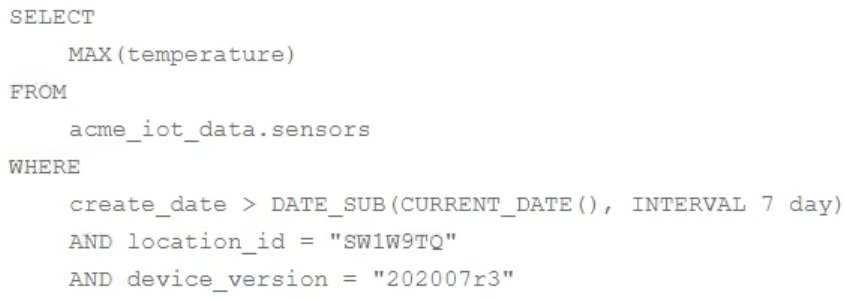
You are collecting IoT sensor data from millions of devices across the world and storing the data in BigQuery. Your access pattern is based on recent data, filtered by location_id and device_version with the following query: You want to optimize your queries for cost and performance. How should you structure your data?

Exhibit 1 for question 207
  • APartition table data by create_date, location_id, and device_version.
  • BPartition table data by create_date, cluster table data by location_id, and device_version. (correct answer)
  • CCluster table data by create_date, location_id, and device_version.
  • DCluster table data by create_date, partition by location_id, and device_version.
Reveal answer & explanation
Correct answer: B

The correct answer is B. Option B: Partition table data by create_date, cluster table data by location_id, and device_version.

Topic 1 Β· Question 208

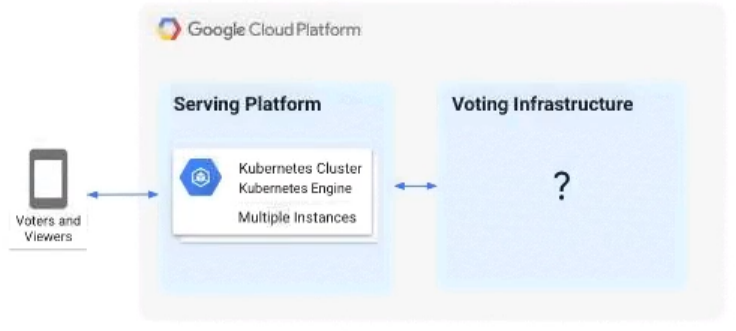
A live TV show asks viewers to cast votes using their mobile phones. The event generates a large volume of data during a 3-minute period. You are in charge of the "Voting infrastructure" and must ensure that the platform can handle the load and that all votes are processed. You must display partial results while voting is open. After voting closes, you need to count the votes exactly once while optimizing cost. What should you do?

Exhibit 1 for question 208
  • ACreate a Memorystore instance with a high availability (HA) configuration.
  • BCreate a Cloud SQL for PostgreSQL database with high availability (HA) configuration and multiple read replicas.
  • CWrite votes to a Pub/Sub topic and have Cloud Functions subscribe to it and write votes to BigQuery.
  • DWrite votes to a Pub/Sub topic and load into both Bigtable and BigQuery via a Dataflow pipeline. Query Bigtable for real-time results and BigQuery for later analysis. Shut down the Bigtable instance when voting concludes. (correct answer)
Reveal answer & explanation
Correct answer: D

The correct answer is D. Option D: Write votes to a Pub/Sub topic and load into both Bigtable and BigQuery via a Dataflow pipeline. Query Bigtable for real-time results and BigQuery for later analysis. Shut down the Bigtable instance when voting conclu...

Explanation

Cloud Bigtable is a managed, low-latency NoSQL wide-column store for very high-throughput workloads. BigQuery is a serverless, petabyte-scale data warehouse for fast SQL analytics with no infrastructure to manage. Dataflow runs serverless Apache Beam pipelines for stream and batch data processing with autoscaling.

Topic 1 Β· Question 209

A shipping company has live package-tracking data that is sent to an Apache Kafka stream in real time. This is then loaded into BigQuery. Analysts in your company want to query the tracking data in BigQuery to analyze geospatial trends in the lifecycle of a package. The table was originally created with ingest-date partitioning. Over time, the query processing time has increased. You need to copy all the data to a new clustered table. What should you do?

  • ARe-create the table using data partitioning on the package delivery date.
  • BImplement clustering in BigQuery on the package-tracking ID column. (correct answer)
  • CImplement clustering in BigQuery on the ingest date column.
  • DTier older data onto Cloud Storage files and create a BigQuery table using Cloud Storage as an external data source.
Reveal answer & explanation
Correct answer: B

The correct answer is B. Option B: Implement clustering in BigQuery on the package-tracking ID column.

Explanation

BigQuery is a serverless, petabyte-scale data warehouse for fast SQL analytics with no infrastructure to manage. This option meets the real-time / low-latency performance requirement.

Topic 1 Β· Question 210

You are designing a data mesh on Google Cloud with multiple distinct data engineering teams building data products. The typical data curation design pattern consists of landing files in Cloud Storage, transforming raw data in Cloud Storage and BigQuery datasets, and storing the final curated data product in BigQuery datasets. You need to configure Dataplex to ensure that each team can access only the assets needed to build their data products. You also need to ensure that teams can easily share the curated data product. What should you do?

  • A1. Create a single Dataplex virtual lake and create a single zone to contain landing, raw, and curated data.2. Provide each data engineering team access to the virtual lake.
  • B1. Create a single Dataplex virtual lake and create a single zone to contain landing, raw, and curated data.2. Build separate assets for each data product within the zone.3. Assign permissions to the data engineering teams at the zone level.
  • C1. Create a Dataplex virtual lake for each data product, and create a single zone to contain landing, raw, and curated data.2. Provide the data engineering teams with full access to the virtual lake assigned to their data product.
  • D1. Create a Dataplex virtual lake for each data product, and create multiple zones for landing, raw, and curated data.2. Provide the data engineering teams with full access to the virtual lake assigned to their data product. (correct answer)
Reveal answer & explanation
Correct answer: D

The correct answer is D. Option D: 1. Create a Dataplex virtual lake for each data product, and create multiple zones for landing, raw, and curated data.2. Provide the data engineering teams with full access to the virtual lake assigned to their data p...

Explanation

Dataplex centrally manages, governs, and organizes data across a data lakehouse.

Topic 1 Β· Question 211

You are using BigQuery with a multi-region dataset that includes a table with the daily sales volumes. This table is updated multiple times per day. You need to protect your sales table in case of regional failures with a recovery point objective (RPO) of less than 24 hours, while keeping costs to a minimum. What should you do?

  • ASchedule a daily export of the table to a Cloud Storage dual or multi-region bucket. (correct answer)
  • BSchedule a daily copy of the dataset to a backup region.
  • CSchedule a daily BigQuery snapshot of the table.
  • DModify ETL job to load the data into both the current and another backup region.
Reveal answer & explanation
Correct answer: A

The correct answer is A. Option A: Schedule a daily export of the table to a Cloud Storage dual or multi-region bucket.

Explanation

Cloud Storage provides durable, scalable object storage that is fully managed.

Topic 1 Β· Question 212

You are troubleshooting your Dataflow pipeline that processes data from Cloud Storage to BigQuery. You have discovered that the Dataflow worker nodes cannot communicate with one another. Your networking team relies on Google Cloud network tags to define firewall rules. You need to identify the issue while following Google-recommended networking security practices. What should you do?

  • ADetermine whether your Dataflow pipeline has a custom network tag set.
  • BDetermine whether there is a firewall rule set to allow traffic on TCP ports 12345 and 12346 for the Dataflow network tag. (correct answer)
  • CDetermine whether there is a firewall rule set to allow traffic on TCP ports 12345 and 12346 on the subnet used by Dataflow workers.
  • DDetermine whether your Dataflow pipeline is deployed with the external IP address option enabled.
Reveal answer & explanation
Correct answer: B

The correct answer is B. Option B: Determine whether there is a firewall rule set to allow traffic on TCP ports 12345 and 12346 for the Dataflow network tag.

Explanation

Dataflow runs serverless Apache Beam pipelines for stream and batch data processing with autoscaling.

Topic 1 Β· Question 213

Your company's customer_order table in BigQuery stores the order history for 10 million customers, with a table size of 10 PB. You need to create a dashboard for the support team to view the order history. The dashboard has two filters, country_name and username. Both are string data types in the BigQuery table. When a filter is applied, the dashboard fetches the order history from the table and displays the query results. However, the dashboard is slow to show the results when applying the filters to the following query: How should you redesign the BigQuery table to support faster access?

Exhibit 1 for question 213
  • ACluster the table by country and username fields. (correct answer)
  • BCluster the table by country field, and partition by username field.
  • CPartition the table by country and username fields.
  • DPartition the table by _PARTITIONTIME.
Reveal answer & explanation
Correct answer: A

The correct answer is A. Option A: Cluster the table by country and username fields.

Topic 1 Β· Question 214

You have a Standard Tier Memorystore for Redis instance deployed in a production environment. You need to simulate a Redis instance failover in the most accurate disaster recovery situation, and ensure that the failover has no impact on production data. What should you do?

  • ACreate a Standard Tier Memorystore for Redis instance in the development environment. Initiate a manual failover by using the limited-data-loss data protection mode.
  • BCreate a Standard Tier Memorystore for Redis instance in a development environment. Initiate a manual failover by using the force-data-loss data protection mode. (correct answer)
  • CIncrease one replica to Redis instance in production environment. Initiate a manual failover by using the force-data-loss data protection mode.
  • DInitiate a manual failover by using the limited-data-loss data protection mode to the Memorystore for Redis instance in the production environment.
Reveal answer & explanation
Correct answer: B

The correct answer is B. Option B: Create a Standard Tier Memorystore for Redis instance in a development environment. Initiate a manual failover by using the force-data-loss data protection mode.

Explanation

Memorystore provides managed in-memory Redis/Memcached caching to reduce latency and offload databases. By spanning multiple Availability Zones / adding redundancy, this option provides the high availability and resilience required.

Topic 1 Β· Question 215

You are administering a BigQuery dataset that uses a customer-managed encryption key (CMEK). You need to share the dataset with a partner organization that does not have access to your CMEK. What should you do?

  • AProvide the partner organization a copy of your CMEKs to decrypt the data.
  • BExport the tables to parquet files to a Cloud Storage bucket and grant the storageinsights.viewer role on the bucket to the partner organization.
  • CCopy the tables you need to share to a dataset without CMEKs. Create an Analytics Hub listing for this dataset. (correct answer)
  • DCreate an authorized view that contains the CMEK to decrypt the data when accessed.
Reveal answer & explanation
Correct answer: C

The correct answer is C. Option C: Copy the tables you need to share to a dataset without CMEKs. Create an Analytics Hub listing for this dataset.

Topic 1 Β· Question 216

You are developing an Apache Beam pipeline to extract data from a Cloud SQL instance by using JdbcIO. You have two projects running in Google Cloud. The pipeline will be deployed and executed on Dataflow in Project A. The Cloud SQL. instance is running in Project B and does not have a public IP address. After deploying the pipeline, you noticed that the pipeline failed to extract data from the Cloud SQL instance due to connection failure. You verified that VPC Service Controls and shared VPC are not in use in these projects. You want to resolve this error while ensuring that the data does not go through the public internet. What should you do?

  • ASet up VPC Network Peering between Project A and Project B. Add a firewall rule to allow the peered subnet range to access all instances on the network. (correct answer)
  • BTurn off the external IP addresses on the Dataflow worker. Enable Cloud NAT in Project A.
  • CAdd the external IP addresses of the Dataflow worker as authorized networks in the Cloud SQL instance.
  • DSet up VPC Network Peering between Project A and Project B. Create a Compute Engine instance without external IP address in Project B on the peered subnet to serve as a proxy server to the Cloud SQL database.
Reveal answer & explanation
Correct answer: A

The correct answer is A. Option A: Set up VPC Network Peering between Project A and Project B. Add a firewall rule to allow the peered subnet range to access all instances on the network.

Explanation

A VPC provides a global, software-defined private network for your Google Cloud resources.

Topic 1 Β· Question 217

You have a BigQuery table that contains customer data, including sensitive information such as names and addresses. You need to share the customer data with your data analytics and consumer support teams securely. The data analytics team needs to access the data of all the customers, but must not be able to access the sensitive data. The consumer support team needs access to all data columns, but must not be able to access customers that no longer have active contracts. You enforced these requirements by using an authorized dataset and policy tags. After implementing these steps, the data analytics team reports that they still have access to the sensitive columns. You need to ensure that the data analytics team does not have access to restricted data. What should you do? (Choose two.)

  • ACreate two separate authorized datasets; one for the data analytics team and another for the consumer support team.
  • BEnsure that the data analytics team members do not have the Data Catalog Fine-Grained Reader role for the policy tags. (correct answer)
  • CReplace the authorized dataset with an authorized view. Use row-level security and apply filter_expression to limit data access.
  • DRemove the bigquery.dataViewer role from the data analytics team on the authorized datasets.
  • EEnforce access control in the policy tag taxonomy.
Reveal answer & explanation
Correct answer: B

The correct answer is B. Option B: Ensure that the data analytics team members do not have the Data Catalog Fine-Grained Reader role for the policy tags.

Explanation

Data Catalog provides metadata management and discovery across data assets.

Topic 1 Β· Question 218

You have a Cloud SQL for PostgreSQL instance in Region’ with one read replica in Region2 and another read replica in Region3. An unexpected event in Region’ requires that you perform disaster recovery by promoting a read replica in Region2. You need to ensure that your application has the same database capacity available before you switch over the connections. What should you do?

  • AEnable zonal high availability on the primary instance. Create a new read replica in a new region.
  • BCreate a cascading read replica from the existing read replica in Region3.
  • CCreate two new read replicas from the new primary instance, one in Region3 and one in a new region. (correct answer)
  • DCreate a new read replica in Region1, promote the new read replica to be the primary instance, and enable zonal high availability.
Reveal answer & explanation
Correct answer: C

The correct answer is C. Option C: Create two new read replicas from the new primary instance, one in Region3 and one in a new region. By spanning multiple Availability Zones / adding redundancy, this option provides the high availability and resilience required.

Topic 1 Β· Question 219

You orchestrate ETL pipelines by using Cloud Composer. One of the tasks in the Apache Airflow directed acyclic graph (DAG) relies on a third-party service. You want to be notified when the task does not succeed. What should you do?

  • AAssign a function with notification logic to the on_retry_callback parameter for the operator responsible for the task at risk.
  • BConfigure a Cloud Monitoring alert on the sla_missed metric associated with the task at risk to trigger a notification.
  • CAssign a function with notification logic to the on_failure_callback parameter tor the operator responsible for the task at risk. (correct answer)
  • DAssign a function with notification logic to the sla_miss_callback parameter for the operator responsible for the task at risk.
Reveal answer & explanation
Correct answer: C

The correct answer is C. Option C: Assign a function with notification logic to the on_failure_callback parameter tor the operator responsible for the task at risk.

Topic 1 Β· Question 220

You are migrating your on-premises data warehouse to BigQuery. One of the upstream data sources resides on a MySQL. database that runs in your on-premises data center with no public IP addresses. You want to ensure that the data ingestion into BigQuery is done securely and does not go through the public internet. What should you do?

  • AUpdate your existing on-premises ETL tool to write to BigQuery by using the BigQuery Open Database Connectivity (ODBC) driver. Set up the proxy parameter in the simba.googlebigqueryodbc.ini file to point to your data center’s NAT gateway.
  • BUse Datastream to replicate data from your on-premises MySQL database to BigQuery. Set up Cloud Interconnect between your on-premises data center and Google Cloud. Use Private connectivity as the connectivity method and allocate an IP address range within your VPC network to the Datastream connectivity configuration. Use Server-only as the encryption type when setting up the connection profile in Datastream. (correct answer)
  • CUse Datastream to replicate data from your on-premises MySQL database to BigQuery. Use Forward-SSH tunnel as the connectivity method to establish a secure tunnel between Datastream and your on-premises MySQL database through a tunnel server in your on-premises data center. Use None as the encryption type when setting up the connection profile in Datastream.
  • DUse Datastream to replicate data from your on-premises MySQL database to BigQuery. Gather Datastream public IP addresses of the Google Cloud region that will be used to set up the stream. Add those IP addresses to the firewall allowlist of your on-premises data center. Use IP Allowlisting as the connectivity method and Server-only as the encryption type when setting up the connection profile in Datastream.
Reveal answer & explanation
Correct answer: B

The correct answer is B. Option B: Use Datastream to replicate data from your on-premises MySQL database to BigQuery. Set up Cloud Interconnect between your on-premises data center and Google Cloud. Use Private connectivity as the connectivity method a...

Explanation

BigQuery is a serverless, petabyte-scale data warehouse for fast SQL analytics with no infrastructure to manage. Cloud Interconnect provides a dedicated, private, high-bandwidth link between on premises and Google Cloud. A VPC provides a global, software-defined private network for your Google Cloud resources.

Showing questions 201–220 of 341 Β· Page 11 of 18