
πŸ”

PDE β€” questions

Page 13 of 18 Β· 341 total questions.

Topic 1 Β· Question 241

You are designing the architecture of your application to store data in Cloud Storage. Your application consists of pipelines that read data from a Cloud Storage bucket that contains raw data, and write the data to a second bucket after processing. You want to design an architecture with Cloud Storage resources that are capable of being resilient if a Google Cloud regional failure occurs. You want to minimize the recovery point objective (RPO) if a failure occurs, with no impact on applications that use the stored data. What should you do?

  • AAdopt multi-regional Cloud Storage buckets in your architecture.
  • BAdopt two regional Cloud Storage buckets, and update your application to write the output on both buckets.
  • CAdopt a dual-region Cloud Storage bucket, and enable turbo replication in your architecture. (correct answer)
  • DAdopt two regional Cloud Storage buckets, and create a daily task to copy from one bucket to the other.
Reveal answer & explanation
Correct answer: C

The correct answer is C. Option C: Adopt a dual-region Cloud Storage bucket, and enable turbo replication in your architecture.

Explanation

Cloud Storage provides durable, scalable object storage that is fully managed. By spanning multiple Availability Zones / adding redundancy, this option provides the high availability and resilience required.
Topic 1 Β· Question 242

You have designed an Apache Beam processing pipeline that reads from a Pub/Sub topic. The topic has a message retention duration of one day, and writes to a Cloud Storage bucket. You need to select a bucket location and processing strategy to prevent data loss in case of a regional outage with an RPO of 15 minutes. What should you do?

  • A1. Use a dual-region Cloud Storage bucket.2. Monitor Dataflow metrics with Cloud Monitoring to determine when an outage occurs.3. Seek the subscription back in time by 15 minutes to recover the acknowledged messages.4. Start the Dataflow job in a secondary region.
  • B1. Use a multi-regional Cloud Storage bucket.2. Monitor Dataflow metrics with Cloud Monitoring to determine when an outage occurs.3. Seek the subscription back in time by 60 minutes to recover the acknowledged messages.4. Start the Dataflow job in a secondary region.
  • C1. Use a regional Cloud Storage bucket.2. Monitor Dataflow metrics with Cloud Monitoring to determine when an outage occurs.3. Seek the subscription back in time by one day to recover the acknowledged messages.4. Start the Dataflow job in a secondary region and write in a bucket in the same region.
  • D1. Use a dual-region Cloud Storage bucket with turbo replication enabled.2. Monitor Dataflow metrics with Cloud Monitoring to determine when an outage occurs.3. Seek the subscription back in time by 60 minutes to recover the acknowledged messages.4. Start the Dataflow job in a secondary region. (correct answer)
Reveal answer & explanation
Correct answer: D

The correct answer is D. Option D: 1. Use a dual-region Cloud Storage bucket with turbo replication enabled.2. Monitor Dataflow metrics with Cloud Monitoring to determine when an outage occurs.3. Seek the subscription back in time by 60 minutes to reco...

Explanation

Cloud Storage provides durable, scalable object storage that is fully managed. Dataflow runs serverless Apache Beam pipelines for stream and batch data processing with autoscaling. Cloud Monitoring collects metrics, dashboards, and alerts to observe system health.

Topic 1 Β· Question 244

Different teams in your organization store customer and performance data in BigQuery. Each team needs to keep full control of their collected data, be able to query data within their projects, and be able to exchange their data with other teams. You need to implement an organization-wide solution, while minimizing operational tasks and costs. What should you do?

  • AAsk each team to create authorized views of their data. Grant the biquery.jobUser role to each team.
  • BCreate a BigQuery scheduled query to replicate all customer data into team projects.
  • CAsk each team to publish their data in Analytics Hub. Direct the other teams to subscribe to them. (correct answer)
  • DEnable each team to create materialized views of the data they need to access in their projects.
Reveal answer & explanation
Correct answer: C

The correct answer is C. Option C: Ask each team to publish their data in Analytics Hub. Direct the other teams to subscribe to them.

Topic 1 Β· Question 245

You are developing a model to identify the factors that lead to sales conversions for your customers. You have completed processing your data. You want to continue through the model development lifecycle. What should you do next?

  • AUse your model to run predictions on fresh customer input data.
  • BMonitor your model performance, and make any adjustments needed.
  • CDelineate what data will be used for testing and what will be used for training the model. (correct answer)
  • DTest and evaluate your model on your curated data to determine how well the model performs.
Reveal answer & explanation
Correct answer: C

The correct answer is C. Option C: Delineate what data will be used for testing and what will be used for training the model.

Topic 1 Β· Question 246

You have one BigQuery dataset which includes customers’ street addresses. You want to retrieve all occurrences of street addresses from the dataset. What should you do?

  • AWrite a SQL query in BigQuery by using REGEXP_CONTAINS on all tables in your dataset to find rows where the word β€œstreet” appears.
  • BCreate a deep inspection job on each table in your dataset with Cloud Data Loss Prevention and create an inspection template that includes the STREET_ADDRESS infoType. (correct answer)
  • CCreate a discovery scan configuration on your organization with Cloud Data Loss Prevention and create an inspection template that includes the STREET_ADDRESS infoType.
  • DCreate a de-identification job in Cloud Data Loss Prevention and use the masking transformation.
Reveal answer & explanation
Correct answer: B

The correct answer is B. Option B: Create a deep inspection job on each table in your dataset with Cloud Data Loss Prevention and create an inspection template that includes the STREET_ADDRESS infoType.

Topic 1 Β· Question 247

Your company operates in three domains: airlines, hotels, and ride-hailing services. Each domain has two teams: analytics and data science, which create data assets in BigQuery with the help of a central data platform team. However, as each domain is evolving rapidly, the central data platform team is becoming a bottleneck. This is causing delays in deriving insights from data, and resulting in stale data when pipelines are not kept up to date. You need to design a data mesh architecture by using Dataplex to eliminate the bottleneck. What should you do?

  • A1. Create one lake for each team. Inside each lake, create one zone for each domain.2. Attach each of the BigQuery datasets created by the individual teams as assets to the respective zone.3. Have the central data platform team manage all zones’ data assets.
  • B1. Create one lake for each team. Inside each lake, create one zone for each domain.2. Attach each of the BigQuery datasets created by the individual teams as assets to the respective zone.3. Direct each domain to manage their own zone’s data assets.
  • C1. Create one lake for each domain. Inside each lake, create one zone for each team.2. Attach each of the BigQuery datasets created by the individual teams as assets to the respective zone.3. Direct each domain to manage their own lake’s data assets. (correct answer)
  • D1. Create one lake for each domain. Inside each lake, create one zone for each team.2. Attach each of the BigQuery datasets created by the individual teams as assets to the respective zone.3. Have the central data platform team manage all lakes’ data assets.
Reveal answer & explanation
Correct answer: C

The correct answer is C. Option C: 1. Create one lake for each domain. Inside each lake, create one zone for each team.2. Attach each of the BigQuery datasets created by the individual teams as assets to the respective zone.3. Direct each domain to man...

Explanation

BigQuery is a serverless, petabyte-scale data warehouse for fast SQL analytics with no infrastructure to manage.

Topic 1 Β· Question 248

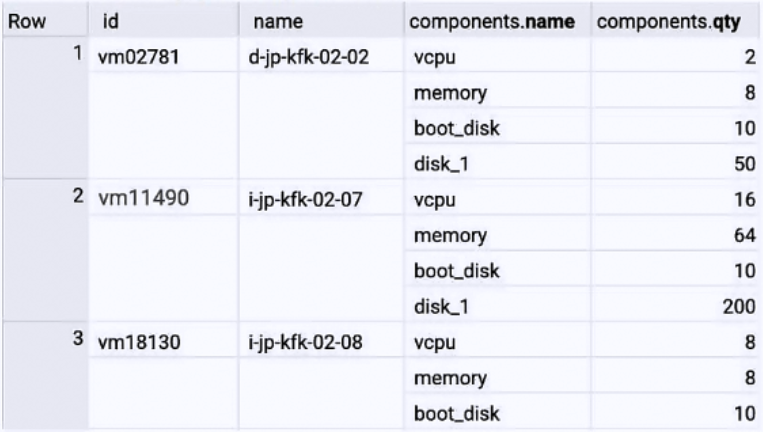
dataset.inventory_vm sample records: You have an inventory of VM data stored in the BigQuery table. You want to prepare the data for regular reporting in the most cost-effective way. You need to exclude VM rows with fewer than 8 vCPU in your report. What should you do?

Exhibit 1 for question 248
  • ACreate a view with a filter to drop rows with fewer than 8 vCPU, and use the UNNEST operator. (correct answer)
  • BCreate a materialized view with a filter to drop rows with fewer than 8 vCPU, and use the WITH common table expression.
  • CCreate a view with a filter to drop rows with fewer than 8 vCPU, and use the WITH common table expression.
  • DUse Dataflow to batch process and write the result to another BigQuery table.
Reveal answer & explanation
Correct answer: A

The correct answer is A. Option A: Create a view with a filter to drop rows with fewer than 8 vCPU, and use the UNNEST operator. This option delivers the requirement at the lowest cost.

Topic 1 Β· Question 249

Your team is building a data lake platform on Google Cloud. As a part of the data foundation design, you are planning to store all the raw data in Cloud Storage. You are expecting to ingest approximately 25 GB of data a day and your billing department is worried about the increasing cost of storing old data. The current business requirements are: β€’ The old data can be deleted anytime. β€’ There is no predefined access pattern of the old data. β€’ The old data should be available instantly when accessed. β€’ There should not be any charges for data retrieval. What should you do to optimize for cost?

  • ACreate the bucket with the Autoclass storage class feature. (correct answer)
  • BCreate an Object Lifecycle Management policy to modify the storage class for data older than 30 days to nearline, 90 days to coldline, and 365 days to archive storage class. Delete old data as needed.
  • CCreate an Object Lifecycle Management policy to modify the storage class for data older than 30 days to coldline, 90 days to nearline, and 365 days to archive storage class. Delete old data as needed.
  • DCreate an Object Lifecycle Management policy to modify the storage class for data older than 30 days to nearline, 45 days to coldline, and 60 days to archive storage class. Delete old data as needed.
Reveal answer & explanation
Correct answer: A

The correct answer is A. Option A: Create the bucket with the Autoclass storage class feature.

Topic 1 Β· Question 250

Your company's data platform ingests CSV file dumps of booking and user profile data from upstream sources into Cloud Storage. The data analyst team wants to join these datasets on the email field available in both the datasets to perform analysis. However, personally identifiable information (PII) should not be accessible to the analysts. You need to de-identify the email field in both the datasets before loading them into BigQuery for analysts. What should you do?

  • A1. Create a pipeline to de-identify the email field by using recordTransformations in Cloud Data Loss Prevention (Cloud DLP) with masking as the de-identification transformations type.2. Load the booking and user profile data into a BigQuery table.
  • B1. Create a pipeline to de-identify the email field by using recordTransformations in Cloud DLP with format-preserving encryption with FFX as the de-identification transformation type.2. Load the booking and user profile data into a BigQuery table. (correct answer)
  • C1. Load the CSV files from Cloud Storage into a BigQuery table, and enable dynamic data masking.2. Create a policy tag with the email mask as the data masking rule.3. Assign the policy to the email field in both tables. A4. Assign the Identity and Access Management bigquerydatapolicy.maskedReader role for the BigQuery tables to the analysts.
  • D1. Load the CSV files from Cloud Storage into a BigQuery table, and enable dynamic data masking.2. Create a policy tag with the default masking value as the data masking rule.3. Assign the policy to the email field in both tables.4. Assign the Identity and Access Management bigquerydatapolicy.maskedReader role for the BigQuery tables to the analysts
Reveal answer & explanation
Correct answer: B

The correct answer is B. Option B: 1. Create a pipeline to de-identify the email field by using recordTransformations in Cloud DLP with format-preserving encryption with FFX as the de-identification transformation type.2. Load the booking and user prof...

Explanation

BigQuery is a serverless, petabyte-scale data warehouse for fast SQL analytics with no infrastructure to manage.

Topic 1 Β· Question 251

You have important legal hold documents in a Cloud Storage bucket. You need to ensure that these documents are not deleted or modified. What should you do?

  • ASet a retention policy. Lock the retention policy. (correct answer)
  • BSet a retention policy. Set the default storage class to Archive for long-term digital preservation.
  • CEnable the Object Versioning feature. Add a lifecycle rule.
  • DEnable the Object Versioning feature. Create a copy in a bucket in a different region.
Reveal answer & explanation
Correct answer: A

The correct answer is A. Option A: Set a retention policy. Lock the retention policy.

Topic 1 Β· Question 252

You are designing a data warehouse in BigQuery to analyze sales data for a telecommunication service provider. You need to create a data model for customers, products, and subscriptions. All customers, products, and subscriptions can be updated monthly, but you must maintain a historical record of all data. You plan to use the visualization layer for current and historical reporting. You need to ensure that the data model is simple, easy-to-use, and cost-effective. What should you do?

  • ACreate a normalized model with tables for each entity. Use snapshots before updates to track historical data.
  • BCreate a normalized model with tables for each entity. Keep all input files in a Cloud Storage bucket to track historical data.
  • CCreate a denormalized model with nested and repeated fields. Update the table and use snapshots to track historical data.
  • DCreate a denormalized, append-only model with nested and repeated fields. Use the ingestion timestamp to track historical data. (correct answer)
Reveal answer & explanation
Correct answer: D

The correct answer is D. Option D: Create a denormalized, append-only model with nested and repeated fields. Use the ingestion timestamp to track historical data. This option delivers the requirement at the lowest cost.

Topic 1 Β· Question 253

You are deploying a batch pipeline in Dataflow. This pipeline reads data from Cloud Storage, transforms the data, and then writes the data into BigQuery. The security team has enabled an organizational constraint in Google Cloud, requiring all Compute Engine instances to use only internal IP addresses and no external IP addresses. What should you do?

  • AEnsure that your workers have network tags to access Cloud Storage and BigQuery. Use Dataflow with only internal IP addresses.
  • BEnsure that the firewall rules allow access to Cloud Storage and BigQuery. Use Dataflow with only internal IPs.
  • CCreate a VPC Service Controls perimeter that contains the VPC network and add Dataflow, Cloud Storage, and BigQuery as allowed services in the perimeter. Use Dataflow with only internal IP addresses.
  • DEnsure that Private Google Access is enabled in the subnetwork. Use Dataflow with only internal IP addresses. (correct answer)
Reveal answer & explanation
Correct answer: D

The correct answer is D. Option D: Ensure that Private Google Access is enabled in the subnetwork. Use Dataflow with only internal IP addresses.

Explanation

Private Google Access lets internal instances reach Google APIs without external IPs. Dataflow runs serverless Apache Beam pipelines for stream and batch data processing with autoscaling.

Topic 1 Β· Question 254

You are running a Dataflow streaming pipeline, with Streaming Engine and Horizontal Autoscaling enabled. You have set the maximum number of workers to 1000. The input of your pipeline is Pub/Sub messages with notifications from Cloud Storage. One of the pipeline transforms reads CSV files and emits an element for every CSV line. The job performance is low, the pipeline is using only 10 workers, and you notice that the autoscaler is not spinning up additional workers. What should you do to improve performance?

  • AEnable Vertical Autoscaling to let the pipeline use larger workers.
  • BChange the pipeline code, and introduce a Reshuffle step to prevent fusion. (correct answer)
  • CUpdate the job to increase the maximum number of workers.
  • DUse Dataflow Prime, and enable Right Fitting to increase the worker resources.
Reveal answer & explanation
Correct answer: B

The correct answer is B. Option B: Change the pipeline code, and introduce a Reshuffle step to prevent fusion. This option meets the real-time / low-latency performance requirement.

Topic 1 Β· Question 255

You have an Oracle database deployed in a VM as part of a Virtual Private Cloud (VPC) network. You want to replicate and continuously synchronize 50 tables to BigQuery. You want to minimize the need to manage infrastructure. What should you do?

  • ADeploy Apache Kafka in the same VPC network, use Kafka Connect Oracle Change Data Capture (CDC), and Dataflow to stream the Kafka topic to BigQuery.
  • BCreate a Pub/Sub subscription to write to BigQuery directly. Deploy the Debezium Oracle connector to capture changes in the Oracle database, and sink to the Pub/Sub topic.
  • CDeploy Apache Kafka in the same VPC network, use Kafka Connect Oracle change data capture (CDC), and the Kafka Connect Google BigQuery Sink Connector.
  • DCreate a Datastream service from Oracle to BigQuery, use a private connectivity configuration to the same VPC network, and a connection profile to BigQuery. (correct answer)
Reveal answer & explanation
Correct answer: D

The correct answer is D. Option D: Create a Datastream service from Oracle to BigQuery, use a private connectivity configuration to the same VPC network, and a connection profile to BigQuery.

Explanation

BigQuery is a serverless, petabyte-scale data warehouse for fast SQL analytics with no infrastructure to manage. A VPC provides a global, software-defined private network for your Google Cloud resources. Datastream provides serverless change-data-capture and replication into Google Cloud.

Topic 1 Β· Question 256

You are deploying an Apache Airflow directed acyclic graph (DAG) in a Cloud Composer 2 instance. You have incoming files in a Cloud Storage bucket that the DAG processes, one file at a time. The Cloud Composer instance is deployed in a subnetwork with no Internet access. Instead of running the DAG based on a schedule, you want to run the DAG in a reactive way every time a new file is received. What should you do?

  • A1. Enable Private Google Access in the subnetwork, and set up Cloud Storage notifications to a Pub/Sub topic.2. Create a push subscription that points to the web server URL.
  • B1. Enable the Cloud Composer API, and set up Cloud Storage notifications to trigger a Cloud Function.2. Write a Cloud Function instance to call the DAG by using the Cloud Composer API and the web server URL.3. Use VPC Serverless Access to reach the web server URL.
  • C1. Enable the Airflow REST API, and set up Cloud Storage notifications to trigger a Cloud Function instance.2. Create a Private Service Connect (PSC) endpoint.3. Write a Cloud Function that connects to the Cloud Composer cluster through the PSC endpoint. (correct answer)
  • D1. Enable the Airflow REST API, and set up Cloud Storage notifications to trigger a Cloud Function instance.2. Write a Cloud Function instance to call the DAG by using the Airflow REST API and the web server URL.3. Use VPC Serverless Access to reach the web server URL.
Reveal answer & explanation
Correct answer: C

The correct answer is C. Option C: 1. Enable the Airflow REST API, and set up Cloud Storage notifications to trigger a Cloud Function instance.2. Create a Private Service Connect (PSC) endpoint.3. Write a Cloud Function that connects to the Cloud Compo...

Explanation

Cloud Storage provides durable, scalable object storage that is fully managed. Private Service Connect exposes and consumes services privately within VPCs without internet exposure. Cloud Composer is managed Apache Airflow for orchestrating multi-step data workflows.

Topic 1 Β· Question 257

You are planning to use Cloud Storage as part of your data lake solution. The Cloud Storage bucket will contain objects ingested from external systems. Each object will be ingested once, and the access patterns of individual objects will be random. You want to minimize the cost of storing and retrieving these objects. You want to ensure that any cost optimization efforts are transparent to the users and applications. What should you do?

  • ACreate a Cloud Storage bucket with Autoclass enabled. (correct answer)
  • BCreate a Cloud Storage bucket with an Object Lifecycle Management policy to transition objects from Standard to Coldline storage class if an object age reaches 30 days.
  • CCreate a Cloud Storage bucket with an Object Lifecycle Management policy to transition objects from Standard to Coldline storage class if an object is not live.
  • DCreate two Cloud Storage buckets. Use the Standard storage class for the first bucket, and use the Coldline storage class for the second bucket. Migrate objects from the first bucket to the second bucket after 30 days.
Reveal answer & explanation
Correct answer: A

The correct answer is A. Option A: Create a Cloud Storage bucket with Autoclass enabled.

Explanation

Cloud Storage provides durable, scalable object storage that is fully managed.

Topic 1 Β· Question 258

You have several different file type data sources, such as Apache Parquet and CSV. You want to store the data in Cloud Storage. You need to set up an object sink for your data that allows you to use your own encryption keys. You want to use a GUI-based solution. What should you do?

  • AUse Storage Transfer Service to move files into Cloud Storage.
  • BUse Cloud Data Fusion to move files into Cloud Storage. (correct answer)
  • CUse Dataflow to move files into Cloud Storage.
  • DUse BigQuery Data Transfer Service to move files into BigQuery.
Reveal answer & explanation
Correct answer: B

The correct answer is B. Option B: Use Cloud Data Fusion to move files into Cloud Storage.

Explanation

Cloud Storage provides durable, scalable object storage that is fully managed. Cloud Data Fusion builds ETL/ELT pipelines visually with little code.

Topic 1 Β· Question 259

Your business users need a way to clean and prepare data before using the data for analysis. Your business users are less technically savvy and prefer to work with graphical user interfaces to define their transformations. After the data has been transformed, the business users want to perform their analysis directly in a spreadsheet. You need to recommend a solution that they can use. What should you do?

  • AUse Dataprep to clean the data, and write the results to BigQuery. Analyze the data by using Connected Sheets. (correct answer)
  • BUse Dataprep to clean the data, and write the results to BigQuery. Analyze the data by using Looker Studio.
  • CUse Dataflow to clean the data, and write the results to BigQuery. Analyze the data by using Connected Sheets.
  • DUse Dataflow to clean the data, and write the results to BigQuery. Analyze the data by using Looker Studio.
Reveal answer & explanation
Correct answer: A

The correct answer is A. Option A: Use Dataprep to clean the data, and write the results to BigQuery. Analyze the data by using Connected Sheets.

Explanation

BigQuery is a serverless, petabyte-scale data warehouse for fast SQL analytics with no infrastructure to manage. Dataprep visually explores, cleans, and prepares data for analysis with no code.

Topic 1 Β· Question 260

You have two projects where you run BigQuery jobs: β€’ One project runs production jobs that have strict completion time SLAs. These are high priority jobs that must have the required compute resources available when needed. These jobs generally never go below a 300 slot utilization, but occasionally spike up an additional 500 slots. β€’ The other project is for users to run ad-hoc analytical queries. This project generally never uses more than 200 slots at a time. You want these ad-hoc queries to be billed based on how much data users scan rather than by slot capacity. You need to ensure that both projects have the appropriate compute resources available. What should you do?

  • ACreate a single Enterprise Edition reservation for both projects. Set a baseline of 300 slots. Enable autoscaling up to 700 slots.
  • BCreate two reservations, one for each of the projects. For the SLA project, use an Enterprise Edition with a baseline of 300 slots and enable autoscaling up to 500 slots. For the ad-hoc project, configure on-demand billing. (correct answer)
  • CCreate two Enterprise Edition reservations, one for each of the projects. For the SLA project, set a baseline of 300 slots and enable autoscaling up to 500 slots. For the ad-hoc project, set a reservation baseline of 0 slots and set the ignore idle slots flag to False.
  • DCreate two Enterprise Edition reservations, one for each of the projects. For the SLA project, set a baseline of 800 slots. For the ad-hoc project, enable autoscaling up to 200 slots.
Reveal answer & explanation
Correct answer: B

The correct answer is B. Option B: Create two reservations, one for each of the projects. For the SLA project, use an Enterprise Edition with a baseline of 300 slots and enable autoscaling up to 500 slots. For the ad-hoc project, configure on-demand bi... This option decouples the components so they scale independently and absorb load spikes.

Topic 1 Β· Question 261

You want to migrate your existing Teradata data warehouse to BigQuery. You want to move the historical data to BigQuery by using the most efficient method that requires the least amount of programming, but local storage space on your existing data warehouse is limited. What should you do?

  • AUse BigQuery Data Transfer Service by using the Java Database Connectivity (JDBC) driver with FastExport connection. (correct answer)
  • BCreate a Teradata Parallel Transporter (TPT) export script to export the historical data, and import to BigQuery by using the bq command-line tool.
  • CUse BigQuery Data Transfer Service with the Teradata Parallel Transporter (TPT) tbuild utility.
  • DCreate a script to export the historical data, and upload in batches to Cloud Storage. Set up a BigQuery Data Transfer Service instance from Cloud Storage to BigQuery.
Reveal answer & explanation
Correct answer: A

The correct answer is A. Option A: Use BigQuery Data Transfer Service by using the Java Database Connectivity (JDBC) driver with FastExport connection.

Explanation

BigQuery is a serverless, petabyte-scale data warehouse for fast SQL analytics with no infrastructure to manage. BigQuery Data Transfer Service automates loading data into BigQuery on a schedule.

Showing questions 241–260 of 341 Β· Page 13 of 18