πŸ”

AZ-800 β€” questions

Page 3 of 7 Β· 124 total questions.

Topic 2 Β· Question 86

Your network contains an Active Directory Domain Services (AD DS) domain. The domain contains a server named Server1. You implement Just Enough Administration (JEA) on Server1. You need to perform remote administration tasks on Server by using only JEA. What should you use?

  • APowerShell only (correct answer)
  • BRemote Server Administration Tools (RSAT) only
  • CPowerShell or Remote Desktop only
  • DPowerShell or Remote Server Administration Tools (RSAT) only
  • ERemote Server Administration Tools (RSAT) or Remote Desktop only
  • FPowerShell, Remote Server Administration Tools (RSAT), or Remote Desktop
Reveal answer & explanation
Correct answer: A

The correct answer is A. Option A: PowerShell only.
Topic 2 Β· Question 87

You have an Azure subscription. The subscription contains a virtual machine named VM1 that runs Windows Server. You plan to manage VM1 by using a PowerShell runbook. You need to create the runbook. What should you create first?

  • Aan Azure Automation account (correct answer)
  • Ban Azure workbook
  • Ca Log Analytics workspace
  • Da Microsoft Power Automate flow
Reveal answer & explanation
Correct answer: A

The correct answer is A. Option A: an Azure Automation account

Explanation

Azure Automation runs runbooks to automate repetitive management tasks across resources.

Topic 2 Β· Question 88

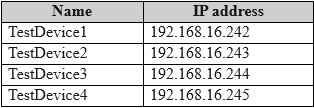
You have a server named Server1 that runs Windows Server and has the DHCP Server role installed. Server1 contains the following single scope: β€’ Scope: 192.168.16.0 β€’ Address pool: 192.168.16.1-192.168.16.254 β€’ Subnet mask: 255.255.255.0 β€’ Lease duration: 8 days You have four testing devices that are configured with static IP addresses as shown in the following table. The test devices are turned on once a month. You need to prevent Server1 from assigning the IP addresses allocated to the test devices to other devices when the test devices are offline. The solution must minimize administrative effort. What should you do?

Exhibit 1 for question 88
  • ACreate a policy.
  • BCreate reservations.
  • CConfigure the Scope options.
  • DCreate an exclusion range. (correct answer)
Reveal answer & explanation
Correct answer: D

The correct answer is D. Option D: Create an exclusion range.

Topic 2 Β· Question 89

You have an Active Directory Domain Services (AD DS) domain. The domain contains three servers named Server1, Server2, and Server3 that run Windows Server. You sign in to Server1 by using a domain account and start a remote PowerShell session to Server2. From the remote PowerShell session, you attempt to access a resource on Server3, but access to the resource is denied. You need to ensure that your credentials are passed from Server1 to Server3. The solution must minimize administrative effort. What should you do?

  • AConfigure Kerberos constrained delegation. (correct answer)
  • BConfigure Just Enough Administration (JEA).
  • CConfigure selective authentication for the domain.
  • DDisable the Enforce user logon restrictions policy setting for the domain.
Reveal answer & explanation
Correct answer: A

The correct answer is A. Option A: Configure Kerberos constrained delegation.

Topic 2 Β· Question 91

You have an Active Directory Domain Services (AD DS) domain. The domain contains a member server named Server1 that runs Windows Server. You need to ensure that you can manage password policies for the domain from Server1. Which command should you run first on Server1?

  • AInstall-WindowsFeature RSAT-AD-Tools
  • BInstall-WindowsFeature RSAT-ADRMS
  • CInstall-WindowsFeature GPMC (correct answer)
  • DInstall-WindowsFeature RSAT-AD-PowerShell
Reveal answer & explanation
Correct answer: C

The correct answer is C. Option C: Install-WindowsFeature GPMC.

Topic 2 Β· Question 95

Your network contains an Active Directory Domain Services (AD DS) domain. The domain contains a server named Server1. On Server1, you install Windows Admin Center and use Windows Admin Center to remove BUILTIN\Users from the allowed groups. You discover that all users can still sign in to Windows Admin Center. You need to prevent unauthorized users from signing in to Windows Admin Center. What should you do in Windows Admin Center?

  • ASet Performance Profile to On.
  • BSet Require manage-as sessions to re-authenticate to On.
  • CFrom the Proxy settings, configure a bypass list.
  • DAdd a security group to the allowed groups. (correct answer)
Reveal answer & explanation
Correct answer: D

The correct answer is D. Option D: Add a security group to the allowed groups.

Topic 2 Β· Question 96

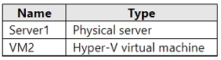
You have on-premises servers that run Windows Server as shown in the following table. You have an Azure subscription that contains a virtual machine named VM1. You need to ensure that you can manage all the servers by using Azure Arc. The solution must minimize administrative effort. On which servers should you install the Azure Connected Machine agent?

Exhibit 1 for question 96
  • AServer1 only
  • BVM1 only
  • CVM2 only
  • DVM1 and VM2 only
  • EServer1 and VM2 only (correct answer)
  • FServer1, VM1, and VM2
Reveal answer & explanation
Correct answer: E

The correct answer is E. Option E: Server1 and VM2 only.

Topic 2 Β· Question 98

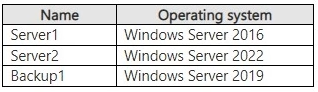
Your network contains an on-premises Active Directory Domain Services (AD DS) domain. The domain contains a user named User1 and the servers shown in the following table. User1 is a member of the Protected Users security group. User1 performs the following actions: β€’ From Server1, establishes a remote PowerShell session on Server2 β€’ From the PowerShell session on Server2, attempts to access a resource on Backup1 The request to access the resource on Backup1 is denied. You need to ensure that User1 can access the resources on Backup1 by using the PowerShell session on Server2. The solution must follow the principle of least privilege and minimize administrative effort. What should you configure?

Exhibit 1 for question 98
  • AKerberos delegation (unconstrained)
  • BCredSSP
  • CPSSessionConfiguration by using RunAs
  • Dresource-based Kerberos constrained delegation (correct answer)
Reveal answer & explanation
Correct answer: D

The correct answer is D. Option D: resource-based Kerberos constrained delegation.

Topic 2 Β· Question 99

You have 50 on-premises servers that run Windows Server. You have an Azure subscription. You plan to monitor the on-premises servers by using Azure Monitor. You need to collect event logs from the on-premises servers. What should you do first?

  • AFrom the Azure portal, create a storage account.
  • BFrom the Azure portal, create a Log Analytics workspace. (correct answer)
  • CFrom the on-premises servers, run azuremonitoragentclientsetup.msi.
  • DFrom the Azure portal, create a data collection rule (DCR) in Azure Monitor.
Reveal answer & explanation
Correct answer: B

The correct answer is B. Option B: From the Azure portal, create a Log Analytics workspace.

Explanation

Log Analytics queries collected logs and metrics to investigate and alert on resource behavior.

Topic 3 Β· Question 100 Β· Select all that apply

You have a server named Host1 that has the Hyper-V server role installed. Host1 hosts a virtual machine named VM1. You have a management server named Server1 that runs Windows Server. You remotely manage Host1 from Server1 by using Hyper-V Manager. You need to ensure that you can access a USB hard drive connected to Server1 when you connect to VM1 by using Virtual Machine Connection. Which two actions should you perform? Each correct answer presents part of the solution. NOTE: Each correct selection is worth one point.

  • AFrom the Hyper-V Settings of Host1, select Allow enhanced session mode. (correct answer)
  • BFrom Virtual Machine Connection, select Show Options, and then select the USB hard drive. (correct answer)
  • CFrom Virtual Machine Connection, switch to a basic session.
  • DFrom Disk Management on Host1, select Rescan Disks.
  • EFrom Disk Management on Host1, attach a virtual hard disk.
Reveal answer & explanation
Correct answer: A, B

The correct answer is A, B. Option A: From the Hyper-V Settings of Host1, select Allow enhanced session mode. Option B: From Virtual Machine Connection, select Show Options, and then select the USB hard drive.

Explanation

An Azure Virtual Machine provides full control of the OS when you need to run custom or legacy workloads.

Topic 3 Β· Question 101

You have a Windows Server container host named Server1 and a container image named image1. You need to start a container from image1. The solution must run the container on a Hyper-V virtual machine. Which parameter should you specify when you run the docker run command?

  • A--expose
  • B--privileged
  • C--runtime
  • D--isolation (correct answer)
  • E--entrypoint
Reveal answer & explanation
Correct answer: D

The correct answer is D. Option D: --isolation.

Topic 3 Β· Question 102

You plan to deploy a containerized application that requires .NET Core. You need to create a container image for the application. The image must be as small as possible. Which base image should you use?

  • AWindows Server
  • BNano Server (correct answer)
  • CWindows
  • DServer Core
Reveal answer & explanation
Correct answer: B

The correct answer is B. Option B: Nano Server.

Topic 3 Β· Question 103

You have an Azure virtual machine named VM1 that runs Windows Server. You perform the following actions on VM1: β€’ Create a folder named Folder1 on volume C. β€’ Create a folder named Folder2 on volume D. β€’ Add a new data disk to VM1 and create a new volume that is assigned drive letter E. β€’ Install an app named App1 on volume E. You plan to resize VM1. Which objects will present after you resize VM1?

  • AFolder1, volume E, and App1 only (correct answer)
  • BFolder1 only
  • CFolder1 and Folder2 only
  • DFolder1, Folder2, App1, and volume E
Reveal answer & explanation
Correct answer: A

The correct answer is A. Option A: Folder1, volume E, and App1 only.

Topic 3 Β· Question 104

You have an Azure virtual machine named VM1 that runs Windows Server and has the following configurations: β€’ Size: D2s_v4 β€’ Operating system disk: 127-GiB standard SSD β€’ Data disk 128-GiB standard SSD β€’ Virtual machine generation: Gen 2 You plan to perform the following changes to VM1: β€’ Change the virtual machine size to D4s_v4. β€’ Detach the data disk. β€’ Add a new standard SSD. Which changes require downtime for VM1?

  • ADetaching the data disk only and adding a new standard SSD.
  • BDetaching the data disk only.
  • CChanging the virtual machine size only. (correct answer)
  • DAdding a new standard SSD only.
Reveal answer & explanation
Correct answer: C

The correct answer is C. Option C: Changing the virtual machine size only.

Explanation

An Azure Virtual Machine provides full control of the OS when you need to run custom or legacy workloads.

Topic 3 Β· Question 107

You have a server named Server1 that hosts Windows containers. You plan to deploy an application that will have multiple containers. Each container will be on the same subnet. Each container requires a separate MAC address and IP address. Each container must be able to communicate by using its IP address. You need to create a Docker network that supports the deployment of the application. Which type of network should you create?

  • ANAT
  • Btransparent (correct answer)
  • CI2bridge
  • DI2tunnel
Reveal answer & explanation
Correct answer: B

The correct answer is B. Option B: transparent.

Topic 3 Β· Question 108

You have an on-premises Active Directory Domain Services (AD DS) domain that syncs with an Azure Active Directory (Azure AD) tenant. You plan deploy 100 new Azure virtual machines that will run Windows Server. You need to ensure that each new virtual machine is joined to the AD DS domain. What should you use?

  • Aan Azure Resource Manager (ARM) template (correct answer)
  • Ba Group Policy Object (GPO)
  • CAzure AD Connect
  • Dan Azure management group
Reveal answer & explanation
Correct answer: A

The correct answer is A. Option A: an Azure Resource Manager (ARM) template.

Topic 3 Β· Question 109

Your network contains an on-premises Active Directory Domain Services (AD DS) domain named contoso.com. The domain contains three servers that run Windows Server and have the Hyper-V server role installed. Each server has a Switch Embedded Teaming (SET) team. You need to verify that Remote Direct Memory Access (RDMA) and all the required Windows Server settings are configured properly on each server to support an Azure Stack HCI cluster. What should you use?

  • AServer Manager
  • Bthe Get-NetAdapter cmdlet
  • CFailover Cluster Manager
  • Dthe Validate-DCB cmdlet (correct answer)
Reveal answer & explanation
Correct answer: D

The correct answer is D. Option D: the Validate-DCB cmdlet.

Topic 3 Β· Question 114

You have an Azure virtual machine named Server1 that runs a network management application. Server1 has the following network configurations: * Network interface: Nic1 * IP address: 10.1.1.1/24 * Connected to: Vnet1/Subnet1 You need to connect Server1 to an additional subnet named Vnet1/Subnet2. What should you do?

  • AModify the IP configurations of Nic1.
  • BAdd an IP configuration to Nic1.
  • CAdd a network interface to Server1. (correct answer)
  • DCreate a private endpoint on Subnet2.
Reveal answer & explanation
Correct answer: C

The correct answer is C. Option C: Add a network interface to Server1.

Topic 3 Β· Question 117

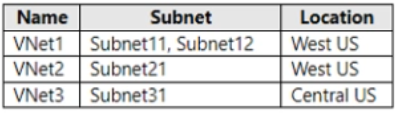
You have an Azure subscription that contains the virtual networks shown in the following table. You deploy a virtual machine named VM1 that runs Windows Server. VM1 is connected to Subnet11. You plan to add an additional network interface named NIC1 to VM1. To which subnets can NIC1 be attached?

Exhibit 1 for question 117
  • ASubnet11 only
  • BSubnet12 only
  • CSubnet11 and Subnetl2 only (correct answer)
  • DSubmet12 and Subnet21 only
  • ESubnet11, Subnet12, Subnet21, and Subnet31
Reveal answer & explanation
Correct answer: C

The correct answer is C. Option C: Subnet11 and Subnetl2 only.

Topic 3 Β· Question 119

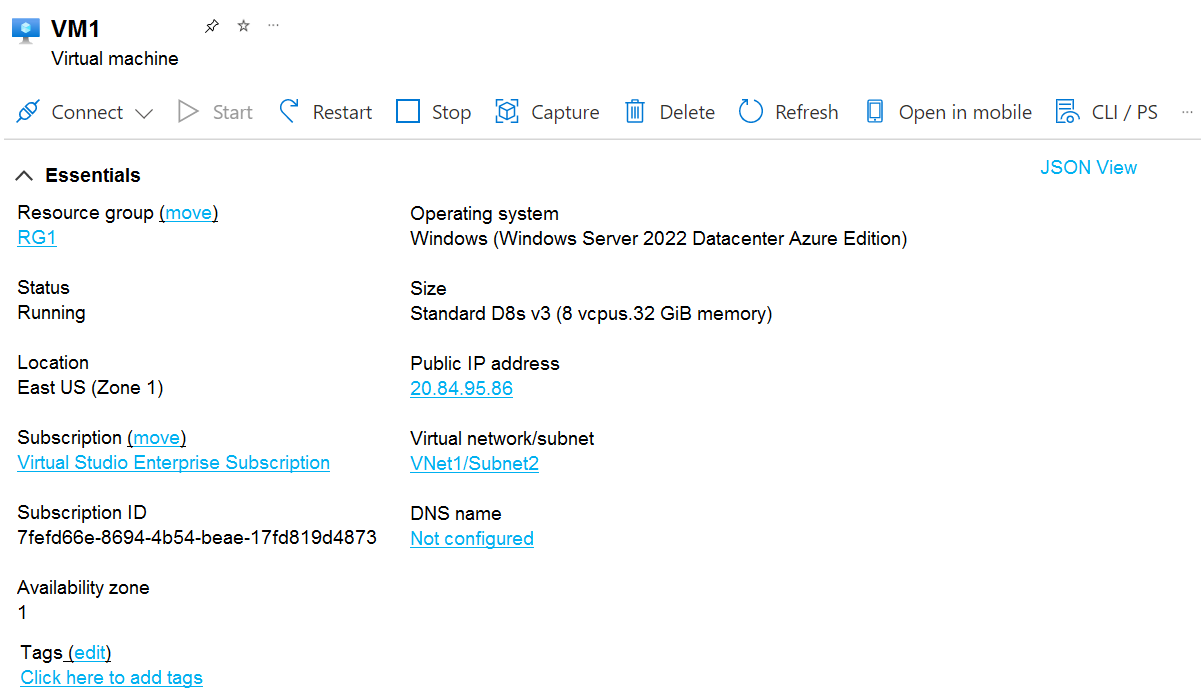
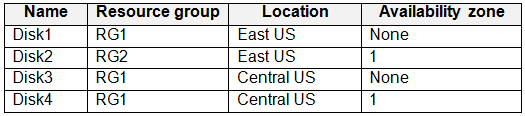
You have an Azure subscription that contains a virtual machine named VM1 as shown in the following exhibit. The subscription has the disks shown in the following table. Which disks can you attach as data disks to VM1?

Exhibit 1 for question 119Exhibit 2 for question 119
  • ADisk2 only (correct answer)
  • BDisk4 only
  • CDisk1 and Disk2 only
  • DDisk2 and Disk4 only
  • EDisk1, Disk3, and Disk4 only
  • FDisk1, Disk2, Disk3, and Disk4
Reveal answer & explanation
Correct answer: A

The correct answer is A. Option A: Disk2 only.

Showing questions 41–60 of 124 Β· Page 3 of 7